
Wittgenstein and the Self
Notes on a transgender experience.
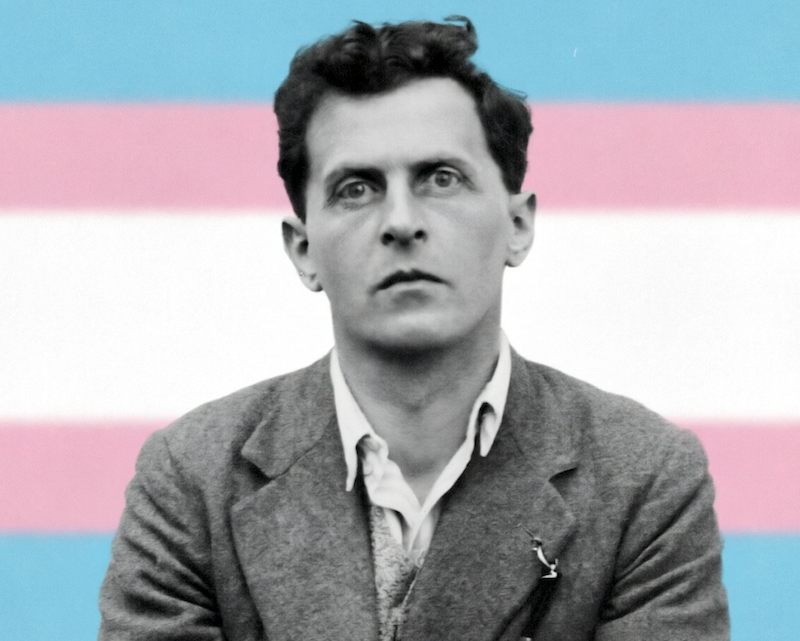
Bea Groves-McDaniel
Feb 26th 2020
“Philosophy aims at the logical clarification of thoughts. Philosophy is not a body of doctrine but an activity. A philosophical work consists essentially of elucidations. Philosophy does not result in 'philosophical propositions', but rather in the clarification of propositions. Without philosophy thoughts are, as it were, cloudy and indistinct: its task is to make them clear and to give them sharp boundaries.”
(Ludwig Wittgenstein, Tractatus Logico-Philosophicus, 1922)
Contextual Background
I’m a teacher in adult, further and higher education, a job I’ve held for over thirty years. During the time I was first training as a teacher, I became very interested in interpersonal communications.
This in turn derived from my (then) sole teaching topic: music history. Communication was an implied part of music: how people interpret musical symbology through a shared cultural context and how musical abstraction becomes meaningful. Through the Shannon-Weaver model, and then the Sapir-Whorf hypothesis, I became fascinated with meaning in the extended sense. How does any language system gain a sense of meaning for human beings when it’s principles are purely arbitrary?
Such are the meandering aspects of learning. You start off with a simple interest… and before you know it, you’re suddenly out in the boondocks of abstruse investigation. Thankfully, this slightly manic trait on my part has never left me and, in the process, has made me into something of a philosopher (though I use the term in a highly provisional sense). The main turning point came when I was collaborating with other tutors in teaching cultural and sociological studies in a WEA course called ‘Great Thinkers’. I very rashly volunteered to teach a session on the philosophy of Ludwig Wittgenstein, even though I had no background in the topic. The preparatory study for this was monumental! I am also sure that first session was a garbled mess. But it started off a fascination with Wittgenstein’s work that stays with me to this day.
The fascination rests on a number of key factors that put him (and his thought) on a different footing from other philosophers:
- His work can be enigmatic and non-linear. He invites speculation, challenges the reader to work on their thinking, and provides no ‘pat’ answers to problems
- He sees philosophy as an activity, not a body of knowledge, therefore encouraging the idea of participation
- He is passionate in his pursuance of honesty, and unwillingness to let go of an uncertain thought
- He was gay, an outcast (of sorts), a difficult person, and yet a firm friend to those who knew him well. He seemed a lot like me, at least in some respects.
- His logic was unassailable.
- His work still gives and gives… there is a sense of applicability that rises above his contemporaries
- I like the challenge!
Wittgenstein’s work became foundational in my personal and career development. Instead of being dependently ‘suspended’ in intellectual space, I gained a purchase on an orientational system that allows me to think and develop. Consequently, Wittgensteinianism has had a formidable impact on my understanding of concepts such as knowledge, meaning, learning, and (most importantly) the Self. Hence this set of notes.
The Transgender Experience from the first person
The conventions of being transgender are echoed in colloquial orthodox parlance found in discourse within the transgender community. Here I mean specifically male-to-female transitioners, where my experience is of greatest use. However, one might (I believe?) apply the same instances to female-to-male trans folk. Common elements of self-description that are heard on social media (and the popular media) include:
• My body is male but my mind (soul, true-Self etc.) is female
• I was born male, but that is purely my biology. My true self is female
• My gender is what is in my head, not between my legs
• I feel female
• I know I’m female
• I am a woman, as much as any
• (Other similar concepts)
There may be variants on these, but the majority give a common conceptual thread: what I would term a Cartesian-Dualist view of the self. Cartesian-dualism has a long inheritance in Western thinking. It can be found in multiple religious persuasions where the ‘soul’ is visualised as the true existential entity (thereby relegating the carnal body, with all its lack of permanence, to a subsidiary ‘container’ role). In philosophy it is found most importantly in Rene Descartes sceptical ‘cogito’ (Cogito ergo sum): “I think, therefore I am”, in which the rational thinker doubts the security of the senses and thereby can only truly rely on what is ‘known’ as a certainty. Namely, that there is a Thinking Thing; that defines the human condition and that this ‘thing’ cannot be identified with the sensory body (albeit that the ‘thinking thing’ experiences the world as it is known through the bodily senses).
The common sense nature of this seems undeniable. Indeed, it has been a cornerstone of philosophical argument ever since Descartes introduced his concept. But there is a problem: namely the issue of solipsism.
Solipsism is the spanner in the intellectual works of existence. It is a nagging problem that is implied by Cartesianism. If the only certainty is the Thinking Thing, then to take Descartes' argument to its obvious conclusion: what, if anything, can be said about an extant world (universe?)… including the purported other entities in it? The answer, from a hardened Cartesian standpoint is: nothing.
Therefore, effectively, the universe shrinks down to the collapsed singularity of the Ego, living and thinking its lonely thoughts in an everlasting solipsistic space.
What has occurred to me, and I am sure to many people, is: there lies madness! Hence, there’s usually a popular turning away from solipsism as a cognitive dead-end. Not surprising really, considering the issues for knowledge and meaning that solipsism creates.
However, as I said earlier, Wittgenstein was not one for ignoring philosophical loose ends. In his early work he comments:
“I know that this world exists.
That I am placed in it like my eye in its visual field.
That something about it is problematic, which we call its meaning.
This meaning does not lie in it but outside of it.”
(Journal entry, 11/6/1916)
Here he take a sideways glance at the solipsistic self, via a mystical view of the world. His meaning comes from ‘beyond’. But what ‘beyond’? Wittgenstein takes a leap of faith, and places God as the guarantor of the sense of self and the world:
“That life is the world.
That my will penetrates the world.
That my will is good or evil.
Therefore that good and evil are somehow connected with the meaning of the world.
The meaning of life, i.e. the meaning of the world, we can call God.
And connect with this the comparison of God to a father.
To pray is to think about the meaning of life."
(Ibid)
This was the beginning of something. It was a journal entry written in the heat of World War One, when Wittgenstein was an officer in the Austrian army. Fighting on the Italian front. His work then was fraught with the danger of the Front, and his wrestling with his own sense of purposeful existence. Later this is developed into his only complete and published work, the Tractatus Logico-Philosophicus:
“The world and life are one.”
“The subject does not belong to the world, but it is a limit of the world.”
“Scepticism is not irrefutable, but obviously nonsensical, when it tries to raise doubts where no questions can be asked. For doubt can exist only where a question exists, a question only where an answer exists, and an answer only where something can be said.”
(Wittgenstein, Tractatus…, 1922)
Here he grapples with the nonsensicality of the Cogito: that such questions as the solitary existence of the Thinking Thing are at odds with asking the very question ‘Who am I?', which in turn modifies the Cartesian singularity: the sense of self is synonymous with life itself, and the self expands to fill the sensory universe of its existence. Such was the Wittgenstein of 1922. But his work did not end there. By the 1930s and after, he had abandoned much of this thinking and had established a more anthropogenic approach… More of which later.
Meanwhile, let me place the above in the context of transgender identity. It seems traditional that transpeople redefine themselves during transition via their Cartesian ‘inner self’. As for Wittgenstein of the Great War, this Self looks out into the sceptical world. It sees itself as genuine, where other ‘givens’ are worthy of doubt. The Thinking Thing of the trans-ego is the true self, and the imposed functional gender of birth-and-life is, at best, illusory and, at worst, a deliberate systemic falsity (imposed on the self by existential experience, which is paradoxically both accepted and denied simultaneously). For the transperson of traditional views, the Self is encased in a ‘false’ body. It looks out into the world in its despair and yearns for the unity of the inner and outer. It sees itself only second-hand: in the false images of mirrors and photographs. It is stationed in its field of view and unable to establish veracity because of its own lack of perceptible instancy (and facticity) in its own existence.
From the position, is it surprising how tortured many trans people are? And how liable to persecution they may be, as others ‘identify’ them as anomalous within their own fields of perception? (Note: It might be said that a therapeutic treatment of this type of mental anguish could be an analysis of this perceptual self based on a deconstruction of Cartesianism)
Dissolving the ‘Little Man Within’
“For a large class of cases — though not for all — in which we employ the word 'meaning', it can be explained thus: the meaning of a word is its use in the language.”
(Wittgenstein, Philosophical Investigations)
“What is troubling us is the tendency to believe that the mind is like a little man within."
(Op. Posth. 1958)
My premise (based on the later philosophy of Wittgenstein) is relatively simple: that the uncertainty of the trans’ identity issue is dependent on the Cartesian ‘little man within’, and that this is caused by confusion based on misuse of words utilised to create identity within the public world.
Dissolving the ‘Little Man within’ is troublesome. He is often identified with the ‘true’ self. He is the Thinking Thing. He is the personal observer within the field of vision but who cannot truly see Himself. This brings about issues of psychological defensiveness. How can I be sure about ‘me’ if I don’t know who ‘me’ truly is?
Wittgenstein’s approach is an analysis of how we qualify, quantify, and qualitatively describe ourselves. In the process. We talk about ‘knowing’ who we are (and identifying this with Cartesian self), and yet the word ‘know’ here is being used in a misleading way.
For example, I may say I know I have a £1 coin in my purse and, in doing so, can verify the truth or falsehood of such a statement by observation (I look… and I find out). But if I say “I know I have a mind," I am not making a statement of the same qualitative type. Here I can have no verifiable observation. There is nothing to be seen and no evidence to present. Hence, Wittgenstein sees such quasi-philosophical propositions as a confusion of language games: a sense that the word ‘know’ retains its identity in both contexts, whereas it patently does not. Each use of a word gathers its cumulative meaning from such social language games and from our very human ‘form of life’, in which our real-world biological existence sets the stage for the actions in which words are used as tools… not as absolutes.
This may seem a pettily obvious statement. But in many respects it is liberating. For the transgender person seeking to investigate identity, there is a need to dissolve away the absolutes of meaning created by the Little Man Within (the Cartesian self). Instead of an immutable transcendental self, Wittgenstein’s vision of identity lies in the social world. The mind, the self, and the very soul become descriptive and joy-givingly accessible. He expresses this very openly in the Philosophical Investigations (1953) when he writes: “The human body is the best picture of the human soul." Here he expresses that very concept of humanity in which the image of the carnal self IS seen as the direct communication of an ‘en-souled-ness’ that we recognise within our language games. There is no essentialism for Wittgenstein. No Little Man who represents the focus of human consideration or, for that matter, a characteristic of womanhood that is immutable and investigable. Instead, the sense of self comes out of the constructs of language exchange, where the use of such words as ‘him’, ‘her’, ‘woman’, ‘female’, etc. are not foundationally guaranteed by the body but are used as tools to express the states of affairs that individuals find themselves in within the real world. Wittgenstein establishes a linguistic dialectic within the language games of our form of life. Therein is the battle field where the sense of self (and consequently, female identity) is fought over.
So much for TERF-isms essentialist nonsense. So much for the religious prioritising of soul over body. So much for solipsism and its confused use of the question 'What do I know?’ and the word ‘certainty’. So much for the Little Man within. What remains is worth having.
The existential reality of life may be fearsome in its own way, but the linguistic-analytic approach that Wittgenstein introduces puts paid to many of the offensive terminology and verbal weaponry that transgender people regularly face. Speaking only from my experience, it has led to my being happy to live with uncertainty of identity since it allows me to define myself as is appropriate to events and time. I recognise my male past, but the word ‘male’ does not nail me to a cross of masculinity that I have to carry with me through life. It is a word, and like all words, it gains its meaning from its use in the social sphere. Similarly, when I use the word ‘woman’ for myself, I do not encroach on the usage that may occur within the domain of cisgendered individuals. I do not need to fight over that definition, because as I use it, I am making a claim to it in my language game and not in some absolutist-essentialist world where I am not ‘privileged’ enough to use it (i.e., as many trans-exclusionary radical feminists would have it). I do not need to mean ‘woman’ in the same way as a genetically-ordained female might; my usage is just as valid and no less meaningful.
(Never completed, BGMcD)