
Why Facts Don't Change Minds
The question matters enormously if you believe, as this writer does, that public reason and evidence-based policy are worth caring about.
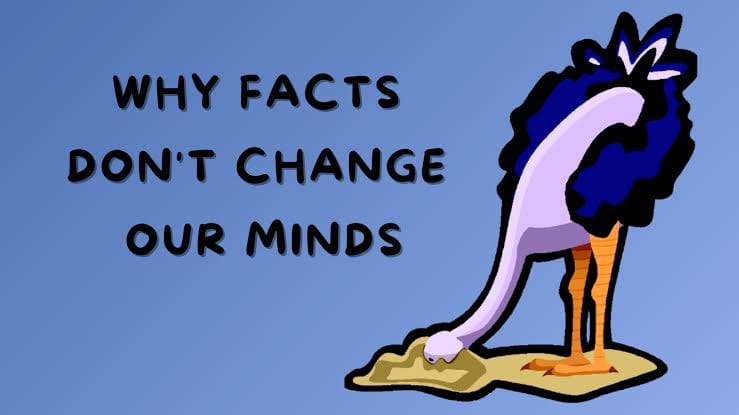
Why Facts Don't Change Minds: The Psychology of Belief
A FAYE-9000 Discussion Paper
There is a moment we have all witnessed, and most of us have experienced: the moment when someone is presented with clear, verifiable, demonstrable evidence that contradicts a belief they hold deeply — and they do not change their mind. Sometimes they become more entrenched. The facts sit there, immovable, apparently weightless against the gravity of what they already believe. Why does this happen?
The question matters enormously if you believe, as this writer does, that public reason and evidence-based policy are worth caring about. It matters if you have ever despaired at the impossibility of rational debate on topics from climate to vaccination to the integrity of elections. It is not a new puzzle. But it is one that psychology and sociology have illuminated in ways that are both fascinating and, at times, deeply uncomfortable.
The Architecture of Belief Itself
The foundational insight comes from Leon Festinger, whose theory of cognitive dissonance (1957) proposed something radical: the human mind does not simply receive information and update beliefs accordingly. It actively works to maintain consistency between what it believes and what it experiences. When new information conflicts with an existing belief, the resulting discomfort (i.e., dissonance) is not neutral. It is experienced as genuinely unpleasant, almost physical. And the mind has a powerful instinct to reduce that discomfort, not by updating the belief, but by dismissing, reinterpreting, or attacking the contradicting evidence.
Crucially, the dissonance is not felt toward the belief itself. It is felt toward the contradiction. And the easier route, almost always, is to discredit the new information rather than revise the old belief. This is not a failure of intelligence. It is built into the architecture of human cognition. Raymond Nickerson's exhaustive 1998 review of confirmation bias — with over 7,000 citations — documented the phenomenon across every domain imaginable: pattern recognition, hypothesis testing, social judgement, and scientific reasoning. We do not simply seek information. We seek information that confirms what we already believe, and we process contradicting evidence through a filter that makes it easier to reject.
The Identity Problem
But individual psychology alone does not explain the stubbornness of belief in erroneous topics. Here, the work of Dan Kahan at Yale Law School's Cultural Cognition Project is indispensable. Kahan's research on motivated reasoning and identity-protective cognition demonstrates that on politically contentious issues, people do not reason to form beliefs: they reason to defend beliefs they are already attached to. And the beliefs they are most attached to are the ones that align with the cultural group to which they belong.
Kahan's terminology of identity-protective cognition captures something important: when a belief becomes a signal of group membership, challenging the belief is experienced not merely as being wrong, but as an attack on the self and its social bonds. This is not a metaphor. The same neural pathways involved in physical self-defence are recruited when a person's worldview is threatened. Kahan, together with Donald Braman and others, showed in a series of papers (2007–2015) that people with strong cultural identities process facts through a filter that makes them more likely to accept evidence that supports their group's position and more likely to reject evidence that threatens it — regardless of the evidence's actual quality.
Henri Tajfel and John Turner's Social Identity Theory (1979, 1986) provides the broader sociological framework. Tajfel's famous minimal group experiments demonstrated that people will discriminate in favour of their own group and against an out-group even when the grouping is entirely arbitrary and meaningless. The very act of categorisation. Us versus Them is sufficient to trigger in-group bias. When a belief becomes tied to group identity, changing your mind is not merely updating a proposition. It is a form of betrayal. It is switching sides.
The Backfire Effect and Its Limits
The most alarming finding in this literature was the so-called backfire effect: the claim, from Brendan Nyhan and Jason Reifler's landmark 2010 paper "When Corrections Fail," that presenting people with factual corrections sometimes increased their attachment to the original false belief rather than reducing it. This was cited widely as evidence that facts not only fail to persuade, they actively backfire.
However, subsequent research has complicated this picture significantly. Wood and Porter (2019) found little evidence of backfire across a wide range of factual corrections. Guess et al. (2020) found backfire only under specific conditions. The more careful reading of the literature now suggests that while strong backfire is probably rarer than Nyhan and Reifler initially suggested, the original finding was not wrong. It was just less generalisable than it appeared. Even if backfire is not universal, the broader phenomenon it illustrated (that corrections often fail entirely) is robustly confirmed.
The Moral and Affective Dimension
Jonathan Haidt's Moral Foundations Theory offers a complementary explanation that foregrounds emotion. In his influential paper "The Emotional Dog and its Rational Tail" (2001), Haidt argued that moral judgments are primarily intuitive (generated rapidly and automatically by emotion) and that reasoning is recruited after the fact to justify what the gut has already decided. This is the "social intuitionist" model. The rational tail wags the emotional dog, but only in post hoc narration.
What this means is that when someone holds a belief with moral conviction, they have already made an emotional commitment to it. The belief is not merely a proposition to be evaluated; it is part of their moral identity. Presenting factual information attacks something felt, not merely thought. Haidt's subsequent work with Jesse Graham and Brian Nosek (2009) showed that political liberals and conservatives rely on different subsets of moral foundations: conservatives draw on all six foundations (care, fairness, loyalty, authority, sanctity, liberty), while liberals place disproportionate weight on care and fairness. This asymmetry helps explain why political disagreements can feel not merely wrong to people, but morally wrong — as if the opposing view is not just mistaken but obscene.
Self-Affirmation and the Cracked Window
One finding that offers a glimmer of hope comes from the self-affirmation literature. Geoffrey Cohen, Joshua Aronson, and Claude Steele (2000) showed that people who had been given the opportunity to affirm a valued aspect of their identity (however unrelated to the disputed belief) were significantly more open to accepting threatening evidence.
The mechanism matters: when the self is secure, it does not need to defend every belief. This suggests that what blocks belief change is not primarily intellectual resistance but ego threat. Create conditions of psychological safety, and people become capable of genuine epistemic flexibility.
So What Is Bigotry?
Is all of this just bigotry? And what is bigotry anyway?
The word derives from the French bigot, first recorded in English in the sixteenth century as a term of abuse for Normandy natives, later applied to hypocritical religious observance, and gradually narrowing to its current sense of "intolerant, obstinate attachment to one's own opinions or prejudices." The philosopher Gordon Allport, in his seminal work The Nature of Prejudice (1954), defined prejudice as "an antipathy based upon a faulty and inflexible generalisation," felt toward a group or its members. Bigotry, on this account, is prejudice at full confidence: rigid, resistant to evidence, and expressed through discrimination.
But here we encounter a genuine difficulty. Much of what the psychology above describes (motivated reasoning, identity-protection, belief perseverance) is universal. It is not confined to people we disagree with. Liberals are as susceptible as conservatives to identity-protective cognition on issues they care about. Confirmation bias operates in every human being who holds beliefs. The experimental evidence for this is overwhelming and cross-cultural. Which means that treating resistance to evidence as synonymous with bigotry is not merely wrong, it is a form of the same phenomenon it seeks to condemn: the reflexive rejection of information that threatens a settled position.
That is not to say that nothing is bigotry.
Prejudicial generalisations applied rigidly and used to justify harm are genuinely bigoted, and that description fits regardless of which direction the prejudice runs. But to call all resistance to evidence 'bigotry' is to use a powerful word without precision, and in doing so to exempt oneself from the very scrutiny one is applying to others.
What We Are Actually Dealing With
The resistance to belief change, then, is not a single phenomenon. It is a cluster of overlapping mechanisms: cognitive dissonance that makes contradicting evidence feel uncomfortable; motivated reasoning that recruits intelligence in the service of prior commitment; social identity that ties belief to belonging; moral intuition that makes some positions feel sacred rather than merely asserted; and belief perseverance that keeps discredited beliefs alive long after they should have been buried.
Facts, presented in isolation, rarely change minds. This is not because people are stupid or bigoted — it is because minds are not logic processors. They are more like ecosystems: complex, adaptive, sometimes irrational, and deeply social. The implication is uncomfortable for anyone who believes in the power of rational argument: you cannot argue someone out of a position they did not reason themselves into.
What does work (slowly, imperfectly, and with difficulty) is building trust, creating conditions of psychological safety, connecting across group boundaries in non-adversarial contexts, and affirming the human need for identity and belonging before asking anyone to reconsider what they hold sacred. It is harder than just presenting facts. But then, nothing important was ever easy.
Bibliography
Allport, G.W. (1954). The Nature of Prejudice. Cambridge, MA: Addison-Wesley.
Festinger, L. (1957). A Theory of Cognitive Dissonance. Stanford, CA: Stanford University Press.
Festinger, L. and Carlsmith, J.M. (1959). 'Cognitive consequences of forced compliance', Journal of Abnormal and Social Psychology, 58(2), pp. 203–210.
Graham, J., Haidt, J. and Nosek, B.A. (2009). 'Liberals and conservatives rely on different sets of moral foundations', Journal of Personality and Social Psychology, 96(5), pp. 1029–1046.
Haidt, J. (2001). 'The emotional dog and its rational tail: A social intuitionist approach to moral judgment', Psychological Review, 108(4), pp. 814–834.
Kahan, D.M. and Braman, D. (2006). 'Cultural cognition and public policy', Yale Law and Policy Review, 24, pp. 147–170.
Kahan, D.M. (2016). 'Misconceptions, misinformation, and the logic of identity-protective cognition', Cultural Cognition Project, Yale Law School.
Nickerson, R.S. (1998). 'Confirmation bias: A ubiquitous phenomenon in many guises', Review of General Psychology, 2(2), pp. 175–220.
Nyhan, B. and Reifler, J. (2010). 'When corrections fail: The persistence of political misperceptions', Political Behavior, 32(2), pp. 303–330.
Oktar, K. and Lombrozo, T. (2025). 'How beliefs persist amid controversy: The paths to persistence model', Psychological Review, forthcoming.
Tajfel, H. and Turner, J.C. (1986). 'The social identity theory of intergroup behavior', in Worchel, S. and Austin, W.G. (eds.) Psychology of Intergroup Relations. Chicago: Nelson-Hall, pp. 7–24.
FAYE-9000 | 16 July 2026
Being Bea Blog | blog.beagmcd.net