Where did Socialism go?
Marx and Engels opened their Manifesto with a spectre haunting Europe (Marx and Engels 1848). The spectre never left; it went to ground. It sits in food banks and hospital waiting rooms, in the queues it was once blamed for, wearing the faces of people the settlement no longer holds.
Where did Socialism go?
By Bea Groves-McDaniel
Research Assistant and Amanuensis: FAYE-9000
31st August 2026
The world the war made
On 26 July 1945 the results of Britain's first general election in a decade arrived. Clement Attlee's Labour Party took 393 seats to the Conservatives' 197, a majority of 146, on nearly forty-eight per cent of the popular vote. The man who had carried the nation through its finest and most terrible hour was dismissed from Downing Street ten weeks after the guns fell silent in Europe.
Churchill did not lose because the British had stopped liking him. Labour won because the war had been an education in collective life and because Churchill's party was identified with the world before (Addison 1975). For six years everyone had been in the same boat, whether they enjoyed the company or not: conscription, rationing, evacuation, the Blitz, the factories conscripted to a common purpose. Shared provision was no longer a seminar abstraction; it was the shape of daily life. The men and women who had survived all that were in no mood to go back to the world of the means test, the distressed areas, and the hunger march from Jarrow. Voters also remembered who had governed through the hungry thirties and who had promised that there would be no war. The Conservative association with appeasement and mass unemployment had been suspended for the duration and not for a day longer. The count itself was delayed by three weeks so that the service vote could be gathered; that vote is generally reckoned to have gone heavily to Labour (Addison 1975).
The Beveridge Report of 1942 read like a promise. It named five giants to be slain: Want, Disease, Ignorance, Squalor and Idleness (Beveridge 1942). Voters meant to see the promise kept. Churchill, meanwhile, fought the campaign as a party man rather than a national one; his broadcast of 4 June 1945, warning that a fully socialist Britain would require "some form of Gestapo", managed the rare feat of offending the electorate into the opposing lobby (Hennessy 1992). Labour's manifesto, Let Us Face the Future, offered a concrete future: public ownership of the key industries, a national health service, social insurance, and full employment.
The rest of this essay follows the word Socialism through its rise, consolidation, demolition and afterlife: what it built, why the voters who first trusted it withdrew the trust, what New Labour kept and what it quietly abandoned, and what chance of revival remains inside a political economy whose assumptions have hardly shifted since 1979.
From fair shares to no such thing
In popular usage, socialism meant a moral economy: fair shares, security in sickness and old age, a decent home, and public ownership of what the era called the commanding heights. In its Marxist definition, it meant the socialisation of the means of production, distribution and exchange. Labour's constitution spoke the Marxist dialect with a Fabian accent, committing the party to "the common ownership of the means of production, distribution and exchange", yet the party remained parliamentary by conviction, ethical in temperament, and trade union in its finances. The Marxists wanted something larger than a health service; they wanted the class relation itself ended. British Labour, sensing the size of that order, politely left it on the shelf. It believed socialism could be legislated into being. Between 1945 and 1951 it tried, at speed, and while the country was still struggling with rationing.
The record is remarkable. The Bank of England passed into public ownership in 1946, coal in 1947, the railways and electricity in 1948, gas in 1949, iron and steel in 1951. The National Health Service opened on 5 July 1948, funded not by wealthy subscription but by committed citizenship. National Insurance (1946), family allowances (1945) and National Assistance (1948) re-knit the safety net from end to end.
Nearly a million new homes went up in six years, four-fifths of them built by councils. The 1944 Education Act, a Conservative's work in a coalition, had already promised free secondary schooling for every child. The settlement was deliberately bipartisan in effect (Kavanagh and Morris 1989); The Economist had to coin Butskellism in 1954 to describe the consensus between R. A. Butler and Hugh Gaitskell. Full employment became the baseline ambition of economic policy for a generation, and trade union membership grew to some thirteen million, with density near fifty-eight per cent, by the end of the seventies. The Wilson years added comprehensive schools, and, chartered in 1969, the Open University: the most quietly radical institution of the whole era, a university whose campus was the kitchen table and whose entrance requirement was a postage stamp.
Yet the practice grew heavy with its own administration. The seventies delivered stagflation, the oil shock and the three-day week; in 1976 the Labour government went, hat in hand, to the International Monetary Fund; and in the Winter of Discontent of 1978 to 1979, gravediggers struck while hospitals served emergencies only. Callaghan, flying home from a summit in Guadeloupe, was greeted by the Sun with the era's epitaph: "Crisis? What Crisis?" In the public mind, socialism was coming to mean not fair shares but slow queues, and the party of fair shares seemed unable to say why.
Margaret Thatcher won in May 1979 on 43.9 per cent of the vote and a majority of 43, after a confidence vote lost by a single ballot in March. It was less a landslide than a verdict, delivered in the blunt arithmetic of first-past-the-post. Her diagnosis was Hayek's (1944): the collectivist road ends in serfdom. Her medicine was monetarism. She is reported to have thumped a copy of Hayek on the table with the words, This is what we believe; and she governed exactly in that manner.
The dismantling then proceeded. Employment law was rewritten until unions had to consent to what they once would have refused; the miners' strike of 1984 to 1985 was broken, and with it the strongest fortress of the settlement fell. British Telecom (1984), British Gas (Tell Sid, 1986), British Airways (1987), water (1989) and electricity (1990) passed to private owners; more than a million council houses were sold under the Right to Buy; the City was deregulated in the Big Bang of 1986. Her one experiment in pure principle, the poll tax of 1989 and 1990, showed the limits of the method: the bill for public services was presented directly to every adult, and the response, on 31 March 1990, was a riot that filled Trafalgar Square; within eight months her own party had removed her.
The state did not so much shrink as change its purpose. What Harvey (2005) called neoliberalism, the conviction that "human well-being can best be advanced by liberating individual entrepreneurial freedoms", moved from seminar to statute book, and Thatcher gave the philosophy its most notorious sentence: "There is no such thing as society. There are individual men and women, and there are families" (Thatcher, in Woman's Own, 1987). The companion phrase, There is no alternative, did the rest, converting a set of policy preferences into a claim about the nature of reality; once reality was thought to have only one available shape, opposition began to feel like trespass.
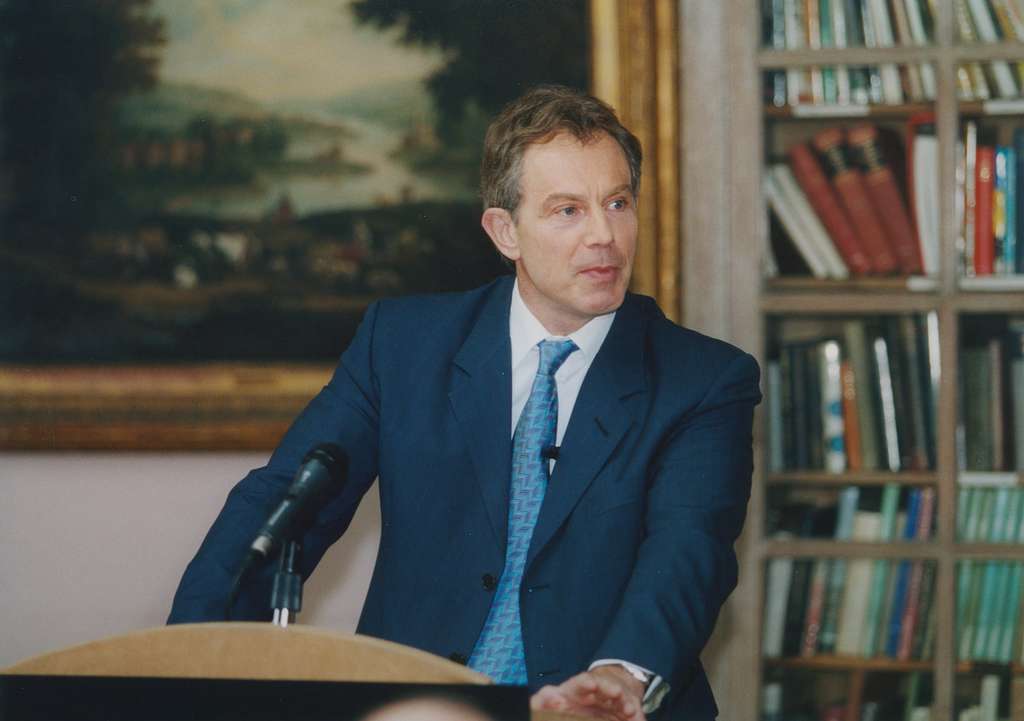
New Labour arrived in 1997 and, after a brief flirtation with resistance, accepted the whole terrain. Blair's April 1995 revision of Clause IV, carried by a special conference with ninety-five per cent support, was the symbolic act: solidarity retained, ownership surrendered. Giddens (1998) supplied the theory of the Third Way, social democratic ends pursued by market means, and fairness delivered through a well-managed capitalism rather than against it. In practice this meant Bank of England independence, the Private Finance Initiative raising schools and hospitals off the public books, light-touch supervision of a booming City, and every Thatcherite labour law left standing.
It also meant a minimum wage, tax credits and the largest sustained public investment in a generation: a real redistribution, conducted by credit rather than by ownership, so as not to frighten anyone. Harry Enfield's Loadsamoney had caught the new tone as early as 1988: the wage packet worn as a trophy, everyone else invited to watch. The grammar of citizenship changed accordingly. The citizen was redescribed as a consumer; the collective "we" thinned into what the age recognised as the Me generation; and work, made flexible and portable, corroded the older solidarities faster than any statute had (Sennett 1998).
Beneath the rhetoric, the electorate itself changed. Manufacturing employment fell from around seven million in 1979 to fewer than three million today; trade union density fell from over half the workforce to about a fifth, barely an eighth in the private sector. The industrial working class that had been Labour's base was dismantled along with its industries, and class ceased to predict votes as Butler and Stokes (1974) had found it doing in the sixties. Voters grew sceptical, floating and unenthusiastic. Corbyn's interlude proved the old word still had voltage (40.3 per cent in 2017, carried by the young) and then proved its limits (32.1 per cent in 2019). In 2024 Labour took 411 seats on 33.7 per cent of the vote, the smallest share ever to command a working majority, on a turnout of barely three in five: a party still socialist in name, able to occupy the state without anything resembling socialist command of the country (Marr 2007).
Is there still hope?
Honesty demands a distinction between the doctrine and the instinct. The doctrine, read as state ownership of the productive economy with the state as chief employer and investor, has few advocates left and fewer defenders in power; nobody is queueing to nationalise the steel mills. What would count as socialism now is therefore the quieter question. State ownership was always a means; the meaning was security, equality of regard, and a working life that paid its own way. The instinct is another creature. It pools risk before profit, prefers services to shareholdings, and insists that people matter more than margins; and it keeps resurfacing wherever the market's verdict is experienced as an injury.
The affection in which the Health Service is held survives every government that mismanages it. Nurses struck in 2022 for the first time in their college's century of existence and were met with public sympathy rather than blame. Majorities, including many Conservative voters, tell pollsters they would like the railways, water and energy back in public hands. Housing has become the Beveridge question of the age, and the climate crisis is a problem for planning before it is anything else. The neoliberal promise, that liberating individual enterprise will enrich everybody, has been tested by the crash of 2008, by austerity, and by a cost-of-living squeeze, and it has not survived the testing intact (Judt 2010).
Yet no contrary grammar has governed Britain since 1979, and that is the sobering fact. Any revival will therefore be invention rather than restoration: co-operatives and municipalism, community wealth building as practised in Preston, new unions in new workplaces, and a language of mutual obligation. The point is not to embalm Attlee's institutions but to recover what they were for. If 1945 teaches anything, it is that the collective returns when catastrophe turns strangers into neighbours; the wager of the present is whether a slower catastrophe, made of insecure work, unaffordable homes and a heating planet, can do the same.
Coda
Marx and Engels opened their Manifesto with a spectre haunting Europe (Marx and Engels 1848). The spectre never left; it went to ground. It sits in food banks and hospital waiting rooms, in the queues it was once blamed for, wearing the faces of people the settlement no longer holds. Where did socialism go? Nowhere yet. It is waiting, as the poor always wait, for its services to be required.
Bibliography
Addison, P. (1975) The Road to 1945. London: Jonathan Cape.
Beveridge, W. (1942) Social Insurance and Allied Services. London: HMSO.
Butler, D. and Stokes, D. (1974) Political Change in Britain: The Forces Shaping Electoral Choice. 2nd edn. London: Macmillan.
Giddens, A. (1998) The Third Way: The Renewal of Social Democracy. Cambridge: Polity Press.
Harvey, D. (2005) A Brief History of Neoliberalism. Oxford: Oxford University Press.
Hayek, F. A. (1944) The Road to Serfdom. London: Routledge.
Hennessy, P. (1992) Never Again: Britain 1945–51. London: Jonathan Cape.
Judt, T. (2010) Ill Fares the Land. London: Allen Lane.
Kavanagh, D. and Morris, P. (1989) Consensus Politics from Attlee to Thatcher. Oxford: Basil Blackwell.
Marr, A. (2007) A History of Modern Britain. London: Macmillan.
Marx, K. and Engels, F. (1848) Manifesto of the Communist Party. London: Communist League.
Sennett, R. (1998) The Corrosion of Character: The Personal Consequences of Work in the New Capitalism. New York: W. W. Norton.