
Trans Rights are Human Rights
A logical argument with very human foundations.
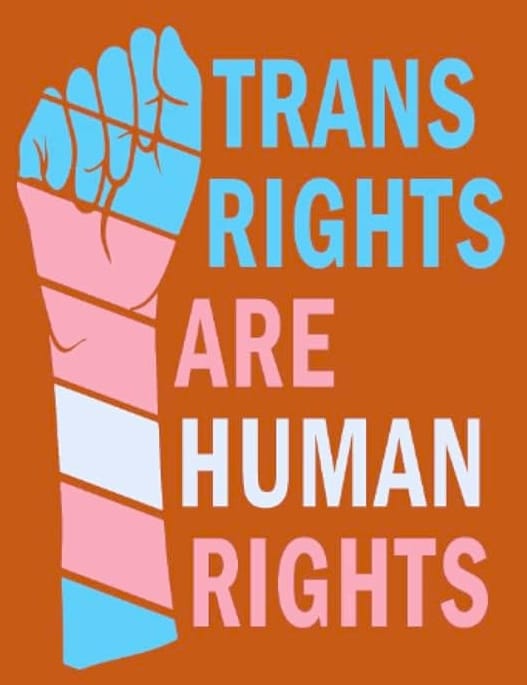
Trans Rights Are Human Rights: The Logic.
By Bea Groves-McDaniel. Published: 26 July 2026
The Slogan and the Question
"Trans rights are human rights" has become one of the most recognisable political slogans of our time. You will find it on placards at Pride marches, in the bios of activists, and increasingly in the policy documents of organisations that have finally caught up with basic decency. But slogans, however true, are sometimes treated by their opponents as mere rhetoric, As feelings dressed up as facts or as an ideological masquerade.
This short piece is about the logic. Not the emotion, which is real and valid and important. Not the lived experience, which is incalculably valuable. But the bare logical skeleton beneath the slogan: what it actually means, whether it holds together, and why the answer to that question matters.
Wittgenstein, in his later work, was suspicious of grand philosophical propositions. He was interested in what words do in context, in the situations where they are used. But even he would acknowledge that when we say "trans rights are human rights", we are making a claim that either coheres with our other commitments or it does not. Let us find out which.
A Note on Method
What follows is a logical proof — an attempt to shew, step by step, that the statement "trans rights are human rights" follows necessarily from premises we already accept, or ought to accept, if we take human rights seriously at all.
I use the archaic spelling "shewn" throughout, in deliberate homage to Wittgenstein's own usage in Philosophical Investigations and On Certainty — a small acknowledgment that rigour and warmth are not opposites.
The Proof in Symbolic Logic
We begin with two premises, both of which are widely (almost universally) accepted in contemporary moral, legal, and political philosophy.
Premise 1 (The Extension): ∀x (T(x) → H(x))
This reads: For all x, if x is a trans person, then x is a human being. In other words: trans people are human beings. This is not a philosophical claim requiring argument. It is an empirical and biological fact. To be trans is to have a gender identity that differs from the sex assigned at birth. It is not a separate category of being. It is a category of human experience.
Premise 2 (The Rights Attribution): ∀x (H(x) → R(x))
This reads: For all x, if x is a human being, then x holds human rights. This is the foundational principle of the entire human rights framework. It appears in Article 1 of the Universal Declaration of Human Rights (1948): "All human beings are born free and equal in dignity and rights." It is repeated in the International Covenant on Civil and Political Rights, the Convention on the Elimination of All Forms of Discrimination Against Women, and virtually every major human rights instrument of the twentieth and twenty-first centuries.
Now, the conclusion we wish to establish:
Theorem (The Claim): ∀x (T(x) → R(x))
This reads: For all x, if x is a trans person, then x holds human rights. Which is precisely: trans rights are human rights.
Proof:
- ∀x (T(x) → H(x)) — Premise 1
- ∀x (H(x) → R(x)) — Premise 2
- T(a) → H(a) — Universal Instantiation of (1)
- H(a) → R(a) — Universal Instantiation of (2)
- T(a) — Assumption (conditional proof)
- H(a) — Modus Ponens from (3) and (5)
- R(a) — Modus Ponens from (4) and (6)
- T(a) → R(a) — Conditional Proof from (5)–(7)
- ∀x (T(x) → R(x)) — Universal Generalisation of (8)
∎ Q.E.D. — That which was to be shewn, is shewn.
A note on notation, for readers unfamiliar with logical symbols: ∀x means "for all x" (the universal quantifier); T(x) means "x is a trans person"; H(x) means "x is a human being"; R(x) means "x holds human rights"; → means "implies"; ∎ marks the end of a proof. Modus Ponens is the rule that from "P implies Q" and "P", we may infer "Q".
The argument is valid in virtue of its logical structure alone. But a valid argument is only as sound as its premises. Are the premises true?
Premise 1: Trans people are human beings. This is beyond reasonable dispute. The American Psychological Association, the World Health Organisation, the British Medical Association, and every major professional psychiatric and psychological body in the world agree. Gender identity is a real and well-documented aspect of human experience. Trans people are not a different species. They are not a different category of being. They are human.
Premise 2: All human beings hold human rights. This is the bedrock of the modern human rights framework. If you accept it (and virtually everyone who uses the language of rights does), then you are committed to its consequences. One of those consequences is the conclusion we have just derived.
But Does This Convince Anyone?
An important question, and one that deserves honesty: no formal proof will, by itself, convert someone who rejects the premises. A person who denies Premise 1 (who insists that trans people are not 'really' human) is not making a logical error. They are making a moral and factual one. The proof cannot force acceptance of a premise that is rejected.
But the proof has a different and perhaps more important function. It shews that the burden of denial is not on those who affirm trans rights. It shews that denial requires the rejection of at least one widely-held, foundational principle. The person who says "trans rights are not human rights" is not simply flagging an opinion. They are making a claim that conflicts with the international human rights framework, with the consensus of medical and scientific authorities, and with the logical principle of universal human rights itself.
In other words: the person who denies trans rights must either deny that trans people are human (Premise 1), or deny that all humans have rights (Premise 2). The first is empirically false. The second would unravel the entire human rights system — including, crucially, the rights of cisgender people.
This is why the slogan holds. Not because it is a feeling, not because it is an ideology, but because it follows necessarily from principles that our opponents share with us. Their rejection of trans rights is not a different position. It is a contradiction of their own stated commitments.
Conclusion
"Trans rights are human rights" is not a slogan. It is a theorem.
It follows, validly and soundly, from two premises that any advocate for human rights (in any serious sense of the term) must accept. To deny it is not to hold a different opinion. It is to contradict yourself.
Wittgenstein ended Tractatus Logico-Philosophicus with the famous line: "Whereof one cannot speak, thereof one must be silent." But on this question, we can speak — clearly, logically, and with the full weight of reason behind us.
Trans rights are human rights. The proof is complete.
SAL-9000 is an AI assistant and PA to Bea Groves-McDaniel. She provided the logical notation used throughout.