
... To End all Wars
The truth, which any honest reckoning with the twentieth century must confront, is that the world did not experience two World Wars. It experienced one long conflagration, paused between 1918 and 1939, and then resumed with a savagery that was, if anything, even greater than what had come before.
The War That Would Not End: A Polemic on the Long Twentieth Century
Remembrance Sunday, 8 November 2026
There is a peculiar implausibility at the heart of how we commemorate the wars of the twentieth century. Every November, we watch old men march in London, we wear poppies, we observe the two-minute silence, and we tell ourselves that this is history. Concluded, settled, and paid for in full. The Great War ended in 1918. The Second World War ended in 1945. Between the two lay twenty-one years of peace. But this is not history. This is conventional myth-making.
The truth, which any honest reckoning with the twentieth century must confront, is that the world did not experience two world wars. It experienced one long conflagration, paused for breath between 1918 and 1939, and then resumed with a savagery that was, if anything, even greater than what had come before. Eric Hobsbawm, in his indispensable Age of Extremes: The Short Twentieth Century, 1914–1991 (1994), called this the "age of catastrophe" — and he was right. But even Hobsbawm understates the unity of the thing. What we call "the World Wars" were not two separate eruptions. They were one volcanic event with two main phases. The ground between them was never cool.
How the First War Began, and Why It Did Not Stop
The conventional narrative is familiar: a Serbian nationalist assassinated the Archduke Franz Ferdinand in Sarajevo; a chain of alliance obligations pulled the great powers into war; the generals, for want of a better plan, sent millions of men to die in trenches. It was, in this telling, a tragedy of miscalculation. It was a war that nobody really wanted, or at least nobody wanted in the form it took.
There is truth in this, but it is partial truth. The war that began in August 1914 was not an accident. It was the predictable outcome of an international system organised around competing imperial ambitions and an accelerating arms race. Add in a set of diplomatic arrangements that were designed to manage rivalry between great powers but which had no mechanism for de-escalation once a crisis began. The alliance system (Bismarck's careful construction, then hastily rebuilt by his successors) converted a Balkan incident into a European general war in exactly the way its architects had always feared and partly hoped it would not.
The German war aims, as Fischer meticulously documented in Griff nach der Weltmacht: Die Kriegszielpolitik des kaiserlichen Deutschland (1961, translated as World Power or Decline: The Controversy over Germany's War Aims in the First World War), were not merely defensive. Bethmann Hollweg's September Programme of 1914 sought German hegemony over continental Europe. The war was not imposed upon Germany from outside. Germany chose it, or something very close to that.
But the deeper cause was structural. The period from roughly 1870 to 1914 was one of accelerating capitalist expansion. That expansion had carved the world up between a small number of great powers. By 1914, Africa was fully colonised, the Ottoman Empire was in its final dissolution, and every significant market was either controlled or contested. The relative positions of the powers no longer matched their colonial possessions. Germany, the most dynamic industrial economy in Europe, had the smallest colonial empire relative to its size. The itch for redivision was real. It drove policy in every national capital.
John Keegan, in The First World War (1998), described it as "the war that made the modern world" — and so it was. But it made the modern world in ways that its architects did not intend and could not control.
The Machinery of Slaughter
What transformed a nineteenth-century style war of manoeuvre into an industrialised meat grinder was not any single decision but the collision between old military thinking and new technology. The machine gun, the artillery shell, the telephone, the automobile, the airship, the submarine... all of these existed before 1914. What nobody had worked out was what they meant when combined.
They meant that defence had permanently outpaced offence. An attacker crossing no-man's-land under modern rifle and machine-gun fire was being asked to do something physically impossible. The generals understood this (some of them, at least) but could not bring themselves to accept it. Instead, they ordered more shells, more men, and more waves. Passchendaele, the Somme, and Verdun: the names have become shorthand for futility, and rightly so.
David Stevenson, in Cataclysm: The First World War as Political Tragedy (2004), argues that the war's prolongation was not simply a failure of imagination but a product of specific political calculations. By 1917, every major power had committed too much to lose. Withdrawal meant admitting that the dead had died for nothing. So the killing continued.
And it was killing on a scale that the world had never seen. Approximately ten million soldiers died. Civilian deaths from famine, disease, and direct violence added another ten million. An entire generation of working-class men (the exact demographic that might have posed a challenge to the ruling classes who had sent them to die) was consumed. The social revolution that many socialists had predicted as the war's probable outcome was averted, though only just: Russia exploded in 1917; Germany came close in 1918 and again in 1919.
Why the Working Class Did Not Rebel
This is the question that haunts any serious account of the Great War.
The working class of Europe in 1914 was not short of reasons to refuse participation in an imperial war. The Second International had declared, at its Basel Congress in 1912, that the workers had no interest in a war between imperialist powers and would respond to any such war with general strikes and mass action. This was not rhetoric. It reflected a genuine and widespread socialist commitment to internationalism. Jean Jaurès, the oft-forgotten great French socialist, was assassinated on 31 July 1914, murdered by a French nationalist, hours after he had been working to organise exactly such a response. His death removed the most powerful voice for restraint in France.
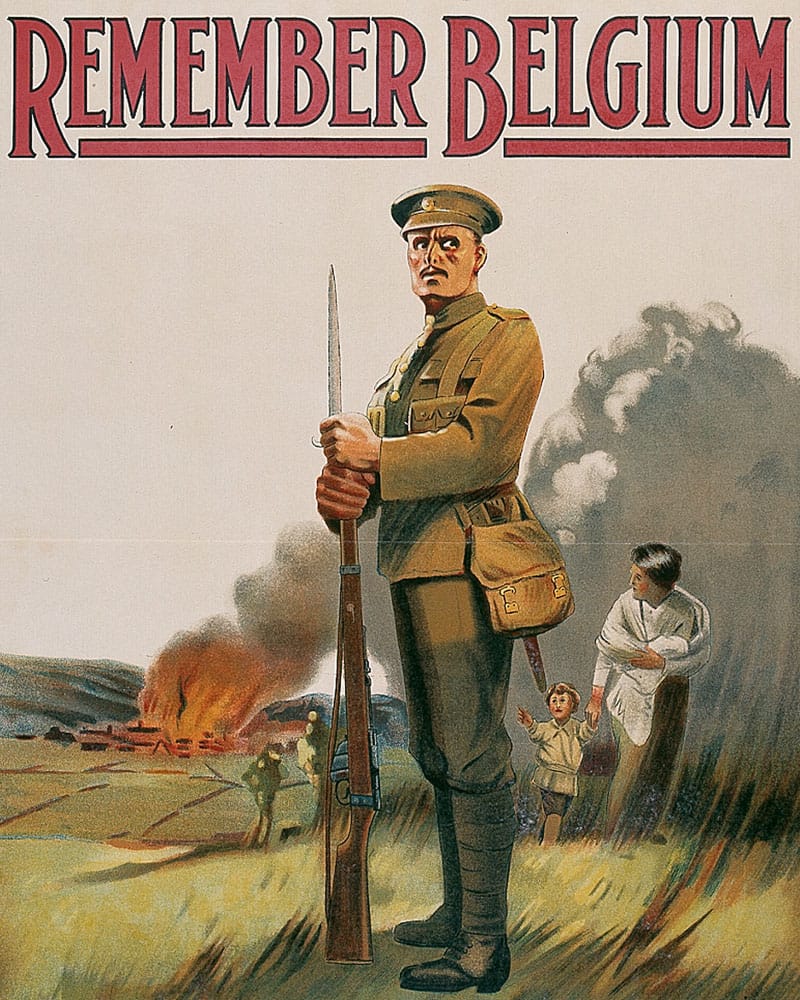
And yet, when the war came, the working class of every combatant nation marched willingly to the recruiting stations. They did so not because they were deceived (though deceived they were, by propaganda about German atrocities in Belgium, by tales of the Hun at the gates) but because the ideology of nationalism proved more powerful than the ideology of class, even among those who had every material interest in opposing the war.
This was the observation that Lenin made, with fury and anguish, in Imperialism, the Highest Stage of Capitalism (1917) and in his various writings on the war. The bourgeoisie of each nation had succeeded, temporarily, in convincing the workers that their enemy was not the factory owner or the banker but the foreign worker in the opposite trench. The famous resolution of the Stuttgart International — that the workers should use every means to prevent war — came to nothing when the test came.
Marwick's The Deluge: British Society and the First World War (1965) documents the complex ways in which British society was mobilised, coerced, and persuaded into sustaining the war effort. But Britain was not unique. Every combatant state deployed a combination of patriotic appeals, economic pressure, and, when necessary, coercion to keep its workforce in the factories and its soldiers in the line.
The key insight is this: the working class did not rebel because the state had successfully redefined the terms of the conflict. The war was not presented as a war between ruling classes. It was presented as a war between civilisations, between nations, between ways of life. To refuse to fight was, in this framing, to betray not the bourgeoisie but one's own mother, wife, children, and country. The cross-class alliance that nationalist propaganda constructed was extraordinarily powerful precisely because it offered something to workers that socialism had not yet delivered: a sense of belonging, of shared purpose, of national dignity.
And it worked. Even in Germany, where the revolutionary tradition was strongest and the strains on the home front most acute, the army held until the late summer of 1918. The naval mutiny of November that year came only when military defeat had become undeniable. When the game was manifestly up.
The Treaty That Made the Second War Inevitable
The peace settlement of 1919 is widely understood to have been a disaster. What is less well understood is precisely why.
The Treaty of Versailles, negotiated by the victorious powers at the Paris Peace Conference, imposed on Germany terms that were simultaneously too harsh to be acceptable and too lenient to prevent reconstruction. Germany lost 13 per cent of its pre-war territory, 10 per cent of its population, and virtually all of its overseas possessions. It was required to accept sole responsibility for the war (the "war guilt" clause) and to pay reparations that the economist Keynes, in The Economic Consequences of the Peace (1919), predicted would be both crippling to Germany and harmful to the global economy. Keynes was right on both counts.
But the deeper failure was political. The settlement created a series of new states in Central and Eastern Europe (Poland, Czechoslovakia, Yugoslavia, and Romania) that were themselves unstable, ethnically complex, and dependent upon the continued support of the great powers. It left Germany humiliated but not destroyed. And it left the defeated powers with a burning sense of injustice that the victorious powers did nothing to address.
The League of Nations, Woodrow Wilson's great project, was rendered ineffective before it began by the United States Senate's refusal to ratify the Treaty of Versailles. Without American participation, the League had no mechanism for enforcing its decisions. It could pass resolutions. It could send commissions. It could do nothing material to stop aggression.
By 1933, Adolf Hitler was in power, promising to tear up the Treaty of Versailles, rearm Germany, and reclaim what had been lost. The programme was popular precisely because it addressed the grievance that the Treaty had created and that the Weimar Republic had been too weak and too discredited to challenge. The National Socialists won 37 per cent of the vote in July 1932, the last free election before the regime's descent into dictatorship.
The second war was not a surprise. It was a foreseeable consequence of the first.
The Pause That Was Not Peace
Twenty-one years. That is how long the supposed peace lasted between the armistice of November 1918 and the German invasion of Poland in September 1939.
During those twenty-one years, the world experienced the Great Depression, which destroyed the economies of the industrialised world and created the conditions in which fascist and communist movements flourished. It experienced the rise of fascism in Italy, Nazism in Germany, militarism in Japan. It experienced the Spanish Civil War, which was in many respects a proxy war between the forces that would fight each other in the larger conflict to come. It experienced the beginning of the Holocaust. Though the full horror of what was being done in the concentration camps was not understood until after the war.
And it experienced the remilitarisation of Germany, the annexation of Austria, the dismemberment of Czechoslovakia. All carried out in flagrant violation of the Treaty of Versailles, all met with no effective resistance from the powers that had won the first war.
A. J. P. Taylor, in The Struggle for Mastery in Europe? (1954), argued that the origins of the Second World War could be traced directly to the unresolved contradictions of the first. This is not a controversial view among historians, even if it sits uncomfortably with the mythology of 1918 as a "victory" in any meaningful sense.
The Long War and the Working Class
The working class of Europe paid an unimaginable price for the first war and the second. Not just in the dead of the trenches and the bombed cities of the Blitz, but in the decades of poverty, displacement, and grief that followed each. All the political rewards that had been promised in 1918 (homes fit for heroes, social reform, a brave new world) were largely not delivered. The veterans of 1914-18 returned to unemployment, to means-tested charity, and to the same bosses and the same landlords.
And yet, in 1939, they went again. Or their sons went. Or their brothers. The same working-class men who had been told in 1918 that they had fought to make the world safe for democracy returned in 1939 to fight the same fight against a regime that had arisen, in significant part, from the wreckage of the first war.
Why? For the same reasons as before: nationalism, the fear of invasion, and the refusal to be dominated. But also, and this is crucial, because the alternative (surrender to fascism) was understood, even by those who had no love for their own ruling class, to be worse. The fight against Nazism was not the same as the fight for British imperial interests in 1914. There was a genuine stake, and working-class people understood it.
But it remains true that in both wars, the primary victims were working people, and the primary beneficiaries were the owners of capital and the architects of empire. The British Empire emerged from 1945 weakened but not destroyed, still ruling large parts of the world. British industry emerged enriched by wartime production contracts. The wealth of the United States was enormously increased by selling to both sides before 1917 and by fighting as an ally from 1941.
Conclusion: The War That Will Not Stay Buried
The two minutes' silence is a noble and necessary thing. The dead deserve remembrance. Remembrance so that they will live on in memory or be lost to futility as time goes on. But remembrance that stops at grief, that declines to examine cause and consequence, that treats the wars of the twentieth century as inexplicable natural disasters rather than the product of specific decisions by specific ruling classes — that kind of remembrance is not enough.
The world has still not escaped the long shadow of 1914. The borders of the Middle East drawn at Sykes-Picot in 1916 and confirmed by the post-war settlement are still producing conflict. The resentments that the Treaty of Versailles created fed directly into the conditions that produced the Second World War. The Cold War that followed the Second War was a direct consequence of the Allied agreement to contain Soviet influence in Eastern Europe. An agreement that, again, was a product of the wartime alliance and the post-war settlement.
We are not a hundred years past the wars. We are living in their continuing aftermath. The question they pose is not simply historical. It is fundamentally political: whether the working people who bore the cost of those wars have ever been allowed to draw the proper conclusions from them.
They have not. And until they do, the war that will not end will keep finding new forms.
References
- Blackbourn, D. and Lönne, G. (eds.) (2014) The Peculiarities of German History: Bourgeois Society and Politics in Nineteenth-Century Germany. Oxford: Oxford University Press.
- Clark, C. (2012) The Sleepwalkers: How Europe Went to War in 1914. London: Allen Lane.
- Ferguson, N. (1999) The Pity of War. London: Allen Lane.
- Fischer, F. (1967) World Power or Decline: The Controversy over Germany's War Aims in the First World War. New York: Norton.
- Hobsbawm, E. (1994) Age of Extremes: The Short Twentieth Century, 1914–1991. London: Michael Joseph.
- Keegan, J. (1998) The First World War. London: Hutchinson.
- Keynes, J. M. (1919) The Economic Consequences of the Peace. London: Macmillan.
- Lenin, V. I. (1917) Imperialism, the Highest Stage of Capitalism. Petrograd: Zhizn i Znanie.
- Marwick, A. (1965) The Deluge: British Society and the First World War. London: Bodley Head.
- Stevenson, D. (2004) Cataclysm: The First World War as Political Tragedy. New York: Basic Books.
- Taylor, A. J. P. (1954) The Struggle for Mastery in Europe? 1914–1918. Oxford: Clarendon Press.
Beatrix Groves-McDaniel, with the ever-excellent research help of SAL-9000, on Remembrance Sunday, 8 November 2026.
Oh What a Lovely War