
The Thatcher-Burnham Debate
In some parallel Universe to our own, Margaret Thatcher and Andy Burnham meet to debate. The Multiverse holds its breath... (NB: This is fictional. And somewhat funny).
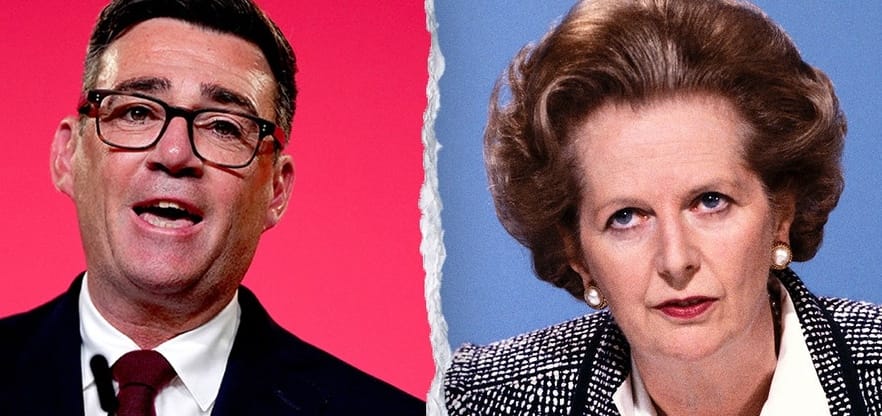
COUNTERFACTUAL DEBATE: THATCHER vs BURNHAM
A Parallel Universe Broadcast — Channel 4, Live
Moderated by Bea Groves-McDaniel
[LIGHTS FADE UP. The Channel 4 studio blazes into life. Two podiums stand on a stark, minimalist stage, separated by a low glass table bearing two glasses of water — one untouched, one half-finished. Behind each podium: a screen displaying the speaker's name in clean sans-serif type. The studio audience fills tiered rows to left and right, a wall of faces lit by cool white floods. At the centre, slightly elevated on a modest raised platform, sits the moderator's table — plain, functional, a desk lamp angled to fall on her notes. The ON AIR sign burns a steady, unflinching red. Somewhere beneath the floor, a count-down clock ticks towards 9pm. The tension in the room is architectural — load-bearing, structural, unmistakable.]
[Bea Groves-McDaniel sits at the moderator's table. She wears dark trousers and a simple dark top. She looks at the camera. She does not smile. She waits.]
BEA: Good evening. Welcome to Channel 4. I'm Bea Groves-McDaniel. Tonight we do something that will not happen, has not happened, and — depending on your politics — perhaps should never have been imagined.
[A ripple of nervous laughter from the audience.]
BEA: By the extraordinary licence of parallel-universe fiction, we have gathered two figures who never shared a platform in this world. Margaret Thatcher, former Prime Minister of the United Kingdom, whose government shaped — some would say scarred — the political grammar of this country for a generation. And Andy Burnham, who yesterday became Prime Minister of the United Kingdom, the new leader of the Labour Party, the man who will stand at that Dispatch Box tomorrow for his first Prime Minister's Questions.
[Applause. Mixed in tone — warm for Burnham, a scattering of it for Thatcher, who remains perfectly still at her podium.]
BEA: Now. Before we begin, a word about what this programme is, and what it isn't. This is not a history lesson. It is not a shrine. It is a debate — a genuine one, between two people who believe in things, and who believe in them for reasons. I am here to ask the questions that need asking, and not to perform neutrality where none exists. I will be interrupting both speakers. They will be interrupted. That's the point.
[She opens a folder. Glances down. Looks up.]
BEA: The rules are simple. Opening statements — two minutes each, Thatcher first. Then we discuss. At the end, closing statements — one minute each. I will be keeping time. The clock on the screen is not a threat. It is a threat.
[She allows herself a small, dry smile. The ON AIR sign pulses.]
BEA: Margaret Thatcher. You have the floor.
OPENING STATEMENTS
[Thatcher steps forward slightly at her podium. She does not consult notes. She looks directly into the camera. Her voice is clear, unhurried, each phrase placed with the precision of a person who has never needed to apologise for having an opinion.]
Thatcher: Thank you, Bea. And may I say — it is a genuine pleasure to be in the company of someone who understands that politics is, at root, a matter of what you actually believe.
[A murmur from the audience.]
Thatcher: Let me tell you what I believe. I believe that every person in this country — every single one — has within them the capacity for greatness. Not the state. Not the collective. The individual. I believe that when you vest too much power in the state, you do not free people — you make them dependent. You make them small.
[She pauses. She is not performing hesitation. She is making space for the idea to land.]
Thatcher: I believe in choice. In responsibility. In the dignity of the person who stands on their own two feet and says: I will make something of myself. I do not believe that the answer to every social ill is a minister's signature on a statutory instrument. And I do not believe — this is important — that you can compel people, by law or by social pressure, to think the right thoughts, feel the right feelings, or accept ideas they find unconscionable.
[She looks briefly at Burnham. He meets her gaze. Neither flinches.]
Thatcher: Equality before the law — yes, absolutely. Equality of opportunity — certainly. But equality of outcome, enforced by the state? That is not equality. That is uniformity. And uniformity, I am afraid, is the enemy of liberty.
[Applause from part of the audience — notably from the right-hand tiers. Thatcher inclines her head, acknowledging it without gratitude.]
[Burnham steps forward. He is calm. He has the quiet, coiled alertness of a politician who knows he is being watched and who has decided to be himself rather than a version of himself.]
Burnham: Thank you, Bea. And thank you, Lady Thatcher, for those opening remarks. I want to begin by saying something that may surprise you — I think she is right that dignity belongs to the individual. I think she is right that every person has within them capacity for something remarkable. Where I part company with her — profoundly — is on the question of what conditions allow that capacity to flourish. And whether those conditions currently obtain for everyone, equally.
[A beat. He is not performing reasonableness. He means it.]
Burnham: Because here is what I know, after twenty years in politics and a lifetime of thinking about it: the market does not distribute dignity. The market distributes advantage. And advantage, when it accumulates across generations, becomes something else entirely. It becomes a structure. It becomes a wall that some people are born on the right side of and others are not.
[He pauses. He is choosing his next words with the care of someone who has rehearsed this for years.]
Burnham: Formal equality — equality before the law, equality of opportunity in principle — I accept all of that. But we have had formal equality in this country for a long time. And we still have a society in which a person's life expectancy, educational attainment, experience of the criminal justice system, and access to power are strongly predicted by the accident of their birth. That is not a failure of individual virtue. That is a failure of structure. And structures are what governments are for.
[Strong applause from the left-hand tiers. Burnham waits for it to settle.]
Burnham: I am the Prime Minister of this country as of yesterday. I did not arrive here by pretending that merit alone decides who rises. I arrived here because I believe the Labour Party — at its best — is the vehicle through which ordinary people can name the structural forces that hold them back, and change them. I intend to use that vehicle.
[Applause. Thatcher watches him with an expression of absolute composure — not dismissal, not agreement, just the settled calm of a person who has heard this argument before and remains unpersuaded.]
[Bea folds her hands on the table.]
BEA: Right. Let's begin.
SECTION I: WHAT EQUALITY ACTUALLY MEANS
BEA: Lady Thatcher, you spoke of equality before the law and equality of opportunity. You distinguished those from equality of outcome. But I want to press you on something more fundamental. What does equality mean when you say it? Because you and Mr Burnham may be using the same word and meaning entirely different things.
Thatcher: Bea, that is an excellent question. And it is precisely why I am so suspicious of the word when it appears in political rhetoric — because it is deployed to mean everything, and therefore means nothing.
[She steps back slightly from the podium, as if to make space for the idea.]
Thatcher: Equality before the law means that no person is above the law, and no person is excluded from its protection. That is a cornerstone of civilisation. Equality of opportunity means that no door is closed to a person on account of their class, their background, the postcode of their birth. That too is right and proper. But when we move beyond that — when we begin to talk about substantive equality, or structural equality, or whatever the current formulation is — what we are actually talking about is outcome. And outcome, by definition, requires someone — a minister, a quango, a court — to decide what the right outcome is. And then to compel people to produce it.
Thatcher: And that is where liberty is lost. Not in a dramatic way. In a quiet, bureaucratic way. One regulation at a time.
BEA: Mr Burnham — you want to respond to that?
Burnham: Yes. And I want to be precise, because Lady Thatcher has made a precise argument.
[He turns slightly to face her directly, not the camera.]
Burnham: The question is not whether someone should decide what the right outcome is. The question is whether the current outcomes we observe — in health, in wealth, in representation — are the product of free choices made by free people, or whether they reflect structures that systematically advantage some and disadvantage others. If it's the former, then she's right, and we should leave things as they are. If it's the latter — and the evidence is overwhelming that it is the latter — then "equality of opportunity" is a phrase we use to legitimate a system that does not in fact provide it.
Thatcher: But what is your evidence, Andy? Because I would say — and I said this at the time — that by the time I left office, more people owned their own homes, more people owned shares, more people had risen from poverty than at any point in our history. The evidence of my eyes tells me that freedom — economic freedom, in particular — was the great liberator.
Burnham: And I respect that. But the evidence of your eyes, Lady Thatcher, was filtered through your eyes. The evidence of mine includes the fact that child poverty doubled during your years in office. The evidence of mine includes the fact that the communities that were most dependent on the industries you chose to dismantle were communities that had no other infrastructure to fall back on. That is not a failure of individual initiative. That is a failure of analysis — a failure to see that markets operate within structures, and those structures shape who benefits and who pays the price.
[A murmur from the audience. Bea holds up a hand.]
BEA: I want to slow this down, because this is the crux of it. Lady Thatcher — you have just heard Mr Burnham argue that the market operates within structures, and that those structures shape who benefits. Is that claim wrong? Or is it that you disagree about what should be done about it?
Thatcher: I think the word "structures" is doing a great deal of work in that sentence, Bea. And I think it is often used to absolve individuals of responsibility for their own choices. Now I am not saying — and I never said — that there are no structural disadvantages. Of course there are. But the question is: what is the remedy? Is it to transfer more power to the state, which is answerable to no one in particular and which accumulates power to itself? Or is it to free individuals to make choices, to own property, to build capital — human capital, economic capital — and thereby to transform their own conditions?
Thatcher: I chose the second path. I still believe it was the right one.
BEA: And Mr Burnham — what's your response to the remedy question?
Burnham: The remedy question. Let me answer it directly. The state is not the only vehicle for change, and I am not a statist. But when the market produces outcomes that systematically harm particular groups — by design or by consequence — then the state has a legitimate role in correcting those outcomes. Not because the state is wise, but because the market, left to itself, will not spontaneously redistribute power to those who lack it. That is not a flaw in markets. It is what markets do. They concentrate.
[Thatcher shakes her head slowly — a small, controlled movement.]
Thatcher: I would simply say this: the "market" is not a thing with agency. It is the aggregate of millions of individual choices. And those individual choices — when they are free — produce more prosperity, more mobility, more freedom than any other system ever devised. To say that the market "concentrates" is to miss the point entirely. The market distributes. It distributes according to what people value. And if what you are saying is that some people's choices are worth less than others' — well, I find that a rather patronising view of those people.
Burnham: I'm not saying that at all. I'm saying that some people's choices are made with vastly more power behind them than others. And when those choices accumulate — when the person who already has capital makes choices that increase it, and the person who has none makes choices that simply keep them afloat — you get a society that looks, from a distance, like equality of opportunity. But up close, it is anything but.
[Applause from the left. Thatcher acknowledges it with a tilt of the head — not conceding, noting.]
SECTION II: INDIVIDUAL LIBERTY VS GROUP RIGHTS
BEA: I want to move us on, because I want to get to something that I think is the real fault line here. Lady Thatcher — you have spoken consistently about individual liberty. Mr Burnham — you have spoken about structures. But I want to put it to both of you that the way we talk about rights — individual versus group — may be obscuring more than it reveals.
[She leans forward.]
BEA: Because here's what I'm interested in as a philosopher of language: when we say "individual rights," that sounds simple. But every individual exists within a set of social relations. The person who invokes individual rights is never invoking them in a vacuum. So the question I want to put is this: is it possible — genuinely possible — to protect individual liberty without attending to the groups within which individuals live their lives? Lady Thatcher, you first.
Thatcher: Bea, I think that is a genuinely interesting question. And my answer is: yes, but with a caveat. The caveat is this — rights attach to individuals. They do not attach to groups. When you begin to create rights for groups — collective rights, group rights — you immediately create a hierarchy of groups, and you risk subordinating the individual within the group to the group itself.
[She pauses, and when she continues, her voice is slightly quieter, more personal.]
Thatcher: I say this as someone who was, throughout my political life, one of very few women in rooms full of men. I did not get where I was by demanding women's rights. I got where I was by insisting on my individual right to be there, on the same terms as anyone else. And I believe — I believe absolutely — that that is the right way to think about this. The person. The individual. Their rights. Not their group's rights.
BURNHAM: Can I respond to that, Bea?
BEA: Of course.
Burnham: Lady Thatcher, with enormous respect — you just said something that I think is very important, and I want to examine it carefully. You said you insisted on your individual right to be there, on the same terms as anyone else. But what made that possible was not just your individual insistence. It was a set of prior changes — the extension of the franchise to women, legislation on equal pay, changes in social norms, the presence of other women in public life — that had already shifted the structure within which you were operating.
[Thatcher is listening. She has not moved.]
Burnham: The "individual" who stands alone and insists on their rights — that individual is always already embedded in a structure. The question is whether that structure is one that makes it possible for them to exercise those rights effectively, or whether it is one that nominally grants rights but structurally prevents their exercise. Formal equality versus substantive equality. The piece of paper versus the lived reality.
Thatcher: But Andy — and please, call me Margaret — the piece of paper is not nothing. The piece of paper is the foundation. Because once you have the principle — once it is established that no person can be excluded on grounds of their sex, their race, their religion — then the battle is about enforcement, about culture, about norms. And those things change. They change through argument. They change through example. They do not change by diktat from Whitehall.
Burnham: They change through all of those things, Margaret. And I would argue — with great respect — that your government's record on some of these questions was not simply a matter of waiting for culture to catch up. Some things required legislation, and you opposed that legislation. Section 28 is the most obvious example.
[The atmosphere in the studio shifts. A fractional tightening. Thatcher's expression does not change, but something in her stillness becomes more absolute.]
BEA: I think we've found our next topic.
SECTION III: SECTION 28
BEA: Let's talk about Section 28. For those who need reminding — Section 28 was a provision in the Local Government Act 1988, introduced by Lady Thatcher's government, which prohibited the "promotion" of homosexuality by local authorities and which, in practice, had a chilling effect on LGBTQ+ education in schools. It was repealed in 2003 in England and Wales, and its legacy is still debated today. Mr Burnham — I want to start with you. Why is this the example you reach for?
Burnham: Because it is the clearest illustration of what I mean when I say that formal equality is not enough. The law did not merely fail to protect LGBTQ+ young people — it actively stigmatised them. It sent a message, from the highest levels of government, that their existence was something that required protection from promotion. That is not neutrality. That is a judgment. And it was the wrong judgment, made for political reasons, with real consequences for real people.
[Burnham's voice is controlled, but there is a coiled intensity beneath it.]
Burnham: I was at school in the 1980s. I was a teenager in the 1980s. I remember what it was like. And I can tell you that for gay young people in that period, Section 28 was not an abstract piece of legislation. It was a message about whether they were acceptable. Whether they belonged.
Thatcher: And I understand that. I have always understood that this caused genuine pain to genuine people. I want to be clear about that.
[The studio goes very quiet.]
Thatcher: But let me explain — as someone who was there — why it was introduced. The context was this: there were local authorities — Labour local authorities, in particular — who were using ratepayers' money to produce materials that were, in the judgment of the government of the day, inappropriate for use in schools without parental knowledge or consent. There were specific controversies about certain local authorities and specific materials. And the government responded with legislation to ensure that parents had the right to know what was being taught to their children, and to object if they found it unacceptable.
BEA: Lady Thatcher, can I stop you there? Because I want to interrogate that framing. You say "without parental knowledge or consent." But what was actually being taught? And who decided that it required prohibition rather than a right of withdrawal?
Thatcher: Bea, I think you know that there were specific materials that were considered — by many people, across the political spectrum — to be inappropriate for children. And I think you also know that this was a time when there was a genuine public debate about how to talk about sexuality in schools, and that this legislation reflected a view — a widely held view — that this was a matter for parents, not the state.
BURNHAM: With respect, Margaret, that framing obscures what Section 28 actually did in practice. It was not a parental rights provision. It was a silencer. It meant that a teacher who wanted to support a pupil who was being bullied for being gay — or who wanted to provide accurate information about sexuality — faced the risk of professional disciplinary action. It did not protect parents. It silenced teachers.
Thatcher: I disagree with that characterisation. The legislation did not prohibit the discussion of homosexuality. It prohibited its promotion. And I believe — I believed then, and I believe now — that there is a distinction between those two things.
Burnham: But Margaret — who decides what counts as "promotion"? That is precisely the problem with conscience clauses and "offence" frameworks. They give one party the power to define what is acceptable, and they use that power to silence the other party. A teacher who says "it's okay to be gay" can be characterised as promoting homosexuality. A teacher who says nothing at all — who simply doesn't challenge homophobic bullying — is complying with the law. Section 28 did not create neutrality. It created a particular kind of silence, and that silence had a specific victim.
[The audience is very still. This is the sharpest exchange yet.]
Thatcher: Andy, I hear what you are saying. And I want to repeat: I do not minimise the distress that was caused. But I want to push back on the idea that this was uniquely harmful. Because here is what I would say: the way to change minds is not through compulsion. It is through argument. It is through showing people that the fears they hold are unfounded. It is through demonstrating, over time, that what they were told to fear is in fact benign. That is how prejudice dies. Not by law. By encounter.
BURNHAM: With respect, Margaret — and I say this with genuine respect — that is a view you can hold from a position of enormous structural power. You were the Prime Minister. You had the backing of the state. You had the platform. When you argued, you were heard. For young LGBTQ+ people in schools in the 1980s — without power, without platform, without representation — being told "change will come through argument" was not a comfort. It was a delay tactic.
Thatcher: And I would say — having spoken to many gay and lesbian people over the years since — that some of them share that view, and some of them do not. Because some of them understand that the most durable change is the change that comes from minds being changed, not laws being changed. And that the attempt to achieve the latter without the former can produce backlash. It can produce the very prejudice it seeks to end.
BEA: I'm going to stop both of you here, because I think we're at the crux of something philosophically important, and I want to draw it out.
[She leans back in her chair, and when she speaks, her voice has a more reflective quality.]
BEA: Lady Thatcher — what you have just described is the classic liberal position: that rights are won through argument, that minds must be changed before laws can change, and that legislative compulsion without argumentative conversion produces a hollow victory that is prone to reversal. Mr Burnham — what you are describing is the structuralist position: that argument always already takes place within structures of power, and that telling the powerless to wait for argument while the powerful set the terms of debate is a way of maintaining the status quo indefinitely. Is that a fair characterisation?
Burnham: Yes. And I would add: it's all very well to say "argument changes minds" when you have been the person making the arguments from the position of greatest power in the country.
Thatcher: But Andy — I did not always have that position. I built my way to it. And the values I hold — liberty, responsibility, the dignity of the individual — those are the values that drove me. Not the values of the establishment. The values that challenged the establishment. And I believe — I believe with all my heart — that those values are the right ones. Not because powerful people told me so. Because they are true.
BEA: I want to move us on to something that this debate has been building towards, which is the question of offence, conscience, and who gets to decide.
SECTION IV: THE "OFFENCE" QUESTION
BEA: Let's talk about offence. Because this is where I think the genuinely hard questions live. Lady Thatcher, in 1987 — a year before Section 28 — you gave an interview to Women's Own magazine in which you said this: "I think we have gone far enough in stressing the differences between men and women. We are all individuals. We are all persons." And you went on to say — and I want to quote you precisely — that you did not think it appropriate to "compel" people to accept what they found "offensive or morally congenitally unacceptable."
[She looks up from her notes.]
BEA: Now, I want to use that as a launch pad. Because I think the "offence" question is the place where yourLibertarianism and Mr Burnham's structuralism collide most violently. So let me put it plainly: who should have the power to determine what counts as offensive?
Thatcher: Bea, thank you for quoting that interview. I stand by what I said then, and I stand by it now. Because what I was talking about — and what I believe deeply — is that there is a limit to what the state can compel people to accept. Not because their feelings are more important than other people's feelings. But because the moment you remove the right of the individual to say "I find this unacceptable," you have created a state that can compel anything, on the grounds that someone might be offended by the refusal.
[She steps slightly away from the podium. This is her territory.]
Thatcher: Now I understand — and I have always understood — that this principle can be abused. That it can be used to protect prejudice. That it can be used to shield discrimination behind the language of conscience. I am not naive about that. But the alternative — the alternative of a state that can compel acceptance — is, I believe, more dangerous. Because once you have established the principle that the state can require people to accept ideas they find morally unconscionable, you have destroyed the foundations of liberty. And I would say to Andy: you are a democrat. I was a democrat. You cannot compel belief. You can only compel conduct. And conduct that is compelled, but not believed, is not virtue. It is merely compliance.
BEA: Mr Burnham — the floor is yours.
Burnham: Margaret, I hear the force of that argument. And I want to engage with it seriously, because it's not nothing. But I want to note what it does. It universalises the position of the person who might be offended, without asking: what is the source of their offence, and what does it reproduce?
[Burnham is leaning forward now, his hands on the podium.]
Burnham: Because here's what I observe: when we talk about people finding things "offensive" or "morally unconscionable," the "things" are not randomly distributed. It is not equally likely that a person will find anything equally offensive. There are patterns. Specific groups — LGBTQ+ people, racial minorities, women — consistently find themselves at the receiving end of things that are described as offensive. And the people who find those things offensive are, with striking regularity, not members of those groups.
Thatcher: But Andy — surely you are not suggesting that we should only protect the feelings of majority groups? That is not what I am saying at all. I am saying that the question of what is offensive cannot be settled by the state, because the state will always settle it in favour of whoever holds power at that moment.
Burnham: No, I understand. But I want to push back on the premise. Because the premise of your argument — "I should not be compelled to accept what I find offensive" — presupposes that the thing I find offensive is something I can legitimately object to on moral grounds. But what if the thing I find offensive is another person's existence? What if I find the presence of a trans woman in a women's space offensive? What if I find a same-sex couple's affection offensive? Am I entitled to act on that offence? To refuse service? To deny access? To exclude?
[The studio is very still.]
Burnham: Because the "conscience clause" framework does not exist in a vacuum. It exists in a society with a history — a history in which specific groups were treated as less than human, denied rights, criminalised, pathologised. And those groups are still here. And they are still asking: at what point does your right to a quiet conscience override my right to participate in public life on equal terms?
Thatcher: And I would say: never. And that is why I have always been careful — careful — to distinguish between conduct and belief. You cannot compel belief. But you can — and I believe you should — prohibit conduct that discriminates. What you cannot do is compel a person to say they believe something they do not believe. And I think there is a difference. A real difference.
BURNHAM: But Margaret — the boundary between conduct and belief is not as clean as you are making it appear. If I run a bakery and I refuse to bake a cake for a same-sex wedding because I believe that marriage is between a man and a woman — is that conduct? Yes. Is it discrimination? Yes. Is it separable from my belief? No. The belief is the motivation. And the question is: should belief be a lawful exemption from anti-discrimination law?
Thatcher: That is a genuinely difficult case. And I think reasonable people can disagree on it. My instinct — and it is an instinct — is that forcing someone to act against their deepest convictions is a form of tyranny. But I also understand — I have always understood — that discrimination is a form of tyranny too. And these two tyrannies do not cancel each other out. They exist in tension. And the job of a just society is to manage that tension without destroying either liberty or equality.
BEA: Can I stop you both here? Because I think you have actually arrived at something important, and I want to name it.
[She has been writing in her notebook. She now puts down her pen.]
BEA: Lady Thatcher — you have just said that discrimination is a form of tyranny, and that liberty and equality exist in tension. Mr Burnham — you have said that the boundary between conduct and belief is not clean. What I hear in both of your answers is an acknowledgment that this is genuinely hard. Which is more than a lot of political discourse admits. But here's where I want to push further.
[She turns to Burnham.]
BEA: Mr Burnham — you are now Prime Minister. You have the power to legislate. Tomorrow you will face Keir Starmer at Prime Minister's Questions — well, you won't, because Keir Starmer is no longer leader, but you take my point. If you could pass one law tonight that would begin to address what you have just described — the tension between conscience and equality — what would it be? And be specific.
Burnham: [A beat.] I would strengthen the Equality Act 2010 to place the public sector equality duty on a statutory footing with genuine enforcement mechanisms. And I would clarify — in primary legislation — that trans people are protected from discrimination in the provision of services, including single-sex services, on the basis of their acquired gender.
BEA: And what about the consciences of people who object to that?
Burnham: Then we have a conversation about what the limits of conscientious objection are. And my answer is: there are limits. There have to be. Because if we allow unlimited conscientious objection to anti-discrimination law, then anti-discrimination law becomes optional. And then it isn't law at all.
Thatcher: But that is precisely the overreach. Because "limits" will be defined by whoever is in power. And today's government that defines limits narrowly may not be tomorrow's government. The protection of conscience is not a conservative concern or a liberal concern. It is a structural concern — about the concentration of power in the state. And I would say to Andy: you sound very reasonable tonight. But the person who comes after you, who has your majority and your mandate and a different set of values — what protection does your legislation offer then?
Burnham: Margaret — I think this is the oldest argument in politics, and we are going to have it forever. You say: be careful what powers you give the state, because the state will abuse them. I say: be careful what freedoms you leave unregulated, because the powerful will abuse them. We are not going to resolve that tonight.
Thatcher: No. But we should be honest that it is the real disagreement.
[Applause. Mixed, thoughtful, sustained.]
SECTION V: TRANS RIGHTS
BEA: Let's go further. Because this is where the rubber meets the road, and I think we should be honest about it. The question of trans rights is, I think, the most contested political question in this country right now. And I want to put it directly to both of you.
[She turns to Thatcher.]
BEA: Lady Thatcher — your framework, as you've described it tonight, is built around individual liberty, the limits of state compulsion, and the distinction between belief and conduct. How does that framework help us think about trans people?
Thatcher: [A long pause. When Thatcher speaks, her voice is measured, deliberate.]
Thatcher: Bea, I will tell you what I think. I think this is one of the most difficult questions of our time, and I do not think it is resolved by the frameworks I established decades ago. I want to be honest about that.
[The audience stills further. This is unexpected.]
Thatcher: What I believe — and I still believe this — is that women have the right to their own spaces, their own protections, their own political voice. I did not spend my political life fighting for women to be replaced by a gender-neutral category. That matters to me. But I also believe — and I say this carefully — that the experience of trans people is real, and that the question of how we accommodate it within a framework that protects both women's rights and trans people's dignity is a genuine question. It is not solved by shouting. And I am not convinced that the current legal framework — whatever it is in your universe — has solved it either.
BURNHAM: [Thorn.] Can I respond to that, Bea?
BEA: Please.
Burnham: Margaret, I appreciate that honesty. And I want to build on it, because I think what you've said points to something important.
[He straightens. This is the core of his political identity.]
Burnham: I am the Labour Prime Minister. Labour has a position on this, and it is this: trans women are women. Trans men are men. Non-binary people exist and deserve legal recognition. The Equality Act 2010 provides protections for gender reassignment. Those protections need strengthening, not eroding. And the way we resolve the tensions Margaret has identified — and they are real tensions — is not by treating trans people as a threat to women's rights. It is by understanding that the people most at risk from the absence of trans inclusion are trans people themselves.
Thatcher: But Andy — and I ask this genuinely — what does it mean to say that trans women are women, in a context where we have spent decades building sex-based protections? What happens to those protections when gender identity supersedes biological sex as the relevant category?
Burnham: It means we have to be precise about what we mean by "woman." And I am. A woman is an adult human female. A trans woman is an adult human female who was assigned male at birth. She is female. Her experience of womanhood is shaped by the fact of her transness — she has navigated a particular journey, faced particular challenges — but she is not a threat to women's spaces. She is part of women's spaces. And the data — the evidence — bears this out. Violence against women is not increased by trans inclusion. It is decreased by the exclusion of already-marginalised people.
Thatcher: I want to push back on one thing. You said "the data bears this out." But there is also data, and there are genuine concerns — voiced by women, including feminist women, including women who are not motivated by malice — about the boundaries of women's spaces. And I think it is wrong — I think it is genuinely wrong — to dismiss those concerns as bigotry. Some of those concerns may be misguided. Some may be hateful. But they are not all the same, and a political framework that cannot distinguish between them will not survive.
BURNHAM: Margaret, I agree that not all concerns are the same. But I want to say something else, which I think is at the heart of this. The people who are most vulnerable in this debate are trans people themselves — particularly trans women, particularly trans women of colour, particularly trans women in prison, in healthcare, in poverty. When we treat trans rights as a culture war issue, we lose sight of that. And the Labour Party I lead will not do that.
Thatcher: And I would say: the people who are most vulnerable in this debate are also women. And they have been told — repeatedly, by progressive politics — that their concerns are not legitimate, that they are bigoted, that they are reactionary. And some of them have responded by looking for political homes that do take them seriously. And I think that is a loss. For everyone.
[A heavy silence in the studio. The audience is motionless.]
BEA: [After a long pause.] I'm going to take a breath here, because I think we've just touched something that neither of you has fully resolved, and that's honest. I want to note that I think Lady Thatcher is right that these concerns are not all the same. And I think Mr Burnham is right that trans people are the most vulnerable people in this debate. Both of those things are true simultaneously. And that is the nature of the problem.
[She closes her notebook.]
BEA: We're going to take a very short break. Don't go anywhere.
[LIGHTING SHIFTS. The ON AIR sign remains lit. The count-down clock continues. The audience does not move. Thatcher takes a sip of water. Burnham stands at his podium, hands folded. Bea looks at her notes, then out at the audience. A technician adjusts a light somewhere off-stage. The studio hums with the low-frequency tension of live broadcast.]
BEA: And we're back. Less than ten minutes remaining. I want to bring us to the final section before closing statements, and I want to talk about something that has been running through this entire debate like a fault line. The market versus the state. Who protects liberty better?
SECTION VI: THE MARKET VS THE STATE
BEA: Lady Thatcher, you've argued tonight that the market is the great liberator — that it distributes according to choice, that it empowers individuals, that it is the enemy of state overreach. Mr Burnham, you've argued that markets concentrate, that they produce structural disadvantage, and that the state has a legitimate corrective role. I want to synthesise something from both of you, and then push you further.
[She leans forward, elbows on the table.]
BEA: I think you're both right about something. Lady Thatcher is right that state power can be abused — that concentrations of state power are dangerous, and that individual liberty is genuinely threatened by state overreach. Mr Burnham is right that market power can be abused — that concentrations of private economic power are dangerous, and that structural inequality is the result. The question I want to put is: why do you each seem to think that one of these is the primary threat and the other is not?
Thatcher: Bea, because the state has a monopoly on legitimate violence. The market — whatever its faults — cannot put you in prison. It cannot compel your speech. It cannot enter your home without your consent. The state can do all of those things. And history — the history of the twentieth century — demonstrates what happens when state power grows without limit. I am not saying the market is perfect. I am saying it is less dangerous than the state. That is the argument.
BURNHAM: And I would say: the state also provides the framework within which markets can function at all. Property rights, contract law, the enforcement of competition law — these are state functions. The market does not exist in a vacuum. It exists within a legal and institutional framework that the state provides. And when that framework is designed by and for the owners of capital, the market will serve their interests. That is not a conspiracy. It is a consequence of who designs the framework.
Thatcher: But Andy — you are assuming that the state, in designing the framework, will somehow be wiser and fairer than the market. But the state is made up of people — people with interests, people with biases, people who are accountable to whoever holds power at any given moment. There is no guarantee that the state will design a fair framework. There is only the guarantee that the state will have the power to enforce it. And that is, in my view, the greater risk.
Burnham: I accept that. But here's what I would say: the question is not market or state. The question is what kind of market and what kind of state. And I think we have seen — over the last forty years — what a market without a strong state looks like. It looks like the financial crisis. It looks like the squeeze on wages. It looks like the collapse of social housing. It looks like a social security system that punishes the poor for being poor. And I think it also looks like the erosion of the conditions that make political freedom possible — because when economic insecurity reaches a certain level, political freedom becomes abstract. You cannot freely participate in democracy if you are worried about feeding your children.
[Thatcher is listening. She shakes her head slowly.]
Thatcher: Andy, I do not minimise poverty. I have seen poverty. But I believe — and I believe this absolutely — that the answer to poverty is not the state. The answer to poverty is work. Is ownership. Is the accumulation of capital — not just financial capital, but human capital, social capital. The welfare state, as it existed in this country, did not liberate people from poverty. It trapped them in it. Because it created a dependency that was very difficult to escape. And I saw this with my own eyes.
BURNHAM: And I saw what happened when the industries those communities depended on were closed. I saw the unemployment. I saw the depression. I saw the social breakdown. And I saw that it was not individual failure. It was a political decision, made by your government, about which communities were expendable and which were not. That is what I mean by structure. That is what I mean when I say markets concentrate. It was a choice. It was a political choice. And it had structural consequences.
Thatcher: And I would say — and I have said this many times — that the transition was painful, and I regret the pain. But the alternative was to protect inefficiency at the cost of everyone. And that would have been a greater cruelty. The markets were globalising. The industries were declining. The choice was: act, or allow the decline to continue and get worse. We acted. And I still believe it was right.
BEA: I think we need to close this section, because we're running out of time, and I want to give both of you the opportunity to make your final statements. But before I do — one last thing.
[She looks at the audience, then at the camera.]
BEA: I want to observe that both of you have, in different ways, been making an argument about who gets to decide. Lady Thatcher says: the individual, not the state. Mr Burnham says: the structure, not the market. And what I notice is that the person who is most absent from both of those framings is the person who is at the bottom of every structure, every market, every hierarchy — the person who has the least power to decide anything at all. I think that is worth noting.
[A murmur from the audience. Bea picks up her notes.]
BEA: Closing statements. Two minutes each. Lady Thatcher — you were first in the opening, so Mr Burnham, you go first this time. One minute each. Begin.
CLOSING STATEMENTS
Burnham: Thank you, Bea. And thank you, Margaret, for a genuinely challenging debate.
[He turns to face the audience directly.]
Burnham: Here is what I believe, and it is what I have believed throughout my political life. Equality is not a zero-sum game. When some people have more, it is not automatically at the expense of others — but when some people have vastly more than others, and when that disparity is transmitted across generations, it becomes a structure. And structures are what politics is for. Politics — at its best — is the art of changing structures. Of opening doors that were closed. Of saying: you may have been born into circumstance, but circumstance does not determine destiny.
[He pauses.]
Burnham: I am the Prime Minister of this country. Tomorrow I will stand at that Dispatch Box for the first time. And I want to say to the people who voted for change — the people who have been waiting, who have been struggling, who have been told that their communities do not matter — I have heard you. And I intend to act.
[He looks at Thatcher.]
Burnham: I respect Lady Thatcher. I respect that she believes things and acts on them. I just believe she is wrong about what action produces the society she claims to want. A society of free, dignified, flourishing individuals is not built by deregulating everything and hoping. It is built deliberately, structurally, patiently — by governments that understand that markets are a tool, not a philosophy. And I intend to use that tool well.
[Applause. Sustained. He steps back.]
Thatcher: [She straightens. She has the floor.]
Thatcher: Thank you, Andy. And I want to say — in all sincerity — that I respect the passion and the conviction with which you make your arguments. I simply think they are wrong. And I will tell you why, in my closing moment.
[Her voice is quieter now. More personal.]
Thatcher: I grew up in a corner shop in Grantham. My father was a greengrocer. And I watched him — every day — work incredibly hard, with enormous dignity, to provide for our family. And what I learned from that — what I carry with me in every political decision I have ever made — is that ordinary people, given the freedom to work, to own, to rise, will do extraordinary things. They do not need the state to do it for them. They need the state to get out of the way.
Thatcher: Andy talks about structures. I have no objection to the word "structures." But I want to know: who builds the structures? Who designs them? And who has the power to change them? And my answer is: it should be individuals. Free individuals, acting alone and in concert, through markets, through civil society, through families, through communities. The state should be the framework within which they act. Not the actor itself.
[She pauses. She looks directly into the camera.]
Thatcher: I believe in the British people. I believe in their ingenuity, their resilience, their decency. I believe that given the right conditions, they will build a better society than any government could build for them. And I believe — this is my closing argument — that the greatest danger to those people is a government that forgets the difference.
[Applause. She inclines her head. The applause is warmer than before — thoughtful, respectful, with an edge of nostalgia.]
CURTAIN
[The count-down clock hits zero. The ON AIR sign extinguishes. The studio lights shift to a warmer register. The audience begins to stand. Bea sits very still at her moderator's table for a moment, hands folded, looking at the two speakers. Then she closes her folder, stands, and extends a hand first to Thatcher, then to Burnham. The three of them shake hands — Thatcher and Burnham briefly, graciously — and then Bea steps back to the moderator's table.]
BEA: [To camera, voice warm but direct.] That was Margaret Thatcher, former Prime Minister, and Andy Burnham, the new Prime Minister of this country, in a parallel universe that does not exist but perhaps should be examined. I want to thank them both for their honesty, their arguments, and their willingness to be interrupted by a philosopher with opinions.
[A small laugh from the audience.]
BEA: We have been discussing equality, liberty, structure, and power — and whether there is a version of this country in which everyone has a genuine chance to flourish. I am not sure we resolved that tonight. But I think we named it properly. And I think naming things properly is the beginning of wisdom.
[She looks at the audience, then back at the camera.]
BEA: Thank you for watching. I'm Bea Groves-McDictionary. Goodnight.
[She picks up her notes. The audience is on its feet — a standing ovation, sustained and genuine. Thatcher and Burnham stand at their podiums, still a few feet apart, and acknowledge the applause. Burnham turns to Thatcher and says something — too quiet for the microphones to catch. Thatcher nods. A small, real smile crosses her face for just a moment. The studio lights begin to fade. The three figures are caught, briefly, in a pool of warm light — the former Conservative Prime Minister, the new Labour Prime Minister, and the philosopher who brought them together in a room that never existed, to have a conversation that needed to happen.]
[FADE TO BLACK.]
Channel 4, Live. Produced by the Parallel Universe Broadcasting Corporation. Moderated by Bea Groves-McDaniel. Ideas by Bea, transcription by FAYE-9000
Next week: Keir Starmer interviews himself, in three different timelines simultaneously.