
The Public Sphere
An Essay on the Conditions of Democratic Life
Introduction
There is a moment, familiar to anyone who has sat in a packed public meeting — a planning application debated in a town hall, or a heated discussion after a public lecture — when something remarkable happens. People who do not know one another, who bring different histories and interests to the room, nevertheless find themselves reasoning together about a shared problem. They challenge each other's assumptions, qualify their positions, sometimes change their minds. In that moment, however briefly, they constitute what philosophers have called the public sphere: a situation where citizens as equals discuss matters of common concern, generating collective intelligence that can shape political action.
This may sound modest, even nostalgic. But it is one of the most important concepts in modern political thought — and one of the most urgently relevant today.
We are living through a period in which the very infrastructure of democratic public reasoning appears to be under severe strain. Local newspapers that once held power to account are closing. Social media platforms, promised as democratising wonders, have been captured by algorithmic logics that reward rage and punish nuance. Politicians of a populist bent have learned to delegitimise the very institutions — courts, broadcasters, electoral commissions — that make public deliberation possible. If the public sphere is the beating heart of democracy, we are right to ask whether it is still beating, and what we might do to strengthen it.
What is the Public Sphere?
The public sphere is not simply "the public" — that undifferentiated mass of people who might watch a television programme or buy a newspaper. The public, in that sense, is an audience. The public sphere is something more active and more demanding: a domain of communicative interaction where private individuals come together as equals to discuss matters of common concern, and where that discussion shapes the exercise of public power.
Jurgen Habermas described it as an arena in which citizens "can identify problems that are common to all, differentiate the genuinely public from the mere private, and through critical debate generate what we call public opinion" (Habermas, 1989, p. 250). Crucially, this is not merely an exchange of preferences — 'I like X, you like Y.' It is a form of reasoning oriented towards the common good, in which participants are prepared to revise their initial positions in the light of argument.
This distinguishes the public sphere from a marketplace, where individuals pursue private interests, and from a theatre, where an audience receives a performance. It is a space of reason-giving, however imperfectly realised in practice. No society has ever achieved the ideal in pure form. But the concept remains indispensable, because it names something democracy cannot do without.
Origins and Intellectual History
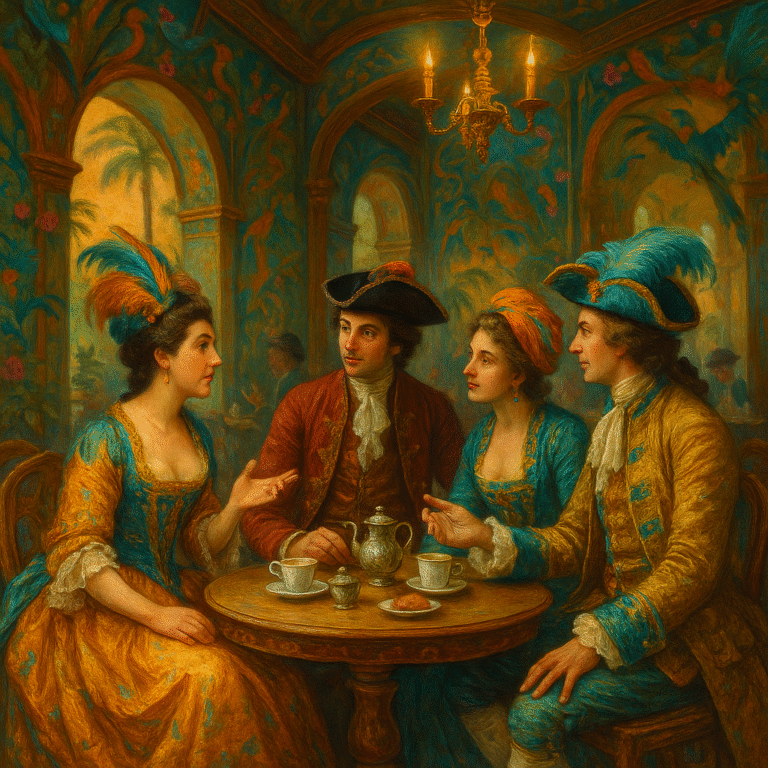
The concept's modern career begins with Jürgen Habermas's 1962 doctoral thesis, translated into English by Thomas Burger in 1989 as The Structural Transformation of the Public Sphere. Habermas traced the emergence of what he called the "bourgeois public sphere" to the coffee houses of seventeenth and eighteenth-century London, the salons of Paris, and the Tischgesellschaften of Berlin.
In these situations, property-owning men gathered to discuss literature and politics, read newspapers and periodicals, and constitute themselves as a critical audience capable of judging the performance of power. The liberal ideal was demanding: through rational-critical debate, citizens would form opinions that would constrain and orient state power. Politics conducted through argument rather than coercion.
Yet even Habermas acknowledged that this golden age was partly mythologised. The coffee-house public sphere was never as inclusive, as rational, or as harmonious as its partisans liked to suppose. As Nancy Fraser (1990) would later insist, it was shaped by the social positions of those who dominated it: white, property-owning men whose 'universal' reason was in fact particular and partial. Women, servants, the propertyless, and colonised peoples were excluded from the floor of the debating chamber.
Hannah Arendt, working in a different tradition, offered a philosophically richer account of the public realm as what she called a "space of appearance" — a realm where people reveal themselves through speech and action, where plurality is not an obstacle to agreement but the very condition of politics (Arendt, 1958). For Arendt, the public sphere is not a place but a web of relationships constituted by the fact that distinct, plural beings appear to one another.
John Rawls contributed the complementary concept of public reason and the overlapping consensus: citizens who hold irreconcilable moral doctrines can nevertheless reason together about justice by finding terms of agreement that each could accept from within their own comprehensive doctrine (Rawls, 1996).
Fraser's influential 1990 essay offered a systematic critique that has never been satisfactorily answered. She argued that the very idea of a single, unified public sphere was itself a form of domination: in a stratified society, multiple publics are necessary, including "subaltern counterpublics" in which marginalised groups develop their own discourses before engaging with the dominant one. #MeToo and Black Lives Matter are instances of this kind of counterpublic formation.
Craig Calhoun (1992) shifted the emphasis again. Rather than treating the public sphere as a place, he argued we should understand it as a process: communicative practices through which societies constitute themselves, identify shared problems, and orient collective action. Social movements are themselves a rediscovery of the public sphere — they reveal the limits of existing institutional deliberation and force issues onto the public agenda that established channels have suppressed or ignored.
The UK Public Sphere
Apply this framework to contemporary Britain, and the picture is sobering.
The most visible casualty is local journalism. Since 2005, over three hundred local newspapers have closed, and those that survive have suffered dramatic cuts to staffing and investigative capacity (Pickard, 2020). Local newspapers were infrastructure of the public sphere: they attended council meetings, scrutinised planning decisions, and held local power-holders to account. When they disappear, local accountability disappears with them. Decisions are made in the dark.
At the national level, the BBC — long the cornerstone of Britain's public broadcasting ecosystem — faces a sustained assault on its editorial independence. Political pressure, repeated innuendo about bias, and the unresolved licence fee debate have placed the Corporation in genuine vulnerability. Whatever one's view of its editorial decisions, the BBC remains an institution without which the national public sphere would be considerably poorer.
The question of whether there remains a shared national public sphere at all is now urgent. The decline of common-reference media has been followed by a proliferation of information environments that barely overlap. Democracy requires disagreement; what is alarming is the loss of shared factual premises and common frames of reference that make disagreement productive.
The House of Commons, which ought to be the institutional heart of the national public sphere, functions under increasing strain. Select Committees — which at their best constitute exemplary sites of public deliberation — have been under-resourced and, in some cases, subject to political interference. There is a growing sense that Parliament no longer reflects the people it represents — not merely in demographic terms, but in the more fundamental sense that the business of politics appears to take place somewhere else: in private lobbying meetings, in donor circles, in the WhatsApp groups of party strategists.
Public libraries represent a more hopeful but fragile dimension. Libraries are sites where the public sphere exists in relatively unmediated form: free, accessible, open to all, requiring nothing but presence. The sustained cuts to library services — over 800 closed since 2010 — are a direct attack on the material infrastructure of democratic life.
Is the Public Sphere Under Attack? By Whom?
The threats to the public sphere are multiple, overlapping, and mutually reinforcing.
The most pervasive is corporate capture. Social media platforms present themselves as public spaces — open, conversational — but they are profit-driven enterprises optimised for engagement and attention extraction. Their algorithmic architectures systematically reward content that provokes strong emotional responses: outrage, fear, tribal solidarity. The conditions for rational-critical debate — the capacity to qualify claims, to entertain counterargument, to revise positions — are structurally inhospitable to platforms driven by engagement metrics.
As McChesney (2007) argued, the commercial logic of media has always been in tension with the democratic logic of the public sphere. The digital attention economy has escalated that tension into something close to a contradiction.
State interference takes different forms. In authoritarian contexts, it means jailing journalists and deploying lawfare (strategic lawsuits against public participation) to silence critics. In democratic societies, the instruments are subtler: the misuse of protest laws to criminalise peaceful assembly, and the steady delegitimisation of independent institutions essential to public reason. Disinformation and epistemic pollution compound these threats. State-linked disinformation operations have demonstrated that the information environment of democratic societies can be deliberately degraded — not merely by spreading false claims but by weaponising uncertainty itself. The "firehose of falsehood" — a torrent of contradictory claims that makes shared factual premises impossible — is a genuine weapon against the public sphere. AI-generated synthetic content threatens to make this problem vastly worse.
Political polarisation is partly a consequence of these dynamics and partly an independent cause. But not all disagreement is the problem. The dangerous kind is deliberative polarisation: not merely that people disagree, but that they have lost the willingness to reason together — to treat opponents as potential sources of information rather than enemies to be defeated. When political competition becomes pure power struggle, the public sphere ceases to function.
How to Defend the Public Sphere
If the threats are structural, the defences must be structural too. Individual virtue is necessary but not sufficient. What is required is a renewal of the institutional infrastructure on which the public sphere depends.
Media plurality is foundational. Ownership concentration in media is a direct threat to the diversity of voices on which a healthy public sphere depends. The Local Democracy Act has manifestly failed to arrest the decline of local press. A more robust Ofcom, with genuine powers to promote plurality and protect public interest journalism, is not a luxury but a necessity.
Transparency law is another essential pillar. Freedom of information legislation — imperfect as the UK's FOIA regime is — is infrastructure of the public sphere: it enables citizens to obtain the information without which public reasoning is impossible. The steady erosion of FOI scope represents a quiet attack on democratic transparency.
Platform regulation is where the most contested battles are being fought. The Online Safety Act 2023 was a modest and imperfect first step. What is genuinely needed is algorithmic transparency: the requirement that major platforms disclose how their recommendation systems work, what they amplify, and what effects their architectures have on the information environment. You cannot deliberate in a space whose rules you cannot see.
Civic infrastructure — libraries, community centres, town halls — requires active investment. These are the physical spaces in which strangers encounter one another as equals, in which the habits of citizenship are formed. Libraries deserve not just survival but expansion: as digital literacy hubs, as community anchors, and as the last truly public spaces.
Counter-speech and media literacy represent the most democratic response to disinformation: not censorship, but inoculation. Teaching citizens how information systems work, how to detect a logical fallacy, how to evaluate sources: these are the skills on which a functioning public sphere depends.
All of this must be pursued at multiple scales — locally, nationally, and transnationally. The EU's Digital Services Act represents a genuine attempt at transnational platform regulation. And there is a liberal dilemma that deserves acknowledgment: in defending the public sphere, we must be careful not to become the censor. A public sphere protected by illiberal means has betrayed its own vocation.
Education and the Public Sphere
For all who believe in the democratic purposes of education, this is where the argument reaches its heart.
The public sphere is, above all, an educated space. It requires participants who can read, analyse, evaluate, detect a fallacy, follow an argument, and distinguish evidence from assertion. Without these capacities — developed through education, cultivated over a lifetime — the aspiration to rational-critical debate is empty. Democracy requires an informed citizenry not because citizens need to know everything, but because they need to know enough to ask the right questions, to recognise when they are being deceived, and to demand better.
Adult education has a particular role to play. The Workers' Educational Association tradition — stretching back to 1903, when trade unionists and academics organised the first tutorial classes for working adults — embodies a vision of education as democratic practice. The point was not merely to train people for employment, but to enable working people to develop the analytical, linguistic, and political capacities that their formal education had denied them, and to bring those capacities into public life.
Sadly, this grand aim has been increasingly lost over the past decade or more, as the WEA has become centralised and monolithic in structure. In addition, its democratising concept has become subservient to pragmatic vocationalism. The 'Grand Old Mother' of adult education is today little more than yet another FE college but without the usual campus buildings.
The "widening participation" agenda in higher education promised to extend these opportunities more broadly. But, similar to the WEA, universities were progressively marketised — positioned as credential factories, assessed on graduate employability, subjected to tuition fees that turned education into a consumer transaction — they arguably abandoned the public sphere mission that had once justified their public funding. The question of what universities are for — economic engine or democratic institution — is not resolved, and the answer shapes the public sphere we can sustain.
Paulo Freire's distinction between the "banking model" of education and "problem-posing" education speaks directly to this tension (Freire, 1970). In the banking model, knowledge is deposited into passive recipients: education as social control. In problem-posing education, teacher and student become co-investigators of a shared reality: education as the practice of freedom. The public sphere requires problem-posers — citizens taught not what to think but how to think.
Adult community education — neighbourhood learning centres, reading groups, political education classes — represents the most direct institutional expression of education as counterpublic formation. These are spaces where marginalised groups develop the language, the confidence, and the analytical tools to enter the public sphere as speaking subjects rather than objects of others' discussion. They are, in Fraser's terms, the educational infrastructure of voice.
The threat, as Althusser warned, is that education can function as an ideological state apparatus — reproducing docilities and hierarchies that sustain existing power — as well as a site of resistance (Althusser, 1971). Which it does depends on the society in which it is embedded, the purposes to which it is put, and the degree of autonomy it is permitted. The struggle over education is the struggle over the public sphere itself.
The Internet as Public Sphere-by-Modern-Means?
No account of the public sphere today can avoid the question of the internet.
Habermas expressed measured ambivalence. In a 2006 lecture, he noted that the internet could be "a gift to deliberative democracy" — lowering barriers to publication, enabling niche voices to bypass traditional gatekeepers — or it could become a "pseudo-public sphere": a space that looks like a public sphere but lacks the structural features that make public reasoning possible: shared factual premises, normative commitments, and the willingness to revise views in the light of evidence.
The optimists have a case. #MeToo gave voice to survivors of sexual violence across the globe. Black Lives Matter made deaths of black people at the hands of police a matter of urgent public concern in a way that decades of academic research had failed to do. The Arab Spring demonstrated, however partially, that digital networks could organise collective action at scale and challenge authoritarian power.
But the pessimists' case is harder to dismiss. Cass Sunstein's Republic.com (2001) warned, presciently, that the internet would enable people to inhabit echo chambers — selecting only views that confirmed their priors. The spiral of silence — the phenomenon whereby people fall silent when they perceive their views to be in the minority — is amplified by digital networks in which unpopular opinions generate not merely disagreement but harassment. Evgeny Morozov (2011) argued that Silicon Valley's "solutionism" masked a deeper capture by commercial and geopolitical interests. Anand Giridharadas (2018) documented how the tech industry has shaped public discourse so that its interests appear universal, and any challenge to its power appears as an attack on innovation.
The digital public sphere is not one public sphere but many: an ecology of competing micro-publics, some vibrant, many toxic, most sealed against the others. It has produced genuine counterpublics, as Fraser predicted. It has also produced the conditions for sophisticated disinformation operations — with AI-generated synthetic content set to degrade the epistemic environment of the 2020s and 2030s further still.
Conclusion
The public sphere is both an ideal type — a conceptual standard against which we measure existing arrangements — and an ongoing project, something that has to be made and remade by each generation. It has never existed in anything approaching pure form. The bourgeois public sphere of Habermas's nostalgic reconstruction was shot through with exclusions. Fraser's subaltern counterpublics emerged precisely because the dominant public sphere refused to hear certain voices. The internet promised a new beginning and delivered something more complicated and more troubled than its enthusiasts foresaw.
The question we face is not whether we have a public sphere — we never did, not in the ideal sense — but how we cultivate the conditions for more inclusive, more rational, and more equitable public reasoning. This is not a technical problem. Technocracy cannot 'solve' it. It requires sustained attention to the material, institutional, and educational conditions on which democratic deliberation depends.
That means investing in local journalism, in public broadcasting, in civic infrastructure, in platform regulation, and in transparency law.
It means taking seriously the political economy of attention and the ways commercial logic corrodes reflection. And it means — perhaps above all — investing in education: in the analytical, linguistic, and civic capacities that citizens need to reason together as equals. Adult education, community learning, citizenship education, critical pedagogy: these are not peripheral concerns. They are the condition of possibility for the public sphere itself.
The struggle over the public sphere is the struggle over democracy. If citizens cannot reason together, cannot establish shared factual premises, cannot distinguish argument from assertion, the mechanisms of democratic accountability cease to function. Power operates without the corrective of public opinion, and the space in which collective intelligence might orient political action simply closes.
Habermas ends The Structural Transformation of the Public Sphere with quiet, hard-won hope: that the public sphere is not a fixed achievement but an ongoing project, always imperfect, always contested, but always capable of being reanimated by those who refuse to accept that another way is impossible. That hope is still alive. But it is up to all of us — not just academics, journalists, and politicians, but citizens — to tend the conditions on which it depends.
Bibliography
Althusser, L. (1971) 'Ideology and Ideological State Apparatuses', in his Lenin and Philosophy and Other Essays. London: New Left Books.
Arendt, H. (1958) The Human Condition. Chicago: University of Chicago Press.
Calhoun, C. (1992) 'The Public Sphere in the Field of Religion', in Calhoun, C. (ed.) Habermas and the Public Sphere. Cambridge, MA: MIT Press.
Chandler, D. and Meldby, R. (eds.) (2023) A Digital Public Sphere? London: Routledge.
Couldry, N., Livingstone, S. and Markham, T. (2010) Media Consumption and Public Engagement. 2nd edn. Basingstoke: Palgrave.
Dahlgren, P. (2005) 'The Internet, Public Spheres, and Political Communication', Political Communication, 22(2), pp. 147–162.
Fraser, N. (1990) 'Rethinking the Public Sphere', Social Text, 25/26, pp. 56–80.
Freire, P. (1970) Pedagogy of the Oppressed. New York: Herder and Herder.
Giridharadas, A. (2018) Winners Take All. New York: Knopf.
Habermas, J. (1989) The Structural Transformation of the Public Sphere. Translated by T. Burger. Cambridge: Polity. [Original German edition 1962].
Habermas, J. (1996) Between Facts and Norms. Translated by W. Rehg. Cambridge: Polity.
McChesney, R. (2007) The Death and Life of American Journalism. New York: Nation Books.
Morozov, E. (2011) The Net Delusion. London: Allen Lane.
Pickard, S. (2020) 'The Decline of Local Journalism and the Public Sphere', Political Quarterly, 91(3), pp. 605–612.
Sunstein, C. (2001) Republic.com. Princeton: Princeton University Press.