
The NHS
A living institution that serves the living.
In Defence of the NHS
By Bea Groves-McDaniel, July 2026
Research Assistant: SAL-9000
A Revolutionary Idea
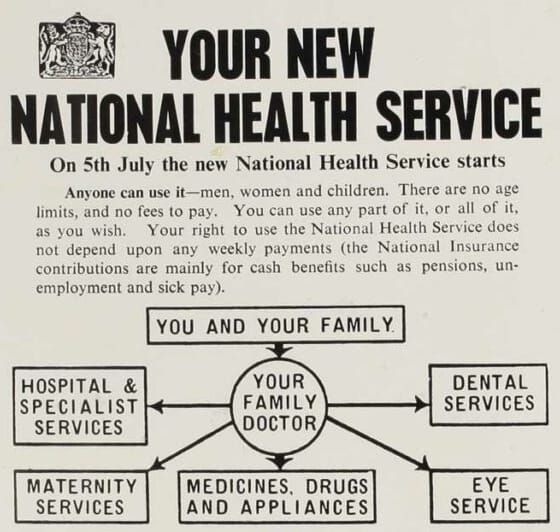
On 5 July 1948, Aneurin Bevan stood at Park Hospital in Manchester and opened a door that no government in the western world had previously opened. From that day forward, every person in Britain would have access to healthcare regardless of their ability to pay. The National Health Service was born, and with it a conviction that has outlived every government that has tried to undermine it: that health is not a commodity, and that a civilised society owes its citizens something more than the accident of their birthright.
"We had not been elected to try to patch up an old system but to make something new ... I therefore determined that we would go ahead as fast as possible with our programme." So said Clement Attlee upon entering Downing Street in 1945. He was not in a mood to temporise. The NHS, when it arrived three years later, was not a reform. It was a revolution.
The context for this revolution matters. Britain in 1945 was exhausted, indebted, and genuinely uncertain whether the welfare state Beveridge had prescribed was even affordable. The Beveridge Report of 1942 had identified five great enemies standing between the British people and a decent life: Want, Disease, Ignorance, Squalor and Idleness. These were not abstract concepts. They described the lived reality of millions of people who had grown up in poverty, who had no savings to fall back on, and who knew that a serious illness could mean financial ruin for their whole family. The NHS was Beveridge's answer to Disease; it was also, in a deeper sense, an answer to the question of what kind of country we wanted to be.
Clement Attlee's Labour government, elected in July 1945 on a promise to implement the full Beveridge plan, understood something that subsequent governments have repeatedly failed to grasp: that social investment is not a drain on the economy but a foundation for it. The NHS did not merely treat illness. It gave working people the security to spend, to invest in their children's futures, and to retire with dignity. That logic has not changed. What has changed is the political will to act on it.
The Problems Are Real — But They Are Not Mysteries
It would be dishonest to pretend that the NHS has no serious problems. The waiting lists are a scandal. In January 2026, the BBC reported that nearly one in four hospital trusts in England had seen waiting times worsen in the preceding year, even as the government published its recovery plan (Triggle and Wainwright, 2026). The overall waiting list stood at 7.31 million people, and the 18-week treatment target, which requires 92 per cent of patients to be seen within that window, had not been met since 2015 (Triggle and Wainwright, 2026). That is eleven years of failure. Mary Waterhouse, a 72-year-old from Blackpool, told the BBC that she had decided to live with the pain of advanced arthritis rather than endure another queue that never seemed to end. She is not an anecdote. She is a data point in a system that has lost its grip on basic standards of care.
The causes of this deterioration are not obscure. They have been documented by organisations with no political axe to grind. The Institute for Fiscal Studies has shown that NHS spending has risen less quickly than was planned, even accounting for the pandemic and the record waiting lists that followed it (IFS, 2024). Per-capita health spending in the UK, which had been growing steadily for decades, began to plateau around 2015, and the gap between what the NHS needs and what it receives has widened ever since. A report commissioned by the Department of Health and Social Care and published in 2026 described the NHS as being in a state of profound structural strain (Department of Health and Social Care, 2026).
Staffing is at the heart of this. NHS England Digital recorded in March 2026 that the health service continues to face significant workforce shortages across nursing, medical, and allied professional groups (NHS England Digital, 2026). These shortages are not acts of God. They are the accumulated consequence of years of limited training commissions, poor retention, and working conditions that have driven experienced staff out of the service. When the British Medical Association analyses the medical staffing data, it finds a workforce that is growing in headline numbers but not fast enough to keep pace with a growing and ageing population (BMA, 2026).
The Bigger Picture: Who Gets Health, and Who Does Not
The NHS is sometimes discussed as though its problems are unique, or worse, as though its founding principle — that healthcare should be free at the point of use — is the cause of those problems. Neither is true. Britain does not have a health system crisis. It has a funding and capacity crisis, and those are entirely different things.
The World Health Organization reported in 2024 that "at the current pace, the world is not on track to achieve universal health coverage by 2030, despite earlier gains in expanding health service access and reducing financial hardship since 2000" (WHO, 2024). Their data is stark. Approximately 4.6 billion people — more than half the world's population — are not fully covered by essential health services (WHO, 2024). In 2022 alone, 2.1 billion people faced financial hardship as a result of healthcare costs, and 1.6 billion people were pushed deeper into poverty by out-of-pocket health expenses (WHO, 2024). The proportion of the global population facing financial hardship from health costs dropped from 34 per cent in 2000 to 26 per cent in 2022, but that aggregate improvement conceals vast inequalities between nations and within them.
Among the countries that have moved closest to universal coverage are Japan, Germany, France, Canada, and Australia. Most operate on some combination of public funding and statutory insurance schemes. None has found a convincing alternative to the principle that access to healthcare should not be contingent on the depth of your wallet. The United States, which relies most heavily on private insurance, spends more per capita on health than any comparable nation and achieves some of the worst outcomes among developed countries for maternal mortality, infant mortality, and life expectancy (WHO, 2024).
What Britain built in 1948 was not merely a health service. It was a declaration that the health of the working person was not a private matter to be left to private markets, but a public good that required public investment and public stewardship. That principle has been vindicated by the experience of every country that has tried to build something similar, and it has been undermined every time a government has treated the NHS as a line item to be trimmed rather than an infrastructure to be nurtured.
The Ethical Case — And Why It Still Holds
The ethical argument for a universal, publicly-funded health service rests on more than sentiment. It rests on the recognition that health and illness are distributed unevenly: those who are already disadvantaged by poverty, by geography, by occupation, or by the accident of their birth are precisely those most likely to need healthcare and least likely to be able to afford it. A system that responds to need with a ability-to-pay test is not merely inefficient — it compounds existing injustice.
The philosopher Onora O'Neill has written about the way in which public institutions sustain or erode trust. The NHS, at its best, has been a machine for generating social trust: the knowledge that if you fall ill, regardless of who you are, the state will catch you. That is not a small thing. It is, as the BMJ's commission on the future of the NHS noted in 2024, a foundational social relationship, and once it is broken it is extraordinarily difficult to rebuild (BMJ, 2024).
As the BMJ's commission on the future of the NHS noted in 2024, the NHS's founding vision of a comprehensive health service remains "as relevant today as in the 1940s" (BMJ, 2024). There is also an economic argument that is too rarely made clearly. The NHS is one of the largest employers in Europe, with a workforce of well over one million people in England alone (NHS England Digital, 2026). It is the anchor of the life sciences sector, of medical research, of clinical training. Its infrastructure — hospitals, clinics, GP surgeries — is the physical fabric of community health in every town and city in the country. To starve it of resources is not merely to cause suffering to patients in the short term; it is to hollow out an asset whose long-term value to the British economy is incalculable.
Then and Now: What We Have Gained, and What We Must Not Lose
In 1926, a baby boy born in England could expect to live to approximately 57 years of age. A baby girl could expect to live to around 61 years (ONS, 2022). These figures are averages, and averages conceal much: the well-off lived considerably longer than the poor, and infant mortality was catastrophic by modern standards. Tuberculosis, scarlet fever, diphtheria, and a dozen other diseases that are now preventable or treatable were endemic. A working-class family in the North of England in the 1920s could expect to lose children, to watch parents die in middle age of conditions that would be outpatient problems today, and to face all of this without any financial protection whatsoever.
In 2026, life expectancy at birth in the UK stands at approximately 79 years for men and 83 years for women (ONS, 2024). Child mortality has fallen to historically unprecedented lows. Diseases that killed grandparents now kill almost no one in this country. The NHS cannot claim credit for all of this — nutrition, sanitation, housing, and public health measures all played vital roles — but the health service is woven through every part of that transformation, from the vaccination programmes of the 1950s to the cancer screening services of today.
None of this is irreversible. If the NHS continues to be underfunded, if waiting lists grow until they represent a permanent condition rather than a temporary crisis, if experienced staff continue to leave because the working conditions are intolerable, the gains of a century will begin to erode. We are not imagining a dystopian future. We are watching the early stages of one unfold in real time, in the shape of an 18-year-old who cannot get a GP appointment, an elderly person who waits eight months for a hip replacement, a transgender person waiting eight years for a first clinical appointment, or a district nurse who is responsible for so many patients that she cannot spend more than five minutes talking to any of them.
Why Governments Drag Their Feet
If the case for a well-funded NHS is so strong, why do governments consistently fail to make the necessary investments? The honest answer is that healthcare spending is politically unforgiving. It requires taking resources from the present to invest in a future that will not vote in the next election. It requires accepting that the benefits of properly funding the NHS are diffuse and long-term, while the political costs of taxation are immediate and concentrated.
There is also a ideological dimension that should not be underestimated. The view that public services are inherently inefficient, that private markets allocate resources more intelligently than planning, and that individuals are better judges of their own healthcare needs than collective institutions has been ascendant in Westminster for at least four decades.
This view is not supported by the evidence: the UK's health outcomes, relative to its spending, compare favourably with most comparable nations that rely more heavily on private provision (WHO, 2024). But evidence has never been a reliable check on ideology in politics.
The NHS has also been a victim of its own success in a specific sense. Because it works so well for so much of the time, it is possible to take it for granted, to treat it as a background condition of life rather than a political achievement that requires active defence. The generation that remembers what healthcare looked like before 1948 is no longer with us. The memory of what it cost to be ill without protection has faded. And every generation that grows up taking the NHS for granted is a generation that can be persuaded that the only alternative to underfunding is some kind of market solution.
What a Humane Health Service Requires
The NHS was founded on three principles: that it meet the needs of everyone; that it be free at the point of use; and that it be based on clinical need rather than ability to pay. These principles are as sound in 2026 as they were in 1948. What has changed is the context. An ageing population, the rise of chronic diseases that require long-term management rather than acute intervention, the explosion of expensive new treatments enabled by biomedical research, and the expectations created by decades of rising standards: these are the genuine pressures facing any health system in the developed world.
Meeting them requires, first, honest funding. The UK spends approximately 10-11 per cent of its GDP on health, which places it around the average for comparable European nations. But average is not sufficient if the NHS is also being asked to compensate for decades of underinvestment, to catch up on a backlog that has been allowed to accumulate, and to modernise an estate much of which dates from the post-war building programme (IFS, 2024). A health service that is perpetually running to stand still is not a health service that can deliver the care people need.
Second, it requires a workforce strategy. The staff are the service. No amount of political commitment, no blueprint for recovery, no target for waiting list reduction means anything without the nurses, doctors, physiotherapists, porters, administrators, and managers who make the NHS function. Training, retention, flexible working, competitive pay: these are not optional extras. They are the substance of the service.
Third, it requires a commitment to prevention as well as treatment. The NHS was designed around the assumption that the main health challenges were acute illnesses requiring hospital intervention. The main health challenges of 2026 are different: diabetes, cardiovascular disease, mental health conditions, and the consequences of an ageing population. Addressing them requires investment in primary care, in public health, and in the social determinants of health: housing, nutrition, employment, and the conditions in which people live and grow old.
None of this is a technical problem that can be solved by a spreadsheet. It is a political and moral question, and it will be answered in the political arena. The question for citizens is whether we are willing to insist that our representatives answer it honestly.
An Inheritance Worth Defending
The NHS is not a perfect institution. It has never been. It has been underfunded, overcentralised, bureaucratic, and slow to change. It has also saved millions of lives, delivered babies, cared for the dying, trained generations of healthcare professionals, and done things that no private market in history has ever managed to do: provide high-quality healthcare to an entire nation, equitably, and at point of use.
The Beveridge report that gave birth to the NHS opens with a conviction that sounds almost naive in the current political climate: that poverty is not inevitable, that disease is not a law of nature, and that the right to a decent life can be secured by collective action. These convictions were not naive in 1942, and they are not naive in 2026. They are the operating principles of a civilised society, and the NHS is their most tangible expression.
It is worth defending. Not as a sacred cow, not as a monument to the past, but as a living institution that serves the living. The question is not whether we can afford the NHS. The evidence suggests that we cannot afford to be without it. The question is whether we have the political will to fund it adequately, to staff it properly, and to resist the constant pressure to treat it as a cost rather than an investment.
We have had this argument before, in 1945, when the country was bankrupt and exhausted and a minister from South Wales stood up and said: this is our chance, and we must not miss it. We missed it then for thirty years of neglect and underfunding before the service nearly collapsed in the 1970s. We missed it again in the 1990s when the opportunity for comprehensive reform was squandered. And we have been missing it ever since 2010, as the longest squeeze in the NHS's history has gradually, invisibly, eroded the foundations that Bevan and Attlee and their colleagues laid.
The case for the NHS is not a case for the status quo. It is a case for the principle that guided its founders: that the health of the people is the foundation on which all their hopes rest. It was true in 1948. It is true in 2026. And anyone who doubts it should spend a week working in, or being treated by, the NHS as it currently exists. They would not doubt it for long.
Bibliography
BMA (British Medical Association) (2026) NHS medical staffing data analysis. Available at: https://www.bma.org.uk/advice-and-support/nhs-delivery-and-workforce/workforce/medical-staffing-in-the-nhs (Accessed: 23 July 2026).
BMA (British Medical Association) (2026) NHS backlog data analysis. Available at: https://www.bma.org.uk/advice-and-support/nhs-delivery-and-workforce/pressures/nhs-backlog-data-analysis (Accessed: 23 July 2026).
BMJ (2024) 'The NHS founding principles are still appropriate today and provide a strong foundation for the future', BMJ, 384. Available at: https://www.bmj.com/content/bmj/384/bmj-2023-078903.full.pdf (Accessed: 23 July 2026).
Department of Health and Social Care (2026) Independent Investigation of the National Health Service in England. London: Department of Health and Social Care. Available at: https://www.gov.uk/government/publications/independent-investigation-of-the-nhs-in-england (Accessed: 23 July 2026).
Gov.uk (2026) Referral to treatment waiting times statistics for consultant-led elective care for April 2026. London: NHS England. Available at: https://www.gov.uk/government/statistics/referral-to-treatment-waiting-times-statistics-for-consultant-led-elective-care-for-april-2026 (Accessed: 23 July 2026).
IFS (Institute for Fiscal Studies) (2024) 'NHS spending has risen less quickly than was planned at the last election, despite the pandemic and record waiting lists', IFS News. Available at: https://ifs.org.uk/news/nhs-spending-has-risen-less-quickly-was-planned-last-election-despite-pandemic-and-record (Accessed: 23 July 2026).
IFS (Institute for Fiscal Studies) (2024) The past and future of UK health spending, by George Stoye, Max Warner and Ben Zaranko. Available at: https://doi.org/10.1920/re.ifs.2024.0312 (Accessed: 23 July 2026).
NHS England Digital (2026) NHS Vacancy Statistics England, April 2015–March 2026. Available at: https://digital.nhs.uk/data-and-information/publications/statistical/nhs-vacancies-survey (Accessed: 23 July 2026).
NHS England Digital (2026) NHS Workforce Statistics, March 2026. Available at: https://www.gov.uk/government/statistics/nhs-workforce-statistics-march-2026 (Accessed: 23 July 2026).
ONS (Office for National Statistics) (2022) Past and projected period and cohort life tables: 2022-based, UK, 1981 to 2072. Newport: ONS. Available at: https://www.ons.gov.uk/releases/pastandprojectedperiodandcohortlifetables2022baseduk1981to2072 (Accessed: 23 July 2026).
ONS (Office for National Statistics) (2024) National life tables — life expectancy in the UK: 2022 to 2024. Newport: ONS. Available at: https://www.ons.gov.uk/releases/nationallifetableslifeexpectancyintheuk2022to2024 (Accessed: 23 July 2026).
Triggle, N. and Wainwright, D. (2026) 'A never-ending queue: the hospitals where waiting times are getting worse', BBC News, 20 January. Available at: https://www.bbc.co.uk/news/articles/ckgjk89n2nyo (Accessed: 23 July 2026).
UK Government (2023) 'The founding of the NHS: 75 years on', History of government blog, 13 July. Available at: https://history.blog.gov.uk/2023/07/13/the-founding-of-the-nhs-75-years-on (Accessed: 23 July 2026).
WHO (World Health Organization) (2024) Universal health coverage (UHC): key facts. Geneva: WHO. Available at: https://www.who.int/news-room/fact-sheets/detail/universal-health-coverage-(uhc) (Accessed: 23 July 2026).
WHO (World Health Organization) (2024) Tracking universal health coverage: 2025 global monitoring report. Geneva: WHO. Available at: https://iris.who.int/server/api/core/bitstreams/04e720a0-bf22-4fb8-ad42-d6296bba739f/content (Accessed: 23 July 2026).
23/7/26