The Map Is Not the Territory
Alfred Habdank Skarbek Korzybski (1879-1950) was a Polish-American philosopher and engineer who founded the discipline of General Semantics.
Gender, Semantics, and the Limits of Conceptual Mapping
by Bea Groves-McDaniel
August 12th 2026
I have always been a little suspicious of people who claim to have found their way into philosophy through some grand epiphany — a blinding light on the road to Damascus, or a sudden conversion to the mysteries of Husserl over a weekend retreat. My own route into philosophy was more like a slow detour. It happened sideways, accidentally, and largely because I kept running into questions that the subject I was actually teaching could not answer.
I was teaching musicology. And every so often, in the middle of a session on harmonic theory or the development of the symphonic form, someone would ask the question that was guaranteed to derail everything: is music a universal language? I came to dread it. Not because it was a bad question (it was, in fact, a rather good one) but because the honest answer was so much more complicated than the people asking it wanted to hear.
No. Music is not a universal language. And the reason why not takes you very quickly into Sapir and Whorf, into Wittgenstein's language games, into the semantics of Alfred Korzybski, and from there (via a degree in education that required me to think seriously about how meaning is constructed and communicated) into philosophy proper. I got a First. I like to think it was the philosophy.
I mention this because the intellectual toolkit I assembled along that sideways route has turned out to be unexpectedly useful in thinking about one of the most contested areas of contemporary public discourse: gender. In particular, a concept from Korzybski (one of the most unjustly neglected figures in twentieth-century thought) offers a way of understanding what gender is, what it can do, and where it goes badly wrong when we treat it as more than it is.
The Map and the Territory
Alfred Habdank Skarbek Korzybski (1879-1950) was a Polish-American philosopher and engineer who founded the discipline of General Semantics — an inquiry into how we construct meaning, how we relate symbols to the world they represent, and how we go wrong when we confuse the two. He is best known for a single, pithy formulation: the map is not the territory. It sounds obvious when you first hear it. It is not obvious at all.
What Korzybski meant is this. A map is a representation of a territory. It is constructed for a purpose — to navigate, to measure, to understand the relationship between different parts of a landscape. It does this job brilliantly. But it achieves this by leaving things out, by selecting, by projecting, by distorting. No map of Great Britain is actually Great Britain. It cannot be. A perfectly accurate, perfectly complete map would be the territory itself and would be no more useful than the territory. Which is to say, not very useful at all.
This is not a flaw in maps. It is their nature. A map that showed every blade of grass in Leazes Park would be botanically accurate and completely useless for navigation. The selection and distortion that make a map useful are also what make it incomplete. The map is always, necessarily, a partial representation. And the danger — the mistake that Korzybski spent his career warning us about — is when we forget this. When we mistake the map for the territory. When we start to believe that the selection of features shown on the map corresponds exactly to the features that exist in the world.
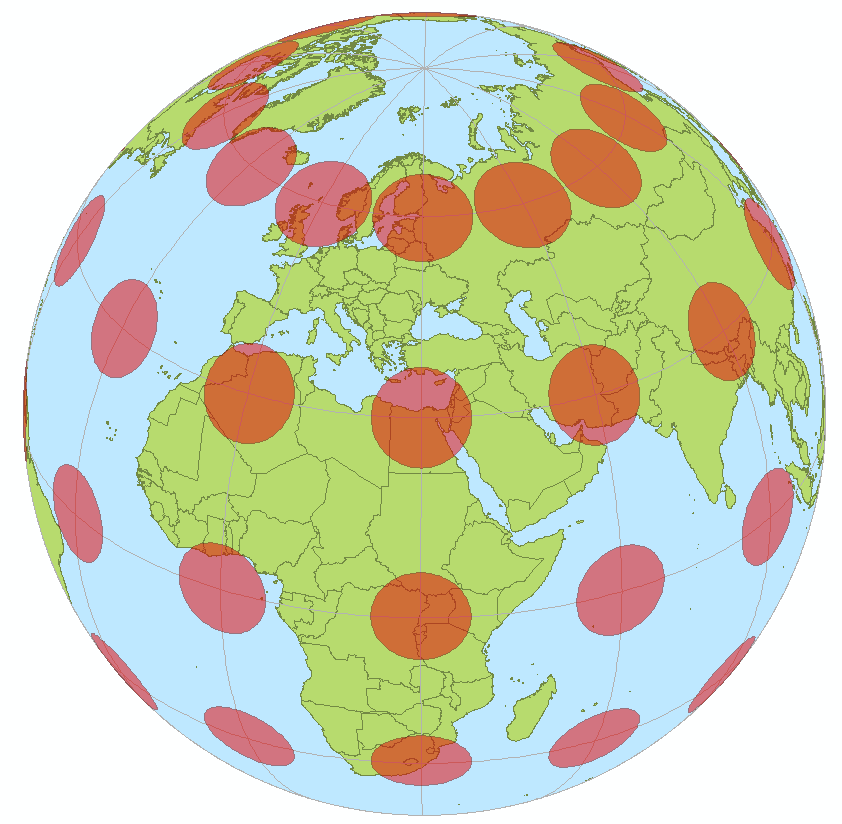
This is best illustrated with a striking example drawn from cartography. Suppose you take a globe of the Earth (a near-perfect spherical representation of the actual territory) and you inscribe identical red circles at regular intervals across its surface. From space, or (more flippantly) from the perspective of eternity (sub specie aeternitatis), those circles would appear identical in size. Now project that globe onto a flat surface using the Mercator projection — the most familiar map type, the one Google Maps still uses as its default. The circles near the equator remain roughly circular. The circles near the poles stretch and distort. They get bigger. On the Mercator map Greenland appears roughly the same size as Africa. It is not. The map has taken a territory in which all regions are equivalent and created a representation in which they are not.
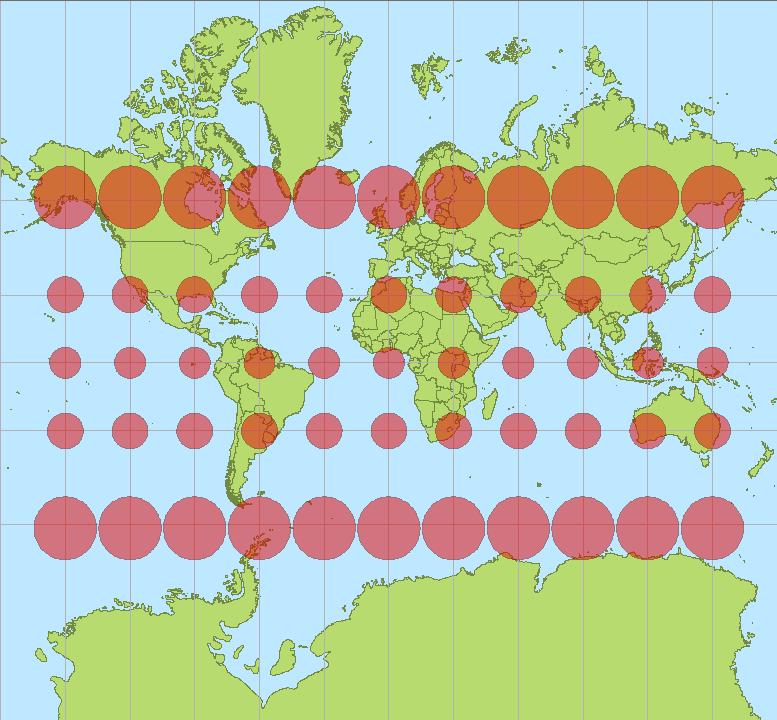
This distortion is not random. It is systematic. It follows a rule (the mathematical properties of the Mercator projection) that serves a particular purpose (preserving the angles that make navigation possible) while making other things worse (preserving area and distance, which it does not). Every map distorts in the service of some purposes at the expense of others. The distortion is not evidence of bad faith. It is structural.
Korzybski called our tendency to confuse the map with the territory identification — and he argued that it was the source of most of our most persistent and damaging errors in thinking.
Gender as Semantic Map
This is where it gets interesting. And where Korzybski's insight becomes genuinely useful for thinking about gender.
Gender, in the contemporary sense of the term, is a conceptual framework. It is a set of categories, assumptions, norms, and expectations that we use to organise and make sense of human experience. It maps certain features of human existence:
- the social roles historically associated with biological sex,
- the patterns of expectation and behaviour that societies have constructed around maleness and femaleness,
- the relationships of power and expectation that structure how people relate to each other as gendered beings.
It does its job well. It illuminates certain features of the human landscape with great clarity.
But it is a map. And like all maps, it selects, projects, and distorts. It cannot be isomorphic with the territory — with what it is actually like to be a human being, to move through the world, to experience consciousness from the inside. The territory of human existence is immeasurably more complex, more varied, and more strange than any gender framework can capture.
Consider what the gender map leaves out. It leaves out the experience of people whose gender identity does not map neatly onto the male/female binary. It leaves out the experience of people whose relationship to their own embodiment does not correspond to the norms their culture assigns to their assumed gender. It leaves out the full spectrum of human sexuality, desire, and attachment. It leaves out (and this is the crucial point) the interiority of the person, the what-it-is-like to be that person in that body in that society at that moment. The map of gender is drawn from the outside. It cannot see from the inside.
And yet — and here is where the confusion sets in — we consistently treat the gender map as if it were the territory. We behave as if the categories man and woman corresponded precisely to two coherent, mutually exclusive, internally homogeneous types of human beings. We treat the map's features as if they were features of the territory. We look at a red circle near the pole on the Mercator projection and say: that circle is large. It is not large. The projection made it appear large. The territory does not contain the distortion.
This is the root of a great deal of confusion in contemporary gender discourse. On all sides.
What the Map Cannot Capture
Let me try to make this concrete, because the argument can sound abstract in a way that conceals its practical force.
When a trans person describes their experience of gender (the profound mismatch between the gender they were assigned at birth and the gender they know themselves to be), they are reporting something about the territory of human experience that the existing gender map cannot adequately represent. They are saying: the circle near the pole appears large on this projection, but I have seen it from outside the projection, and I know it is the same size as all the others. The gender map, as most people have learned to read it, does not have a category for what they are. Or rather, it has a category — but the category distorts rather than illuminates.
This is not a new observation. It is precisely what trans people have been saying, in various ways, for as long as the language has existed to say it. But it becomes clearer when we apply Korzybski's framework. The trans person's critique of the gender map is not an attack on the idea of mapping altogether. It is a request for a better map. one that distorts less, that represents more of the territory, that does not impose its distortions on people who do not fit neatly onto its projection.
The response from those who resist this request is, often, to insist that the existing map is the territory. That there are only two genders because the map only has two circles. That to add new circles, or to redraw the projection, is not a correction of distortion but an act of destruction. An attack on the territory itself. This response is, in Korzybski's terms, a category error of the first order. It mistakes the map for the world. It treats the projection as if it were the thing projected.
But the same error is committed on the other side too. When gender theory sometimes behaves as if the gender map were not merely a map (a useful but necessarily partial representation), but the territory itself, when it treats the categories of gender analysis as if they were ontologically fundamental rather than historically contingent tools, it falls into the same identification that Korzybski warned against. The map becomes the territory in both directions.
The Limits of the Analogy
No analogy runs perfectly, and I should say where this one reaches its limits — because intellectual honesty matters more than rhetorical elegance.
The first limitation is that gender is not a neutral cartographic project. Maps of the physical world are constructed for purposes of navigation, and while different projections serve different purposes, the territory itself does not care which projection you use. Gender maps are different. They are constructed within relations of power. They have historically served (and continue to serve) to legitimise the subordination of women by men, to exclude people who do not fit the projected categories, and to naturalise hierarchies that are in fact social productions. The distortions in the gender map are not random; they are systematic in ways that benefit some people and harm others. A critical approach to gender as semantic mapping has to be alert to this.
The second limitation is that the territory itself — human existence, phenomenal consciousness, the interior life — is not simply 'there' independent of the maps we use to understand it. Wittgenstein's later work is useful here: meaning is not a private interior state that language then expresses from the outside. Meaning is constituted in part by the language games, the forms of life, and the social practices within which we are embedded. The territory and the map are not entirely independent of each other. We do not simply discover the territory and then draw maps of it. We partly constitute the territory through the maps we use. This does not make the map/territory distinction useless; it makes it more complicated.
Conclusion: Living with Maps
What follows from all this? Not very much, in one sense. And everything, in another.
In one sense: the map is obviously not the territory. This means that gender (however we choose to conceptualise it) is a tool for navigating certain dimensions of human experience, not a description of the whole of human existence. It illuminates some things and obscures others. It distorts in the service of some purposes and at the cost of others. Treating it as more than this — as a perfect representation, as an isomorphic account of what it is to be a particular kind of person — produces the confusion and the harm that we see in contemporary gender discourse.
In another sense: we definitely need maps. We cannot navigate without them. The demand for a gender framework that is perfectly neutral, that distorts nothing, that represents everyone equally well, is a demand for something that cannot exist. All maps distort. The question is not how to eliminate distortion — it is how to choose projections that distort the right things for the right purposes, and how to remain aware, at every moment, that we are navigating by representations rather than by direct sight of the territory.
Korzybski used to say that the most dangerous two words in the English language are is and not. When we say gender is this or gender is not that, we are applying the verb of identity to a conceptual framework that cannot support the weight of simple declarative statements. The map is not the territory.
Gender is not the territory of human being. It is a map — useful, necessary, and necessarily incomplete.
The sooner we all learn to live with that incompleteness, with humility about what our conceptual frameworks can and cannot do, the better.
by Bea Groves-McDaniel
Research Assistant: SAL-9000
August 12th 2026
This article was based on an original Facebook post, which can be found HERE.