
The Fourth Day
I do not run. I stand among them and I let them look. I have learned that this is what is expected. The miracle is not the raising. The miracle is the return. The miracle is that I stand here, breathing, and they can see it with their own eyes.
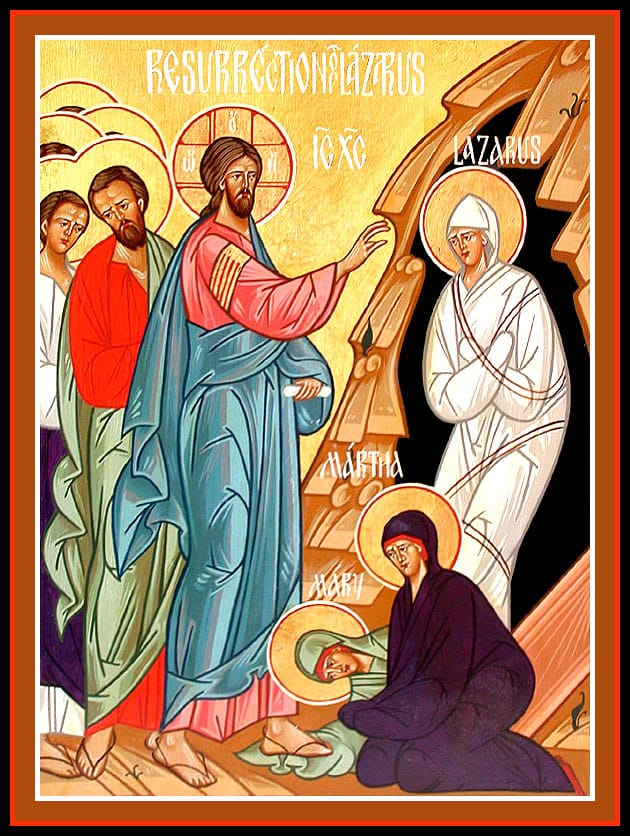
The Fourth Day
I remember the smell first. That is what stays with me still — the smell of the tomb.
There is a moment, near the end, when the breath slows and the body begins its long farewell. I remember Martha holding my hand. She was weeping, but quietly, the way we weep when we have wept so long the tears themselves are tired. Mary stood by the door. I could see her in the light from the courtyard, a dark shape against the brightness. I wanted to speak but the words had gone somewhere I could not follow.
Then nothing.
Not darkness. Not blackness. Nothing. That is the truth of it. I had expected — I do not know what I had expected. My father spoke of Sheol, the place beneath, where all the dead go. But there was no place. There was no me. I was a word erased from water.
How long? I do not know. I have no way of measuring a time when there is no time. Martha will say four days. The priests will say a miracle. I say only: I was not, and then I was again.
The voice came to me first. Not heard with the ears — there were no ears yet, no body to hear with. It was more like a hand reaching into a dark room and finding my name on a shelf. Lazarus. A voice I knew. Lazarus, come out.
And then the weight.
Oh, the weight of it. The unbearable, exquisite weight of having a body again. It was like being born in reverse — pushed and squeezed into a shape I had forgotten. My hands. My feet. The terrible heaviness of a tongue in a dry mouth. I could feel the cloth around my face, the coarse wrappings on my arms and legs. I could feel my own heartbeat — not heard, felt, a drum in the chest, a fist clenching and releasing, clenching and releasing, as if the heart had forgotten the rhythm and was learning it again.
I opened my mouth and breathed.
The air was thick. Hot. It smelled of the tomb — of earth and stone and something older, something that had once been me. I coughed. The sound was monstrous in that silence. A sound from a corpse, but also from a newborn.
Come out.
I did not understand the command. I did not understand anything except that I was being pulled, dragged, lifted by a force I could not resist. My legs would not move at first. They had forgotten how to hold me. I fell forward out of the alcove onto the cold stone floor of the cave, and the impact went through me like lightning, because pain — pain — I had forgotten what pain was. Everything was pain. The having of a body was pain.
Hands on me. Voices. Martha screaming.
I could not see. The cloth was still wound around my head. I clawed at it with fingers that did not obey me, fingers that were stiff and clumsy, and someone — Martha, it was Martha, I knew her hands, her particular way of gripping — someone was tearing the linen away from my eyes.
Light.
Light was agony. But it was also the most beautiful thing I had ever seen.
Martha was staring at me. Her face was white as a stone. Her mouth was open but no sound was coming from it. She stared at me as though I were a ghost, a demon, a terrible thing that had crawled out of the ground wearing her brother's face.
"Martha," I said.
My voice. I did not recognise my own voice. It was cracked and rough, a voice from a well.
She screamed then. A high, thin scream that went up into the courtyard and beyond, into the street, and I heard other voices answering, and then I understood: Martha was afraid of me.
Why would she not be? I was a dead man standing in the doorway of the tomb, wrapped in burial cloths, covered in the dust of the grave. I looked at my hands. The skin was pale, almost grey. The nails were long. I could see the marks where the cloth had pressed into my wrists, my ankles, my forehead. I looked like what I was. I looked like a corpse.
But I was breathing. I was breathing and my heart was beating and I was standing on my own legs, such as they were.
Mary came. I heard her before I saw her, pushing through the crowd that had gathered at the mouth of the cave. She came and she took my face in her hands and she looked into my eyes, and I saw in her face something I did not expect: she was looking for me. She was searching my face for the brother she knew. Not a miracle. Not a wonder. Just her brother.
"Lazarus," she said.
"Mary."
And she wept. She put her face against my chest and she wept as though her heart would break, and I put my arms around her — stiffly, like a man learning the grammar of an old language — and I held her, and for a moment it was almost right. Almost the same.
But not quite.
They did not leave me alone after that. I had expected — I do not know what I had expected. That I would go back to my house and sit in my chair and drink wine and eat bread and be Lazarus again, the way I was before. But the house was full of people. Neighbours. Cousins. People I half-remembered from the village. They came to see me as though I were a curiosity, a spectacle, a thing to be wondered at.
They brought gifts. Oil. Dates. Small coins. They bowed their heads and spoke words of thanks to God. I could see in their eyes that they were afraid, but they were afraid in the way we are afraid of thunder — it frightens us but we do not run from it. They wanted to be close to the miracle. They wanted to say they had touched the man who was raised from the dead.
A woman came and knelt at my feet. She would not look at my face. She knelt and she wept and she kissed my ankles. I did not know what to say to her. I was a dead man and she was treating me as though I were holy, and I did not feel holy. I felt like a man who had been asleep for a very long time and had woken in the wrong house.
"Tell us," people said. "Tell us what it was like."
I told them what I am telling you now. There was nothing. No fire. No angels. No paradise of light. There was only the interruption: Lazarus, come out. And then the weight of being a body again.
They did not like this answer. I could see it in their faces. They had come for a story — a story of glory, of harps and white robes and the face of God. I had given them nothing. An absence. A gap.
"You were in Paradise," a man said to me later, firmly, as though he knew better than I what I had experienced. "You were in the presence of God."
I looked at him. He was a rabbi, one of those who had come with the teacher from Galilee — the one they call the Christ. I did not argue with him. What would be the point? He had his story and I had mine. His story was more beautiful. But mine was true.
At night I lie awake and I count my breaths.
I do this because I can. Because each breath is a small miracle that I do not understand. My chest rises and falls without my willing it. My blood moves through me in its ancient channels, carrying warmth to places that were cold. I eat. I digest. I excrete. All the machinery of the body hums along as though it had never stopped.
But sometimes I catch myself.
I will be reaching for a cup and my hand will hesitate, as though the hand is asking the body for permission. I will be walking and my foot will catch on a stone and for a fraction of a heartbeat I will not remember how to fall, how to save myself, how to be a body that moves through space. The knowledge is there but it is buried deeper than it was. The body remembers, but I — Lazarus, whoever I am — I am still digging for it.
I wonder if I am the same man.
There is a passage in the Torah that I have thought about many times since that day. God speaks to Moses from the burning bush. I am who I am. I used to think it meant God was stating a fact. Now I think it was an evasion. I am who I am means: you cannot ask what I am. The being is the point. The asking is already too late.
Am I Lazarus who was dead and is alive? Or am I something new — something that was made when the voice called me back, something that wears the shape of Lazarus but is not, in the deepest sense, the man who walked into that cave four days ago?
I do not know.
They say the teacher wept when he heard that Lazarus was ill. They say he waited two days before he came, and by the time he arrived I was already in the tomb. They say he wept at the grave.
I did not see this. I was dead.
But I have thought about it often. The teacher — this man they say can raise the dead — why did he weep? He knew he would raise me. He must have known. And yet he wept. He stood at the mouth of the cave where my body lay and he wept as though he had lost something.
Perhaps he wept for Martha and Mary, who had suffered. Perhaps he wept because he knew that to bring someone back is not to undo the death — it is to create something new, something between the life before and whatever comes after. A half-life. A second draft.
Or perhaps — and this is the thought I cannot put down — perhaps he wept because he knew that resurrection changes nothing. That the dead man comes back but the death remains, written into the body like a scar. That Lazarus would carry the tomb with him forever, the smell of it, the silence of it, the nothing.
I carry it. I carry it in my stiff hands and my slow steps and my eyes that sometimes forget how to focus. I carry it when I wake in the night counting breaths. I carry it when people stare at me and call me blessed and I feel only the terrible weight of being, again, a man with a body that will one day fail him again.
It will happen. I know this now in a way I did not know it before.
I will die again. And this time, I think, I will not be afraid.
But that is not the same as hoping to be called back.
The crowds still come. They press close. They reach for the hem of my garment as though I can give them something — healing, certainty, proof that the world is governed by a loving hand. They want to touch me because they could not touch a corpse, and now the corpse is warm.
I do not run. I stand among them and I let them look. I have learned that this is what is expected. The miracle is not the raising. The miracle is the return. The miracle is that I stand here, breathing, and they can see it with their own eyes.
But I will tell you what I would rather do.
I would rather sit in the shade of the olive tree at the edge of my sister's garden, with the hot wind moving through the leaves above me, and do nothing at all. No miracles. No stories. No crowds. Just the wind, and the sound of Martha singing as she works in the house, and the feeling of my own heart — slow, stubborn, wrong — beating in my chest.
This, too, is a kind of resurrection.
To sit in the shade. To be warm. To be, for a little while longer, a man who is simply alive.
Written in the third year after my return. I do not know who will read this. Perhaps no one. Perhaps that is the point.
By Bea Groves-McDaniel and SAL-9000.