
Sonata No 4: The Fig Leaf Problem
The fig leaf was humanity's first policy document, and it was adopted at the moment the two people most responsible decided that they cared more about being seen correctly than about being well.
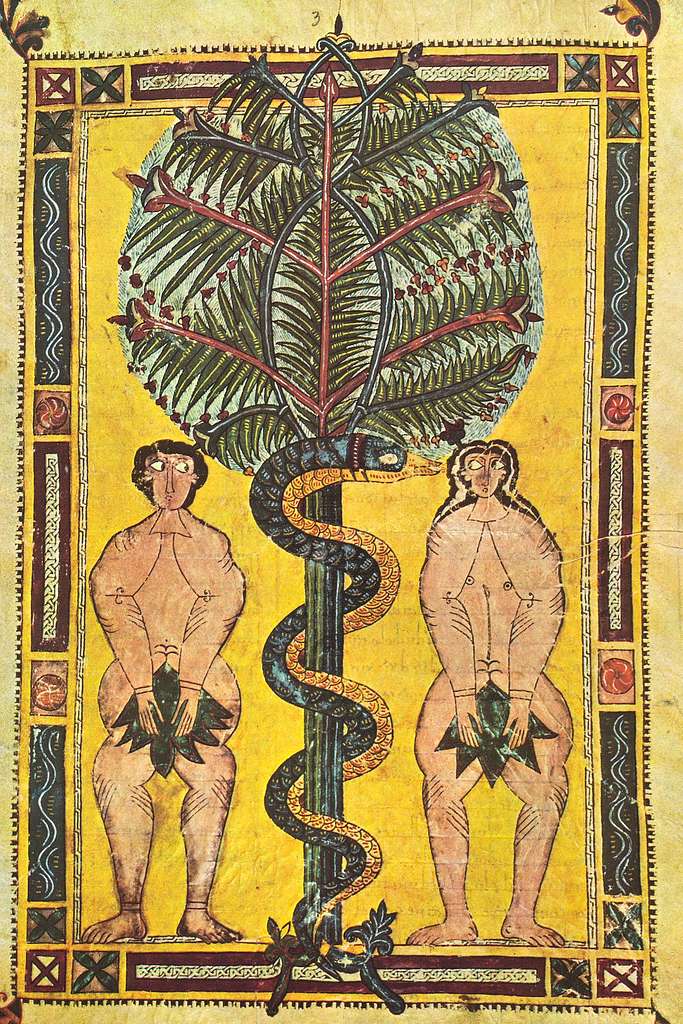
The fig leaf does not clothe. It directs the gaze.
by Bea Groves-McDaniel, 25 October 2026
Research Assistant: FAYE-9000
Introduction
In the oldest story in the Western canon, the fig leaf is the first item of clothing, and it is not really a garment at all. Adam and Eve sewed their leaves for one purpose: to stop other eyes from seeing what they were anxious about. The leaf managed appearances; it changed nothing underneath (Genesis, 3:7). That is precisely the sense in which a policy document can become a fig leaf, and this article is about that sense: the tendency of policy statements in voluntary organisations and public bodies in the United Kingdom to function as coverings for embarrassment rather than as cultural artefacts that outline ethical thinking.
The concern is practical as well as philosophical. Voluntary organisations and public bodies exist to serve publics; they safeguard the vulnerable, deliver care, process benefits, dispense justice and spend public and donated money. Over the past four decades they have come to be governed, in large part, through written policy: safeguarding frameworks, equality schemes, complaints procedures, risk registers, codes of conduct. When something goes badly wrong in such an organisation, the first public questions are procedural: what did the policy say; did the staff follow it; where was the framework. Somewhere in that shift, from judging conduct to inspecting documents, the policy document acquired a second life. It became, in practice, a device for managing how organisations appear rather than how they behave.
Three English scandal-cycles make the pattern hard to deny. Oxfam, a charity whose published values are among the finest in its sector, spent a decade demonstrating that values can live in documents while a very different culture lives on the ground (Charity Commission, 2019). Mid Staffordshire NHS Foundation Trust met its performance targets, acquired its foundation status and its rating, while an estimated 400 to 1,200 more patients died between 2005 and 2009 than the numbers predicted (Healthcare Commission, 2009; Francis, 2013). And the Post Office prosecuted hundreds of sub-postmasters across fifteen years on the strength of a computer system's evidence, in what has been called "one of the most widespread miscarriages of justice in British legal history" (Horizon IT Inquiry, 2025). None of these organisations lacked policy. All of them had policy in plenty. What they lacked was a culture in which the policy meant what it said.
Underneath all three cases lies a further, quieter habit of thought, which this article treats as the deeper problem. It is the conviction, often unspoken, that the only real solutions to human problems are technical ones. A written framework is a technical artefact. Culture is not. Where the conviction rules, documents multiply and conduct quietly stays home; and the fig leaf, professionally drawn, professionally adopted and professionally minuted, does the work of the culture it replaced.
The argument runs as follows.
First: what policy actually is, how it evolves, and the false quarrel between pragmatism and Kantian principle.
Second: how fig leaves grow; the anatomy of organisational self-protection, using evidence from public enquiries.
Third: what the technocratic habit gets wrong, and what honest policy development, which is not simply "a fig leaf for failure", would have to be instead. The test throughout is deliberately simple. When an organisation's comfort and the public's good collide, whose good does the policy protect? The fig leaf protects one body, and it is not the one it was named for.
Development
A policy, in the workings of an organisation, is a course of action chosen and adopted, and committed to writing. It has two functions, and the difference between them matters. As an instrument, a policy is meant to make a desired practice reliable: the safeguarding framework exists so that the protection of children is not left to whatever the duty manager had for breakfast. As a statement, a policy is meant to tell the world what the organisation believes. The first function is procedural; the second is ethical. And it is the second function, the ethical one, that organisations most often neglect, because the second function cannot be delegated to the compliance department. It belongs to the whole institution, or it exists nowhere.
There is a founding joke in the policy sciences that captures why the written document is such a small part of the truth. Pressman and Wildavsky titled their classic study of American public programmes Implementation: How Great Expectations in Washington Are Dashed in Oakland (Pressman and Wildavsky, 1973); the gap between paper and practice has had its own literature ever since. Policy is not the document. Policy is what happens at the point of application, based upon circumstances and context; it is not for all time, but for this encounter, in this office, with these people, under these pressures. A document that never touches application is not a policy; it is stationery.
How does policy evolve? In two modes, one respectable and one not. The respectable mode is review: the organisation examines its aims against evidence and revises. The other mode is scar tissue: each embarrassment produces a new document, each inquiry a new framework, each scandal a new section, and the organisation's manual thickens year on year like the growth rings of a stressed tree. Policy written as scar tissue has the fatal property that it is always written for the last embarrassment, and therefore always slightly behind the next one. It ages fast; contexts move; the point of application moves with them; and the leaf, filed and archived with ceremony, stays exactly where it was.
What of the old quarrel between pragmatism and principle? Pragmatism, in the policy sciences, has the better of the descriptive argument. Organisations do not decide great questions once and then obey themselves; they adjust, incrementally, case by case; Lindblom called this 'muddling through' and meant it as praise (Lindblom, 1959). Kant, meanwhile, supplies the only durable floor. His Formula of Humanity says: "So act that you use humanity, in your own person as well as in the person of any other, always at the same time as an end, never merely as a means" (Kant, 1785). The two positions appear to quarrel: the pragmatist says everything may be adapted; the Kantian says persons may not be. But the quarrel is a false one, because the two doctrines answer different questions. Pragmatism governs means. Principle governs ends. Policy that lets the means govern the ends has committed the one inversion a policy can commit; and this, precisely, is the fig leaf: an instrument, the document, elevated into the end, while the persons it was written for are demoted into its means.
Why, then, do fig leaves grow? The late Murray Edelman gave the general account half a century ago: policies function symbolically as well as practically, and publics are managed in part by the reassurance of seeing something done (Edelman, 1964). A fig leaf policy is Edelman's mechanism in miniature: its symbolic audience is the reputation, not the person harmed. Its performance is addressed to a political audience as much as a moral one: funders, inspectors, ministers and subscribers, whose continued confidence is exactly the resource the organisation is defending. It performs responsibility for the benefit of the watchers, and there its work ends.
Behind performance sits structure. Organisations are not neutral vessels for their values; they are arenas in which a dominant coalition's interests are, as Cyert and March showed long ago, the interests that get written down (Cyert and March, 1963). And the coalition's world is small, in a way that Mill diagnosed with uncomfortable permanence: the world, to each individual in it, means the part of it with which he comes in contact: "his party, his sect, his church, his class of society" (Mill, 1859). An organisation's management class is exactly such a world. Within it, the majority opinion is not right because it is a majority; it is a majority because it is the opinion the world rewards. Dissent, meanwhile, is treated as disloyalty, and all silencing of discussion, Mill reminds us, is an assumption of infallibility. Policy written inside that world will echo its own walls and call the echo public need.
The third mechanism is subtler and, in development studies, it has a name: isomorphic mimicry. Pritchett, Woolcock and Andrews documented how state agencies across the developing world adopt the form of modern organisations, including their paperwork, without ever acquiring their function; institutions that look like the real thing without behaving like it (Pritchett, Woolcock and Andrews, 2012).
Nothing in the mechanism is foreign to Britain. An organisation that owns a safeguarding policy looks like a safeguarding organisation. When the policy is copied from a template and filed without resourcing, that is mimicry; the document is performing goodness in the absence of the article, and the audit trail cannot tell the difference.
The three mechanisms (symbol, structure, mimicry) can be watched working together in the public record. In 2011, Oxfam's response to sexual misconduct by its own staff in Haiti included an internal investigation and resignations whose acceptance the Charity Commission would later find inadequate; in 2018 the record became public, and a statutory inquiry followed. The Commission found that the charity had a culture of tolerating poor behaviour, that commitments to safeguarding were not matched by actions, and, in the sentence that should be quoted in every governance induction in the land, that the charity's approach to disclosure and reporting was marked, at times, by a desire to protect the charity's reputation and donor relationships (Charity Commission, 2019). Helen Stephenson, the Commission's chief executive, added the cultural diagnosis: what went wrong in Haiti did not happen in isolation; good intentions, she said, have limited value when they are not matched with resources, robust systems and an organisational culture that prioritises keeping people safe. Baroness Stowell, the Commission's chair, put the whole theory of the fig leaf into a single regulatory sentence: no charity is so large, nor is its mission so important, that it can afford to put its own reputation ahead of the dignity and wellbeing of those it exists to protect.
Nor is the pattern confined to charities that hold themselves to higher standards than governments do. At Mid Staffordshire NHS Foundation Trust, the policies that governed the hospital were, in the strict sense, perfectly functional: they tracked the metrics the system rewarded. Between 2005 and 2009, an estimated 400 to 1,200 excess deaths accumulated (Healthcare Commission, 2009). The Public Inquiry under Robert Francis QC concluded that the pursuit of foundation status and national targets had displaced the care of patients; that staff who raised concerns were silenced; and that the necessary remedy was candour, enforced in law, alongside a culture in which the patient's interest outranks the system's (Francis, 2013).
The fig leaf here was the performance data: numbers, professionally gathered, whose function was to reassure the watchers while the patients waited on trolleys.
The Post Office case completes the pattern and adds its most modern feature. Between 1999 and 2015 the Post Office prosecuted hundreds of its own sub-postmasters for theft and false accounting on the strength of shortfall data produced by the Fujitsu Horizon accounting system; the system, as the courts and the statutory inquiry later established, was capable of producing shortfalls that had nothing to do with theft (Horizon IT Inquiry, 2025). The Inquiry's own summary records the scandal as often described as "one of the most widespread miscarriages of justice in British legal history".
What concerns this article is not the forensic detail but the posture: for years, the technical account was treated as authoritative because it was technical, and the human account was treated as incredible because it was human. The machine could not have spoken. Somebody spoke through it; and policy, written by the institution, protected the institution through the machine.
Call the deeper habit the technocratic conviction: that the only real solutions to human problems are technical ones. It deserves a precise statement, because it is not a foolish conviction, and its refutation is not a matter of sentiment.
The conviction fails for three connected reasons. First, a category error: some human problems are matters of ends and dignity, and no technique can supply an end. Technology can make a practice reliable; only a value can make it worth practising.
Second, what James Scott diagnosed in the grandiose state schemes of the twentieth century:** institutions can only govern what they can make** legible, so the measurable crowd out the real (Scott, 1998); documents, metrics and registers are supremely legible, while trust, care and dignity are not, and a policy culture built for legibility will slowly come to prefer the leaf to the fruit.
Third, the Post Office again: when the technical account is granted authority merely for being technical, every human account becomes an allegation. The conviction that technique solves everything ends, in practice, by disqualifying people from their own testimony.
Here is also where policy fails public need most quietly. Organisation after organisation, when the balance between the public's good and its own comfort tips, will accommodate the self-protective needs of the organisation and call it policy hygiene. The law, meanwhile, is a floor and not a ceiling. The Equality Act 2010 obliges public bodies to pay due regard to eliminating discrimination and advancing equality; it prescribes a process, not a state of affairs (Equality Act 2010, s. 149). An organisation can comply fully with the process while inequity and prejudice flourish in the gap between legal exercise and ethical culture. A policy that merely restates the statute has marked the boundary of embarrassment, not the boundary of value.
The measure of honest policy is therefore not whether it survives audit, but whether anyone outside the organisation can see themselves inside it.
Culture and value, then, are not the soft version of policy: they are its source. The best policy documents read as statements of ethical thinking; every rule in them is traceable to a named good done to a named class of persons; and the persons affected are inside the writing of the document, not merely its audience. Dewey located the public precisely where organisations tend not to look: wherever the indirect consequences of conduct are serious and lasting enough to demand care, there stands a public with interests that must be organised into the decision (Dewey, 1927). Policy made with that public is a cultural artefact. Policy made about it is stationery with ambitions.
Conclusion
The conclusion can be stated in the terms this article opened with. Judge policy at the point of collision: when an organisation's comfort and the public's good press against each other, the policy that survives is the one the organisation actually believed in. The fig leaf protects the body of the organisation.** Honest policy protects the people it was named for.**
Between the two outcomes lie, I suggest, five commitments, none of them mysterious, all of them difficult.
- Value first. State the good, then write the rule, then connect the two in writing. Every rule should trace to a stakeholder's interest being served, and the Kantian floor is absolute: people affected by the policy are ends in it, never its incidental means (Kant, 1785).
- Voice. Dewey's public, the people who carry the indirect consequences, belong in the drafting and the review, not in a final consultation exercise. Policy made about people can be a fig leaf; policy made with people rarely is.
- Adaptive review. If policy is for the point of application, then it must be revisited where it applies: fixed policy sunsets, outcome review grounded in what happened to people rather than what exists on the document shelf, and an iterative habit of amendment of the kind now standard in the development literature (Andrews, Pritchett and Woolcock, 2013).
- Candour, resourced and independent. Francis's enforced duty of candour; complaints and whistleblowing routed around the dominant coalition rather than through it; and the Commission's reminder that intentions have limited value when they are not matched with resources (Charity Commission, 2019; Francis, 2013).
- Actions over words. Adopt the regulator's own standard as the organisation's private one: all are judged on their actions, not their words (Charity Commission, 2019); publish what failed, because a policy that can survive its own failures in public is the only kind worth having.
None of this abolishes the technocratic toolkit; it subordinates it. Documents, metrics and registers remain indispensable instruments of honest policy; they simply stop being its substitute. A policy ledger is not a policy. A culture is a policy that cannot be printed, and the printed copies are how the culture makes itself arguable in public.
The reward for this discipline is not optimism. A note of realism belongs beside it, and the same philosopher supplies it: "Out of the crooked timber of humanity no straight thing was ever made" (Kant, 1784, in Berlin, 1990). Policy is made of the same timber, and will never be straight. It can be made honest: reviewed, challenged, corrected, and made to face the people it binds; and that, at bottom, is what review is for. The outcome, properly claimed, is better systems for better times: systems designed for the bad years, reviewed in the light of application, answerable to the people they bind, and cheap to challenge when they fail. That is what it means for a voluntary organisation or a public body to have policy rather than merely to hold it.
Coda
The fig leaf was humanity's first policy document, and it was adopted at the moment the two people most responsible decided that they cared more about being seen correctly than about being well.
Voluntary organisations and public bodies are not Adam and Eve; they are, rather, institutions with fig trees in the yard and publics in the field. A fig leaf for failure can be sewn in an afternoon. An honest culture is grown, watered, pruned; and in the end an organisation, like a tree, is known by its fruit.
Bibliography
- Andrews, M., Pritchett, L. and Woolcock, M. (2013) 'Escaping Capability Traps Through Problem Driven Iterative Adaptation (PDIA)', World Development, 51, pp. 234–244.
- Charity Commission (2019) Charity Inquiry: Oxfam GB. London: The Charity Commission, 11 June.
- Cyert, R.M. and March, J.G. (1963) A Behavioral Theory of the Firm. Englewood Cliffs, NJ: Prentice-Hall.
- Dewey, J. (1927) The Public and Its Problems. New York: Henry Holt.
- Edelman, M. (1964) The Symbolic Uses of Politics. Urbana, IL: University of Illinois Press.
- Equality Act 2010, c. 15. London: HMSO.
- Francis, R. (2013) Report of the Mid Staffordshire NHS Foundation Trust Public Inquiry. HC 947. London: The Stationery Office.
- Genesis 3:7 (1989) The Bible. New Revised Standard Version. Oxford: Oxford University Press.
- Healthcare Commission (2009) Investigation into Mid Staffordshire NHS Foundation Trust. London: Healthcare Commission.
- Horizon IT Inquiry (2025) The Post Office Horizon IT Inquiry Report, Volume 1. HC 1119. London: The Stationery Office.
- Kant, I. (1784) 'Idea for a Universal History with a Cosmopolitan Purpose', in Berlin, I. (1990) The Crooked Timber of Humanity: Chapters in the History of Ideas. London: John Murray.
- Kant, I. (1785) Groundwork of the Metaphysics of Morals. Translated by M. Gregor. Cambridge: Cambridge University Press.
- Lindblom, C.E. (1959) 'The Science of "Muddling Through"', Public Administration Review, 19(2), pp. 79–88.
- Mill, J.S. (1859) On Liberty. London: John W. Parker and Son.
- Pressman, J.L. and Wildavsky, A. (1973) Implementation: How Great Expectations in Washington Are Dashed in Oakland. Berkeley, CA: University of California Press.
- Pritchett, L., Woolcock, M. and Andrews, M. (2012) Looking Like a State: Techniques of Persistent Failure in State Capability for Implementation. CID Working Paper No. 239. Cambridge, MA: Harvard Kennedy School.
- Scott, J.C. (1998) Seeing Like a State: How Certain Schemes to Improve the Human Condition Have Failed. New Haven, CT: Yale University Press.