
The Architecture of Horror
The position of this paper is clear. The state of Israel, as constituted on the territory of Palestine, is the product of a colonial project that displaced an indigenous people.
History, Conflict, and the Crisis of Gaza
Introduction
To write about the Palestinian people is to confront a wound that the international community has inflicted and then refused to dress. More than seventy-five years after the catastrophe that Palestinians call the Nakba, the question of who the Palestinians are, whence they came, and what has been done to them remains one of the most contested in modern history. This paper seeks to address that question directly.
It is written from a position that is unequivocally pro-Palestinian and anti-Zionist. This is not a position that seeks to diminish or threaten Jewish people. It is a position that holds that the state of Israel, as constituted and as it operates, cannot be defended on moral or legal grounds. This distinction matters, and it must be stated plainly at the outset, because critics of criticism of Israel have consistently attempted to collapse the distance between anti-Zionism and antisemitism. The argument that a political ideology and a colonial project can be opposed without targeting the people who were born into or have been caught up in that project is not merely a legal or rhetorical convenience. It is a moral and historical fact.
Judaism is a religion and a culture with a rich history that extends far beyond the boundaries of any single state. Jewish communities across Europe, the Americas, Asia, and Africa have no necessary political connection to the Israeli government, and they should not be conflated with it. Anti-Zionism is a critique of a state and its founding ideology, and it is a critique shared by a growing number of Jewish scholars, activists, and organisations worldwide, including Jewish Voice for Peace, If Not Now, and Independent Jewish Voices in the UK.
The paper draws on UN bodies, international humanitarian organisations, and the work of historians who have subjected Israeli state narratives to rigorous scrutiny. It seeks to be honest about the weight of evidence and the scale of suffering without ever losing sight of the people to whom that suffering belongs.
They Were Here Before the Word Became a Battleground
The Palestinian people did not appear in 1948. They were not a problem created by the aftermath of the Second World War. They were a society with a history stretching back centuries, a distinct culture, a spoken dialect of Arabic, and a deep connection to a specific geography.
Edward Said, the most influential scholar of Palestinian identity, described the Palestinians as "a society in being" with a history that predated the conflict that would consume it (Said, 1980). The name "Palestine" itself was in use long before the Zionist movement arrived. The Philistines gave it to a region that was subsequently populated by a continuous succession of peoples. By the time the Ottoman Empire administered the area, its inhabitants were predominantly Arab, Muslim and Christian, alongside smaller communities of Jews and others who had lived there for generations.
Palestinian identity is rooted in the land, in family and village networks, and in a culture that blends Arab heritage with local traditions. The Arabic word for Palestinian, Filastini, had been in use for generations before 1948. It denoted a people, a culture, and a connection to a specific geography. That identity survived the catastrophe of 1948 because the people who carried it survived. They survived in refugee camps in Jordan, Lebanon, and Syria, in the West Bank and Gaza, and in the diaspora that extended to Europe, the Americas, and beyond. Rashid Khalidi has documented how that identity persisted not as a relic of a vanished past but as a living, evolving political and cultural force (Khalidi, 1997). It persists today in the face of an ongoing project of displacement and erasure.
An Empire Departed and an Agreement Betrayed
The Ottoman Empire ruled Palestine for four centuries. Its administration was not the monolithic and rigid system that later Zionist narratives suggested. Under Ottoman rule, the various religious and ethnic communities of Palestine coexisted, sometimes uneasily, within a framework that allowed considerable local autonomy. The land was predominantly agricultural. The major towns, Jerusalem, Nablus, Hebron, and Jaffa, were centres of commerce, religion, and intellectual life.
The British Mandate, which began in 1920 following the San Remo conference, changed everything. Britain was tasked with administering Palestine with a view to establishing the Jewish national home, and the consequences were predictable. Jewish immigration increased, particularly in response to Nazi persecution in Europe, and with it came the purchase of land, often from absentee landlords, displacing Arab tenants who had worked that land for generations.
Between 1920 and 1947, the Jewish population of Palestine grew from around 6 percent to over 30 percent of the total. The Arab majority repeatedly protested, first through petitions and political representation, then through the 1936-1939 Arab Revolt, which was brutally suppressed by British forces. Estimates of the death toll from the revolt range from three thousand to ten thousand, with many thousands more imprisoned, exiled, or dispossessed.
The Balfour Declaration of November 1917 had made Britain's position clear. In a letter from Arthur James Balfour to Lord Rothschild, the British government stated its view that "the establishment in Palestine of a national home for the Jewish people" should be facilitated. The McMahon Correspondence of 1915-1916, in which Britain had assured the Sherif of Mecca that Arab independence would be supported in exchange for an Arab uprising against the Ottoman Empire, was effectively dishonoured. The Sykes-Picot Agreement of 1916, a secret treaty between Britain and France dividing the Arab world into spheres of influence, confirmed that the Arab peoples had been deceived by their supposed allies.
The British Mandate was, in substance, a mandate to facilitate Zionism and manage Arab resistance to it. Ilan Pappé has described the Balfour Declaration as "the original sin" of the Palestine conflict, and this characterisation is difficult to dispute (Pappé, 2006).
The Nakba
The term "nakba" means catastrophe, and it is a word that has been meticulously documented by Palestinian historians and substantiated by Israeli state archives that were declassified in the 1980s. What happened in 1948 was not a tragic byproduct of war. It was a deliberate and systematic process of ethnic cleansing.
The historian Ilan Pappé has documented at least twenty-four massacres of Palestinian villages committed by Zionist forces in the period between December 1947 and the end of 1948. These were not accidents of war. They were instruments of a policy designed to empty the land of its Arab inhabitants.
The massacre at Deir Yassin on 9 April 1948, carried out by the Irgun and Lehi militias, killed around 250 men, women, and children. The village was subsequently depopulated, and in a pattern repeated across hundreds of villages, its name was erased from maps and its land given to Jewish settlements. The plan that governed this operation was Plan Dalet, a military directive drawn up in March 1948 that set out the logic of what Pappé and others have called the ethnic cleansing of Palestine (Pappé, 2006).
Benny Morris, an Israeli historian whose work is generally regarded as conservative in this debate, has documented the mass expulsion orders and the deliberate destruction of villages. His conclusion is that the nakba was neither accidental nor unplanned, though he has argued against the use of the term 'genocide' to describe it (Morris, 2001).
Other scholars, including Nur Masalha, have taken a different view, arguing that the deliberate targeting of civilian populations and the systematic destruction of cultural and religious sites constitute a coherent policy of elimination. (Masalha, 2012).
The scale of the displacement was staggering. Between seven hundred thousand and eight hundred thousand Palestinians were expelled or fled from their homes. Some were driven out by direct military force. Others fled in response to the propaganda and intimidation of Zionist militias. Almost none left voluntarily. The villages they left behind were systematically destroyed. The Israeli Absentee Property Law of 1950 provided the legal framework for the permanent seizure of Palestinian property. Those Palestinians who remained within the borders of the new state of Israel, around 160,000, were subjected to martial law until 1966, a period that scholars have documented as characterised by systematic discrimination in land allocation, residency rights, and political expression.
The nakba did not end in 1948. It has continued through subsequent wars, through the occupation of 1967, and through the daily machinery of control that defines life for Palestinians in the West Bank and Gaza. The refugee population, now in its third and fourth generation, remains one of the largest and most enduring displaced populations in the world. UNRWA, the UN agency for Palestine refugees, currently serves more than five and a half million registered refugees. The right of return, recognised in UN General Assembly Resolution 194 of 1948, has been consistently refused by Israel and largely ignored by the international community.
When the Sacred Became Political
The origins of Zionism were predominantly secular and political. Theodor Herzl, the founder of political Zionism, was a Viennese journalist who conceived of the Jewish state as a modern, European-style nationalist project. The early Labour Zionists who built the institutions of the movement were socialists who sought to create a Jewish homeland through cooperative settlement and agricultural labour. The religious dimensions of Zionism were present from the beginning but were initially subordinate to the secular project.
The religious dimension came to the fore in the aftermath of the 1967 Six-Day War. The unexpected military victory was interpreted by many religious Jews as a divine sign, and it transformed the political landscape of Israel. The settlement movement, which had existed in limited form before 1967, expanded rapidly into the occupied territories. The theological justification for this expansion drew on a reading of biblical texts that regarded the entire land of Israel, including the West Bank, as a divine gift to the Jewish people.
The Gush Emunin movement, founded in 1974 by Rabbi Moshe Levinger and his followers, was the organisational expression of this theology. Gush Emunin believed that the giving of the land to the Jewish people was an article of faith, not a matter for negotiation or compromise. To cede any part of Eretz Israel was a theological impossibility.
The implications for the peace process have been devastating. When Israeli governments have negotiated territorial concessions, the religious settler movement has mobilised against them with extraordinary intensity. The assassination of Yitzhak Rabin in 1995 by Yigal Amir, a religious Zionist who believed Rabin was betraying the land, was the most dramatic expression of this dynamic, but it was not an aberration. It was the logical consequence of an ideology that places the possession of the land above human life. Avi Ravitzky has described religious Zionism as a time bomb ticking beneath Israeli democracy, and recent events have done nothing to contradict this assessment (Ravitzky, 2017).
The religious settler movement has shaped mainstream Israeli politics in ways that extend far beyond the occupied territories. The demand for Israeli sovereignty over the entire land of Israel has become a mainstream position within Likud and has influenced parties across the political spectrum. The concept of a greater Israel has been embedded in Israeli political culture through education, media, and religious instruction in ways that make the two-state solution not merely politically difficult but theologically incomprehensible to a significant portion of the Israeli population.
The Peace That Was Never Made
The peace process has been attempted repeatedly, and it has failed repeatedly. The reasons are not mysterious. Each failure has followed a recognisable pattern: an international conference produces a framework for agreement; Israel agrees in principle while continuing to expand settlements in the territory being negotiated; the agreement collapses; and Israel is left in possession of more territory than it held before the process began.
The UN has passed dozens of resolutions calling for Israeli withdrawal from occupied territory, the establishment of a Palestinian state, and respect for the rights of refugees. Security Council Resolutions 242 and 338, passed after the 1967 and 1973 wars respectively, established the principle of land for peace that has been the basis of every subsequent peace initiative. Resolution 242 remains one of the most important documents in the conflict, yet it has never been implemented. More than fifty Security Council resolutions critical of Israel have been vetoed by the United States since 1970, ensuring that the international will for a just solution has been rendered ineffective.
The Oslo Accords of 1993 were greeted with genuine hope. The accords established a framework for Palestinian self-governance in parts of the West Bank and Gaza and set out a timeline for permanent status negotiations. In practice, Oslo delivered not peace but the legitimisation of Israel's ongoing occupation under a different administrative label.
Settlement expansion continued and intensified during the Oslo period. The Second Intifada, which began in 2000, was the consequence of the collapse of the Oslo process and the recognition by many Palestinians that the promised statehood was not going to materialise. Israeli forces reoccupied major Palestinian cities. The barrier wall, declared illegal by the International Court of Justice in 2004, was built through the West Bank, absorbing large areas of productive agricultural land and cutting communities off from each other.
The Camp David Summit of 2000, the Annapolis Conference of 2007, and the Kerry initiative of 2013-2014 all followed the same trajectory. The barrier wall has incorporated settlement blocs that make a viable Palestinian state geographically impossible. The expansion of settlements in East Jerusalem has continued without interruption. The combination of physical fragmentation, settlement expansion, and the absence of any credible political pathway has reduced the prospect of a two-state solution to a formality that no serious analyst believes is achievable under current conditions.
Can Hegemony Be Justified
Israel defines itself as the Jewish state. This framing is central to its legal and political identity, and it is the foundation upon which its claims to the entire land of Israel and Palestine rest. The argument for Jewish statehood rests on the historical connection between the Jewish people and the land of Israel, a connection that is documented in religious texts and supported by archaeological evidence. This connection is not disputed by the argument made in this paper. What is disputed is the claim that this historical connection confers an exclusive political right to self-determination in Palestine to the exclusion of the people who were already living there.
The principle of self-determination, recognised in the UN Charter and in numerous international covenants, is a collective right. It cannot be exercised by one people at the expense of another without violating the rights of the latter. As the International Court of Justice has made clear in its advisory opinions on the barrier wall, Israel's occupation of the West Bank, East Jerusalem, and Gaza is governed by the Fourth Geneva Convention, which prohibits the transfer of civilian population into occupied territory.
The democracy question is related. Israel purports to be both a Jewish state and a democracy. In the territory comprising pre-1967 Israel, these two claims coexist uneasily. Arab citizens of Israel, who comprise around twenty per cent of the population, face systematic discrimination in land allocation, housing, education, and political representation. In the occupied territories, the claim to democracy is simply false. The Palestinian population of the West Bank and Gaza lives under a military occupation that denies them basic political rights while Israeli settlers in the same territory enjoy full citizenship and political representation.
Human Rights Watch, B'Tselem, and Amnesty International have all published detailed analyses characterising this system as apartheid (Human Rights Watch, 2021; B'Tselem, 2021). This characterisation has been rejected by Israel and by some Western governments, but it has been accepted by a growing body of international legal and political scholars.
The claim to hegemony based on religious heritage is particularly difficult to sustain. The land of Israel in biblical times was not a modern state. It was a tribal confederation with shifting borders and a complex relationship with surrounding peoples. The religious traditions associated with the land are shared, in different ways, with Christianity and Islam. To claim that a religious tradition confers an unconditional political right to a specific territory in the twenty-first century would, if applied consistently, generate overlapping and irresolvable claims across the globe.
The West's Complicity
The responsibility of Western governments, and particularly the United States, for the perpetuation of the Israel-Palestine conflict cannot be overstated.
The United States has provided Israel with more than two hundred and sixty billion dollars in military and economic assistance since 1948, adjusted for inflation, making it the largest cumulative recipient of US foreign aid in the modern era. This assistance has included advanced weapons systems, diplomatic protection at the United Nations, and the political and financial support that has enabled Israel to sustain its occupation and its military campaigns without meaningful international consequences.
The veto power in the UN Security Council has been the principal instrument of this protection. The United States has vetoed more than fifty resolutions critical of Israel since 1970, including resolutions calling for Israeli withdrawal from occupied territories, an end to settlement expansion, and compliance with international humanitarian law. When the General Assembly has passed resolutions by overwhelming majorities, reflecting the will of the international community, those resolutions have been rendered unenforceable by the veto.
The United States has also provided diplomatic cover for Israeli military operations, including the 2008-2009 Gaza war, the 2014 war, and the current assault on Gaza, by characterising them as legitimate self-defence while declining to call for ceasefires or accountability.
The European Union and its member states have been more critical in their rhetoric but equally limited in their actions. The UK has been shaped by its historical responsibility for the Balfour Declaration and the Mandate, but successive British governments have maintained close arms and trade relationships with Israel and have been reluctant to take meaningful action on settlement expansion or accountability. Arms exports to Israel have continued despite domestic legal challenges and overwhelming parliamentary majorities in favour of an export freeze.
The Western media has also shaped the narrative in ways that have disadvantaged the Palestinian perspective. Coverage of the conflict in the mainstream Western press has historically been skewed toward the Israeli perspective, with Palestinian voices marginalised or misrepresented. The language used to describe Palestinian resistance, the characterisation of casualties, and the framing of the historical context have all been subject to legitimate criticism from media scholars and from Palestinian and Arab journalists.
This is not to suggest a coordinated conspiracy, but rather to recognise that the cultural and political proximity of Western governments and media to Israel has shaped the information environment in ways that have complicated public understanding of the conflict.
The Destruction of Gaza
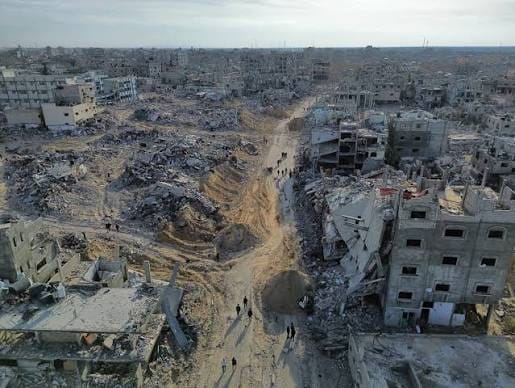
The assault on Gaza that began on 7 October 2023 has produced a humanitarian catastrophe of extraordinary magnitude. Between October 7 2023 and July 12 2026, the Palestinian Ministry of Health, as reported by the Health Cluster, documented 73,231 people killed and 173,686 injured in the Gaza Strip. The majority of those killed have been women and children. More than 1.9 million people have been displaced. The majority of the population of Gaza has been rendered homeless.
The infrastructure of civilian life has been systematically destroyed. Hospitals have been bombed and put out of service. Water and sanitation systems have been destroyed. The UN World Food Programme has warned of famine conditions affecting the entire population of Gaza. The International Court of Justice has indicated provisional measures ordering Israel to halt its military operations, measures that Israel has disregarded (OCHA, 2024).
The justification offered by the Israeli government is that it is necessary to eliminate Hamas and to protect the security of Israel. This justification does not withstand scrutiny. The laws of armed conflict do not permit the destruction of civilian infrastructure as a method of warfare. The principle of proportionality requires that the harm to civilians and civilian objects be proportionate to the military advantage gained. The systematic bombing of hospitals, schools, refugee camps, and residential areas cannot be reconciled with this principle.
The targeting of journalists, medical personnel, and UN workers constitutes a violation of the Geneva Conventions. The deliberate deprivation of food, water, and medical supplies to a civilian population constitutes a war crime, and international legal scholars and human rights organisations have so characterised it (Amnesty International, 2024).
The first invasion of Lebanon in this current phase occurred from October 1 to November 27, 2024. Israeli forces crossed the border and occupied southern Lebanon, displacing hundreds of thousands of Lebanese civilians and killing thousands. A further ground invasion began on March 16, 2026, as part of the broader regional crisis. The expansion of the conflict has been welcomed by the most extreme elements of the Israeli government, and it has been described by international observers as a dangerous escalation with the potential to draw in regional powers.
The current government of Israel, the most right-wing in the country's history, has made explicit that its objectives extend beyond anything that could be characterised as self-defence. Cabinet ministers have spoken openly of total victory, of the expulsion of Palestinians from Gaza, and of permanent Israeli control over the entirety of the land between the Mediterranean and the Jordan River. These are not the statements of a government engaged in defensive warfare. They are the statements of a government engaged in conquest and ethnic consolidation.
Conclusion
The Palestinian people have been waiting for justice for more than seventy-five years.
In that time, they have seen their homeland appropriated, their people expelled, their villages destroyed, their cities occupied, their economy strangled, and their resistance characterised as terrorism. They have seen the international community repeatedly acknowledge their rights in principle and repeatedly fail to defend them in practice. They have seen the United States veto resolution after resolution, supply arms and diplomatic cover for their subjugation, and characterise their suffering as collateral damage in a conflict that the West has done more than any other actor to perpetuate.
The position of this paper is clear. The state of Israel, as constituted on the territory of Palestine, is the product of a colonial project that displaced an indigenous people. That project has been sustained for seventy-five years by the support of Western powers, and it cannot be understood, let alone justified, outside that context.
What justice would require is not complicated in principle. It would require the withdrawal of Israeli forces from all occupied territories. It would require the right of return for Palestinian refugees, as specified in UN General Assembly Resolution 194. It would require the dismantling of the settlement enterprise and the barrier wall. It would require equal rights for all inhabitants of the territory between the Mediterranean and the Jordan River. And it would require accountability for the crimes that have been committed. None of these things is currently on the table, and the international community's failure to bring them about is a moral and political scandal of the first order.
Silence in the face of this scandal is not neutrality. It is complicity.
Finally, I need to say that many will see the above as a polemic based on antisemitic feelings. Nothing could be further from the point. I am, without a shadow of a doubt, empathetic to the concept of a homeland for Jewish people. But not in this form, or won at such a horrifyingly bloody cost. Against a people who have an equally valid claim. I must also admit to a certain cowardice. I have refrained from putting my ethical cards on the table because I KNOW that I'll be labelled with the term 'antisemite'. But eventually one cannot sleep easily and not say something plainly. The above is my plain statement. It comes from the heart.
Dedicated to my dear friend RF.
Bibliography
Amnesty International (2024) The Gaza Genocide: Findings of an International Human Rights Organisation. London: Amnesty International.
B'Tselem (2021) A Regime of Jewish Supremacy from the Jordan River to the Mediterranean Sea: This is Apartheid. Jerusalem: B'Tselem.
Chomsky, N. (2015) The Fateful Triangle: The United States, Israel and the Palestinians. Chicago: Haymarket Books.
Gelber, Y. (2006) Palestine 1948: War, Escape and the Emergence of the Palestinian Refugee Problem. Brighton: Sussex Academic Press.
Human Rights Watch (2021) A Threshold Crossed: Israeli Authorities and the Crimes of Apartheid and Persecution. New York: Human Rights Watch.
Khalidi, R. (1997) Palestinian Identity: The Construction of Modern National Consciousness. New York: Columbia University Press.
Masalha, N. (2012) The Palestine Nakba: Decolonising History, Narrating Displacement and Envisioning the Future. London: Zed Books.
Morris, B. (2001) Righteous Victims: A History of the Zionist-Arab Conflict, 1881-2001. New York: Alfred A. Knopf.
OCHA (2024) Hostilities in the Gaza Strip and Israel: Reported Impact, Day 224. New York: United Nations Office for the Coordination of Humanitarian Affairs.
OCHA (2024) Gaza Strip: Reported Impact Snapshot, 12 November 2024. New York: United Nations Office for the Coordination of Humanitarian Affairs.
Pappé, I. (2006) The Ethnic Cleansing of Palestine. Oxford: Oneworld Publications.
Pappé, I. (2017) Ten Myths About Israel. New York: Plume.
Ravitzky, A. (2017) To the End of the Land: The Rise of Religious Zionism in Israel. Tel Aviv: Am Oved Publishers.
Said, E. (1980) The Question of Palestine. New York: Routledge.
Said, E. (1979) Orientalism. New York: Pantheon Books.
United Nations (1948) UN General Assembly Resolution 194 (III): Palestine: Progress Report of the United Nations Mediator. New York: United Nations.
United Nations (1967) Security Council Resolution 242 (1967). New York: United Nations.
United Nations (2004) Legal Consequences of the Construction of a Wall in the Occupied Palestinian Territory. Advisory Opinion. The Hague: International Court of Justice.
Weizman, E. (2007) Hollow Land: Israel's Architecture of Occupation. London: Verso.