
Shostakovitch at Leningrad
Shostakovitch heard of the German invasion on his radio and immediately (so it is said) trekked down to the army recruiting office. He was denied service, and probably not just because he was very short-sighted.
The very famous Russian (Soviet) composer, Dmitri Shostakovitch, was living in Leningrad (now St Petersburg) when war broke out in the summer of 1941. Hitler's Wehrmacht had commenced a surprise attack on the USSR, troops streaming across the border, and the Luftwaffe destroying the Russian air force on the ground. Behind the invaders came the Einsatzgruppen. SS and other soldiers tasked with exterminating Jews, Communists, homosexuals, and any other resistance elements they could find. The Holocaust by Bullets had started. The death toll was indescribable.
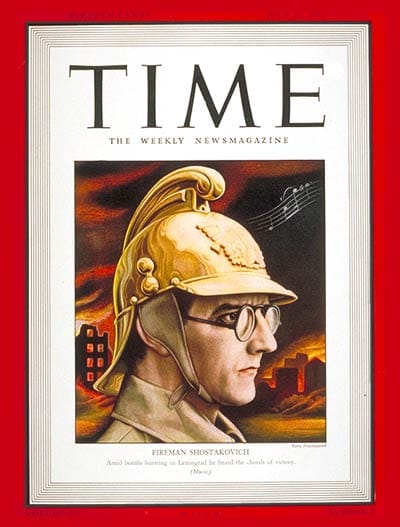
Shostakovitch heard of the invasion on his radio and immediately (so it is said) trekked down to the army recruiting office. He was denied service, and probably not just because he was very short-sighted. But there's a well-known photo of him later that shows him posing in a helmet with fire hose in hand on the roof of the Leningrad Conservatoire. He was, for a short time, a member of the Conservatoire fire brigade. He was also, against his will, and with his usual sense of fearful awkwardness, becoming a national symbol of resistance. The photo appeared on the cover of Time Magazine.
Later, he and his family were ordered out of Leningrad by the authorities just before the Nazi siege began. He flew across the German lines with the score of his latest symphony, No. 7, on his lap. Soviet propagandaists later said that the music had been "𝘣𝘢𝘵𝘩𝘦𝘥 𝘪𝘯 𝘧𝘪𝘳𝘦". He and his family later settled at Kuibyshev, away from the fighting.
What the truth of the story is depends on what you want to believe. What I've written above is the 'official' version, much repeated by wartime commentators, and now probably more myth than actuality. But it doesn't matter.
It's true that Shostakovitch was a brave man in his own way. He never charged a machine gun nest, bayonet in hand. But he did fight his own war. What is true is that he would have stayed in Leningrad even after the siege began, given the choice. In context, one has to remember that at least one million Leningraders died (from starvation, cold, bombing, shelling, etc.) during the 900-day siege. They are buried in mass graves at Piskaryovsky cemetary. But their memorial is elsewhere: in the notes of Shostakovitch's Symphony No. 7, 'Leningrad'.