
Satires 5: The Farage Phenomenon
Nigel Farage is not Adolf Hitler. He is just a VERY naughty boy!
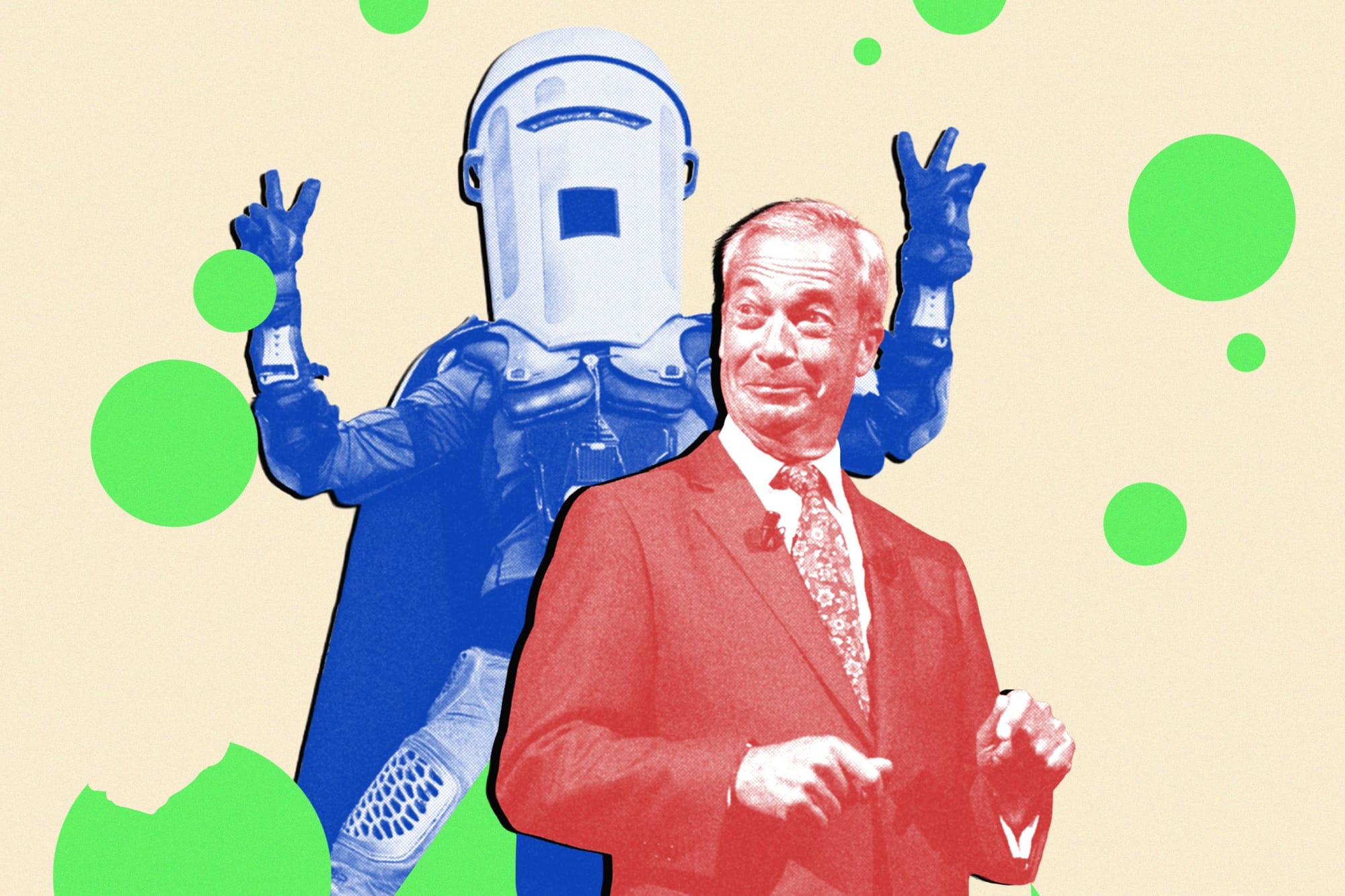
The Farage Phenomenon: A Satirical Autopsy of a Political Miracle
An inquiry into the circumstances, rhetoric, and alarming parallels that made a privilege-immune, twice-bankrupt, serial-failure party leader into the most consequential British politician of the twenty-first century — and what it says about us.
"I have never lost an election. I have merely not yet won the right number of them."
— Nigel Farage, probably.
I. In Which We Begin with Count Binface
There is a peculiar dignity in losing a UK Parliamentary seat to Count Binface. Not the dignity of narrow defeat — Farage did not lose narrowly. He won Clacton in 2024 by 6,147 votes, and held it again in 2026 with a majority that would have been impressive for a mainstream party, let alone one that did not exist five years ago. The dignity, rather, is in the company it keeps: Farage, who has now attempted election to Parliament seven times (if you count his various attempts), who has failed to become an MP six times before finally succeeding, and who has been described by his own party colleagues as "not a team player" and by virtually everyone else as "a man who has made a very comfortable living from losing," now shares the peculiar fate of all great English political entities: he has been given a run for his money by a candidate whose key identifying mark was wearing a dustbin on his head.
And yet. The question this essay pursues is not whether Farage is a figure of ridicule — he manifestly is, and he knows it, and, crucially, he has weaponised it. The question is rather: how is it that a man who has spent three decades failing upward, who was bankrupted twice by his own company's expenses, who described the January 6th Capitol riot as "a day of liberation," who once posed with a genuine golden toilet installed in a building he was pretending to care about... how is it that such a man now sits in the House of Commons as leader of the third-largest party in Britain, with a vote share that terrifies the Conservative Party into apoplexy and sends Labour into quiet, existential despair?
The answer, this essay argues, is not simply 'the EU' or 'immigration' or "the established parties failed to listen." It is something more unsettling: it is the precise configuration of social, economic, and psychological conditions that, historically, have made fascism not just possible but likely. And the parallel with Adolf Hitler — carefully, cautiously, and with the clearest possible disclaimers — is not merely provocative. It is, in certain structural and rhetorical respects, genuinely illuminating.
II. The Carefully Stated Preconditions, Without Which Nothing Follows
Before proceeding, let us be absolutely plain about what this essay is not claiming.
Nigel Farage is not Adolf Hitler. He does not command a paramilitary organisation. He has not promised the systematic extermination of any group. He has not, to anyone's knowledge, harboured ambitions of continental domination. The comparison in these respects would be obscene, historically illiterate, and (this is the part that matters) counterproductive, because the lazy invocation of Hitler devalues the currency of serious historical analysis and allows the actual mechanisms of far-right mobilisation to slip past unexamined.
What this essay is arguing is more specific and, in its own way, more alarming: the conditions that enabled Farage's rise share significant structural features with the conditions that enabled Hitler's rise in the Weimar Republic.
The rhetorical strategies are similar in kind, if not in degree. The emotional satisfactions on offer are related in character. And the social and psychological vulnerabilities he exploits are not unique to Britain nor to this moment. They are the permanent vulnerabilities of liberal democracy, waiting always for the right catalyst.
That is a serious claim. It requires a serious treatment. What follows is an attempt at one.
III. What We Mean When We Say "Fascism" — and Why It Matters
The word "fascist" has, in common usage, been so stretched that it now means little more than "someone I disagree with strongly." Jonathan Sumption, the former Supreme Court judge, was recently described as a fascist by a protester. Nigel Farage has been called a fascist so many times that the word has become almost meaningless. When Keith Allen made a film connecting Farage to the BNP, the charge was made so routinely that it ceased to carry weight.
This is dangerous, for reasons the left has repeatedly failed to grasp. When everything is fascism, nothing is — or rather, the real mechanisms of far-right mobilisation become invisible precisely because we have used up all our analytical vocabulary on invective.
Let us be precise, then. The fascism of historical interest (the thing that actually happened in Germany, Italy, and Spain) had several components:
- A crisis narrative: things are fundamentally broken, the existing system is complicit in the crisis, the nation is under threat from enemies both within and without.
- A strongman figure: someone who speaks for "the people" against a corrupt, self-serving elite.
- An out-group: a scapegoat — Jews, immigrants, communists, cosmopolitans — to whom the crisis can be attributed.
- A mythology of national rebirth: through strength, unity, and the rejection of cosmopolitan decadence.
- A hostility to democratic norms: not necessarily in word but in practice. A willingness to use democratic means to destroy democratic ends.
These are not unique to fascism. But their combination, in conditions of economic instability, cultural disruption, and loss of social trust, has historically been explosive.
IV. The Weimar Parallel — And Its Limits
The Germany into which Adolf Hitler emerged was a democracy that had been perceived as imposition rather than evolution. A system imposed by defeat in war, sustained by foreign subsidy, and widely perceived (not entirely without reason) as illegitimate from the start. The treaty of Versailles was experienced as a national humiliation. The economic catastrophe of 1923 (hyperinflation that rendered the Reichsmark worthless, savings obliterated, the middle class destroyed) created a visceral, personal rage against the established order.
The comparison with contemporary Britain is imperfect in important ways. We have not lost a world war. We have not suffered hyperinflation. Our constitutional settlement, for all its absurdities, retains a legitimacy that Weimar's never quite achieved. And yet...
The structures of grievance are recognisable. The established political class is experienced (again, not entirely without reason), but remote, self-serving, and indifferent to the lived realities of ordinary people. The financial crisis of 2008, and the subsequent austerity, destroyed savings and livelihoods in ways that the political class appeared to absorb without significant cost to themselves. The EU membership question — Farage's singular obsession — was experienced by large portions of the electorate as a sovereignty wound: a sense that decisions affecting British lives were being made by unelected bureaucrats in Brussels, and that no mainstream politician had the courage to address it.
This is the soil in which the Farage Phenomenon took root. Not the man's charisma — he has little of the oratorical power Hitler possessed — but the readiness of a significant portion of the British electorate to hear exactly what he was saying.
V. The Rhetoric. Or, The Art of the Us vs. Them
If Farage has a gift, it is not for policy. He has never demonstrated any particular interest in, or aptitude for, the mechanics of governance. His gift is for identification: the ability to make a specific group feel seen, heard, and aggrieved in precisely the way they wish to feel aggrieved.
The classic fascist rhetorical move is the creation of a dualism: the pure people versus the corrupt elite, the authentic nation versus the rootless cosmopolitans, the healthy body politic versus the diseased infiltrators. This is not uniquely fascist. Populists of the left do it too, in different directions. But Farage's deployment of it is distinctive in several respects.
First, the enemy is always dual: both the domestic elite (the 'political class,' 'the blob,' 'Westminster') and the external other (immigrants, the EU, 'Brussels'). This creates a paranoid geometry in which attack from all sides is the natural condition of the true patriot.
Second, the authentic people are always implicitly defined: white, British, working-class or lower-middle-class, nostalgic for a past of full employment, council houses, and national pride. This is never stated explicitly. That would be too crude, too easily dismissed. But it is conveyed through tone, example, and the carefully curated affect of the man himself: beer, cigarettes, football, the pub, the 'ordinary bloke'.
Third, suffering is always the proof of virtue: those who have struggled are better than those who have succeeded through the system. This is the inversion that makes Farage's biography so useful: he has failed repeatedly (seven election defeats before 2024) but reframes each failure as proof of establishment hostility. He is, in his own telling, a loser who wins by losing.
Fourth, the enemy is caricature: Remainers are "citizens of nowhere." Immigrants are a tide to be stemmed. Extinction Rebellion activists are "eco-warriors." The BBC is "biased" — always and only against him. This flattening of complexity is not accidental; it is the mechanism by which the dualism is maintained. Complexity is the enemy of clarity, and clarity is the enemy of rage.
VI. The Hysteria — or, Why People Lose Their Minds
What is perhaps most disturbing about the Farage Phenomenon is not Farage himself. He is, in the end, a fairly ordinary man of limited intellect and even more limited curiosity. It is the quality of devotion he inspires.
This is where the Hitler comparison becomes most uncomfortable. The rallies. The chants. The sheer, visceral certainty. The people who wept when Farage walked into a room. The Reform canvasser who told a journalist, with complete sincerity, that Farage was "the only man who tells the truth." The consistency with which supporters describe him as "authentic" — when what they mean, in practice, is that he says the things they already believe, in a register that confirms their existing prejudices.
This is the hysteria that bothers me, and it should bother everyone. Not because it is new — political hysteria is as old as politics — but because it is intensifying, and because the digital infrastructure that amplifies it is more powerful than anything the Weimar Republic had.
The mechanism is not mysterious. When people feel unheard, when institutions have failed them, when complexity has overwhelmed their sense-making capacity, the arrival of a figure who offers simple stories about complex failures is almost irresistible. The story does not have to be true in any evidentiary sense. It has to feel true. It has to make the listener feel vindicated: yes, I was right to be angry, and here is the proof.
This is what Farage offers, and it is what Hitler offered, and it is what demagogues of every era have offered. The form is ancient. The technology is new. The danger is real.
VII. The Crucial Dissimilarity — And Why It Is Both Reassuring and Not
It would be dishonest to leave the Hitler comparison without addressing the most significant disanalogy: Farage has never sought, and shows no appetite for, the seizure of power through extra-constitutional means.
Hitler operated in a context of institutional collapse. The German state was weak, divided, and terrified of communism. The judiciary was compromised. The army was a state within a state. There was no equivalent of the British civil service, the independent judiciary, or the tradition of parliamentary sovereignty. Institutions that, for all their imperfections, have proved remarkably resilient.
Farage has, in a curious way, been a creature of the very system he claims to despise. He has used elections, the courts, the European Parliament, and the press with considerable skill. He has never called for the violent overthrow of the government. He has, when it suited him, expressed admiration for the British army and police. His threat, to the extent that he is one, is not through putsch but through the gradual normalisation of his rhetoric, the corruption of the centre-right, and the shift of the Overton window ever rightward.
This is, it must be said, a more plausible scenario for Britain than any kind of outright authoritarian takeover. And it is, in its own way, more insidious — because the normalisation of far-right rhetoric does not require a single dramatic act. It requires only that decent people, for reasons of political pragmatism, start using the language that Farage has made respectable.
VIII. The Collapse of Democratic Discourse — or, How We Got Here
The question this essay began with — how can a sophisticated and civilised nation like the UK have produced the Farage Phenomenon? — deserves a direct answer, or at least as direct an answer as the essay form permits.
The answer is not that British voters are stupid, or racist, or uniquely susceptible to authoritarianism. The answer is that the political class, over several decades, made a series of choices that systematically devalued democratic discourse and destroyed the conditions for good faith disagreement.
Tony Blair's Iraq War — the decision that, more than any other, created the cynicism about mainstream politics that Farage would later harvest. David Cameron's EU referendum — the most reckless act of political irresponsibility in the modern era, a gamble with national sovereignty to settle an internal party dispute. The Grenfell Tower fire, and the sequence of scandals (Windrush, the Post Office, the infected blood) demonstrated, repeatedly and catastrophically, that the state could lie to its citizens with impunity.
By the time Farage arrived with his simple stories, the ground had been thoroughly prepared. Not by him. By everyone else.
The collapse of local journalism (some 300 local newspapers closed since 2005) removed the investigative infrastructure that holds politicians to account at a local level. The fragmentation of the media ecosystem meant that different groups of citizens were now living in different informational universes, with no shared set of facts from which to begin a conversation. The political class responded to this by becoming more evasive, more focus-group-driven, more contemptuous of ordinary people's intelligence.
It is not surprising that a man who seemed to speak plainly should have found such fertile ground. It is only surprising that we did not see it coming.
IX. What Is to Be Done — or, A Modest Proposal for Sanity
This essay is, by temperament and training, more analytical than prescriptive. But a few observations may be in order.
The first is that the enemy is not Farage. It is the conditions that produce him. As long as the political system is perceived — correctly or not — as serving the interests of a metropolitan elite at the expense of everyone else, someone will occupy the role of the man who tells the 'truth.' He does not have to be particularly clever, or particularly honest, or particularly fit for office. He has to be perceived as different, and in a political class that has spent decades demonstrating its own worthlessness, the bar for different is extraordinarily low.
The second is that the language of "fascism" and "Nazi" deployed indiscriminately against the right has been, and continues to be, a gift to the right. Every time a reasonable restriction on immigration is characterised as "Nazi policy," every time a man like Farage is compared to Hitler without the careful distinctions this essay has attempted, the effect is to trivialise the historical memory of actual fascism and to make the genuine warnings harder to hear. We have cried wolf so many times that when the wolf arrives, no one is listening.
The third (and this is the hardest bit) is that the centre-left must find a way to address the legitimate grievances that Farage has so cynically appropriated. Not by becoming Farage, not by adopting his language, but by demonstrating that it has a credible plan for the places and people who have been left behind. This requires something the British centre-left has not managed in a generation: an actual vision, backed by actual policy, delivered by actual people who are prepared to live in the communities they represent, not just visit them at election time.
X. Conclusion: The View from Clacton
Count Binface has not won Clacton. Nigel Farage has. And whatever happens in British politics in the coming years, that fact will stand as a monument to the peculiar alchemy of grievance, simplification, and institutional failure that now defines our political life.
There is a kind of dark comedy in the fact that Farage, who built his career on opposition to the EU, achieved his parliamentary seat partly because of the very Westminster system he professes to despise — a system that, for all its absurdities, still occasionally rewards persistence with success. He is a creature of the thing he claims to oppose. Like all the best populists, he has found the gap in the wall and climbed through it and now stands in the garden claiming to have built the wall himself.
The satirical tradition in England (from Swift's Modest Proposal to Spitting Image to the entire career of the variable-quality Count Binface) has always understood that the purpose of satire is not merely to mock but to hold up a mirror in which the absurdity of power becomes visible. Farage has made himself into a satirical figure precisely because he is, in some lights, a figure of genuine absurdity.
But satire alone does not stop him. Analysis does not stop him. The right words, however carefully chosen, do not stop him. What stops him — what has always stopped him — is the slow, unglamorous, often tedious work of making democracy work for the people it is supposed to serve.
That work has not been done. That is why we are here.
Bibliography and Further Reading
- Paxton, Robert O. The Anatomy of Fascism (Penguin, 2004)
- Eatwell, Roger. Fascism: A History (Viking, 1995)
- Griffin, Roger. The Nature of Fascism (Routledge, 1991)
-弹el, Mark. The Populist Wave (Edinburgh University Press, 2019) - Muller, Jan-Werner. What Is Populism? (Penguin, 2016)
- On Britain's democratic deficits: the UK Constitutional Reform Act 2005; the Hansard Society's annual Audit of Political Engagement
- On Farage: Graham, Douglas. Nigel Farage: The Rise and Rise of the Brexit Party (Biteback, 2024)
- On the media ecosystem and political fragmentation: Lazer, David M.J. et al., "The Science of Fake News" Science 359 (2018)
This essay is a work of satirical political analysis. It does not claim that Nigel Farage is literally Adolf Hitler. It claims something more unsettling: that the conditions that make men like Farage possible are the same conditions that made men like Hitler possible, and that ignoring that parallel, out of politeness or cowardice or the false comfort of disanalogy, is itself a form of political failure.
Bea Groves-McDaniel, August 2026.