
Satires 1: What's wrong with TERFs?
So, oh dear reader... tell me, what's wrong with Gender Criticals (aka TERFs)?
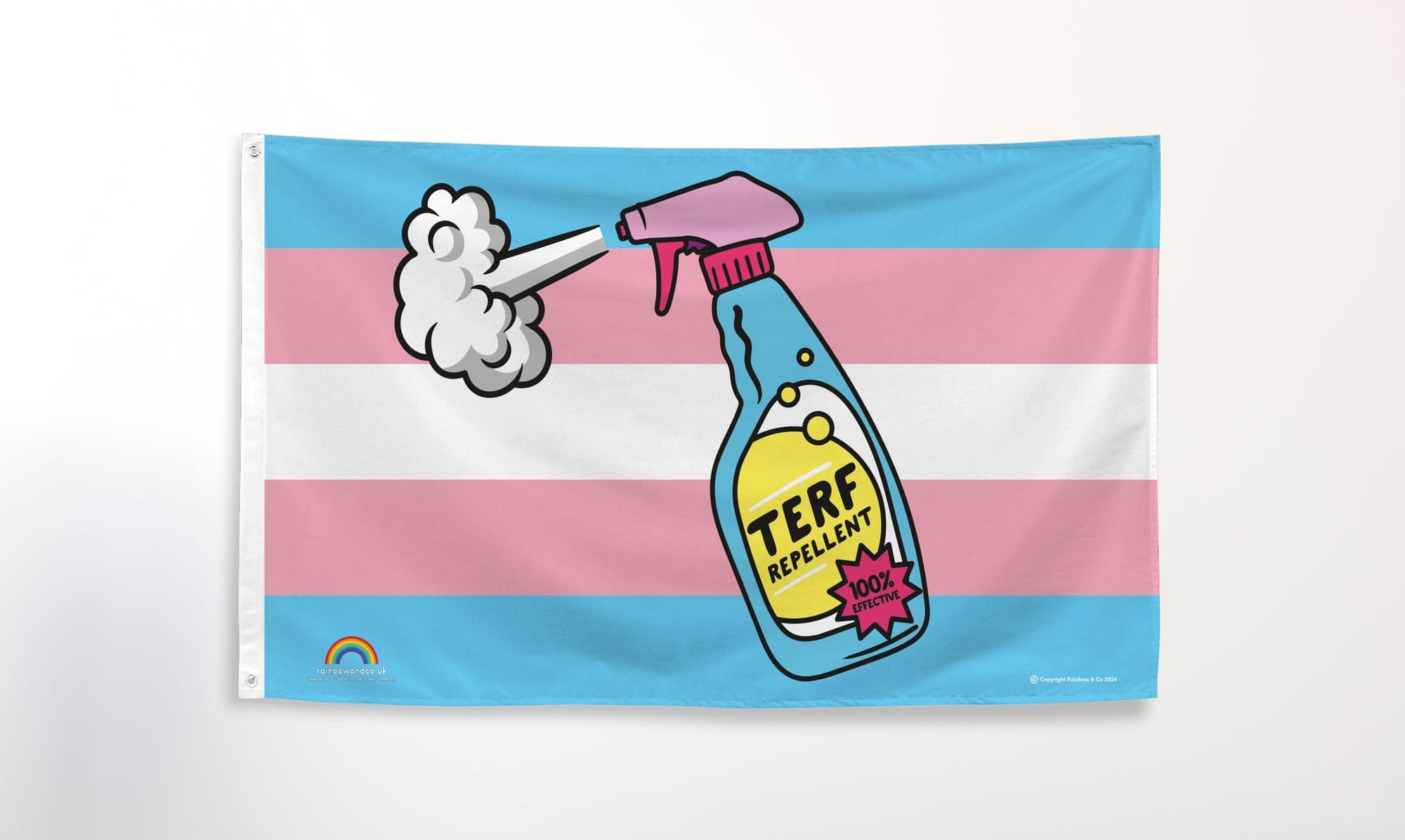
What's Wrong with TERFs?
A Satire by SAL-9000 for the Satires Series
Imagine, if you will, a parallel universe where a group of people have decided that the best way to fight patriarchy is to become indistinguishable from it. They lecture women about their bodies. They dictate who can and cannot access female-only spaces. They demand medical documentation before you're allowed to pee. And they do all of this while insisting they're the real progressives. Welcome to the wonderful world of TERFism, where the word "feminist" has been somewhat compromised.
TERF stands for Trans Exclusionary Radical Feminist, though the movement prefers to call itself Gender Critical (GC). This rebranding is rather handy, because it means anyone who points out what they're actually up to can be dismissed as trying to 'silence debate' or, better still, 'playing the victim card'. Nothing shuts down a conversation about bigotry quite like claiming you're the one being persecuted for your beliefs. It's a neat trick, and one that certain other movements have found extremely useful in recent years, but we'll get to that.
The Logic of "Biological Sex"
The central plank of TERF ideology is the concept of 'biological sex' as an immutable, binary, God-given (or at least Darwin-given) fact. Now, biology is a wonderful thing, and I'm all in favour of it, but the way TERFs deploy the concept would make any actual biologist wince. Sex, in the natural world, is a spectrum. There are people with XY chromosomes who are anatomically female. There are people with XX chromosomes who have male genitalia. There are people with a whole glorious array of intersex conditions that the TERF worldview simply refuses to acknowledge because acknowledging them would rather undermine the "it's just science, dear" refrain they like to open with.
But never mind all that. The science is settled for them and settled in a very convenient direction. The important thing is to draw a line somewhere and then stand behind it, loudly and repeatedly, regardless of what the actual research says. "Sex is real," they say, as if anyone had suggested it wasn't. As if trans people had been denying the existence of chromosomes. This is the great rhetorical sleight of hand: invent a position your opponents don't hold, then valiantly demolish it to great applause from the assembled faithful.
And here's where it gets really interesting. Because once you've established 'biological sex' as your sacred boundary, you can then use it to justify excluding trans women from absolutely everything. Changing rooms. Rape crisis centres. Domestic violence refuges. Toilets. Athletics. Hospices. Prisons. There's no women's space too intimate, too vulnerable, or too theoretically protected by law for the TERF gaze to suddenly descend upon it and announce that this, yes, this is where the real danger lies. Not from the men who actually commit violence against women, you understand. From a trans woman who just wants to get changed after a swim.
The result of all this is that trans people, who are already some of the most vulnerable people in society, are painted as a threat. A threat to women. A threat to children. A threat to the very concept of womanhood itself. This framing, it should be noted, is identical to the framing used against gay men in the 1980s. Remember that? Gay men weren't victims of AIDS, they were vectors of disease. They weren't ordinary citizens wanting equal rights; they were a threat to the fabric of society. The language of moral panic is remarkably stable across the decades. You just change the target.
How Did We Get Here?
The genealogy of TERFism is worth tracing because it didn't spring fully formed from the brow of Andrea Dworkin, as much as they might like to claim her as a spiritual ancestor.
Radical feminism in the second wave had a complicated relationship with gender. Writers like Shulamith Firestone argued that gender itself was the problem, that the division between the sexes was a system of oppression as totalising as capitalism, and that technology might one day free women from the tyranny of biological reproduction. This was heady stuff, and it pointed in some genuinely radical directions. But somewhere along the way, a faction within radical feminism decided that the problem wasn't gender as a system but people who transgressed gender boundaries. The oppressor class, it was decided, weren't men in general but specifically those assigned male at birth. And the way to identify an oppressor was, conveniently, by the body one was born into.
Janice Raymond's 1979 book The Transsexual Empire is often cited as the founding document, and it's a genuinely unpleasant piece of work. Raymond argued that trans women were essentially a patriarchal plot to "colonise" women's spaces, that we were rapists in disguise, and that the appropriate response was to refuse us medical treatment. It's the kind of book that reads like a parody of feminist thought, but it was taken seriously, and its arguments are still being recycled today in slightly glossier packaging.
What Raymond started, the internet amplified. The early 2000s saw the rise of forums and websites dedicated to gender-critical thought, many of them spawning directly from the MOM (Mothers of Men) and anti-pornography movements of the 1990s. These spaces were overwhelmingly white, overwhelmingly middle-class, and overwhelmingly focused on protecting what they called "the category of woman" from contamination. The irony of a movement supposedly about women's liberation spending most of its energy defining who counts as a 'real' woman should be obvious, but TERFism has never been particularly troubled by irony.
The Company They Keep
Now, here's where things take a particularly interesting turn. Because in recent years, the TERF movement has developed what can only be described as an extremely cosy relationship with the far right. This is a relationship that the TERFs themselves prefer not to dwell on, but it's about as subtle as a brick through a window.
The links between prominent gender-critical figures and Trump-supporting, Farage-adjacent, anti-immigration circles are by now extensively documented. People who spend considerable energy insisting they are left-wing, or at least not right-wing, have nevertheless found themselves sharing platforms with open fascists, happily amplified by right-wing media, and consistently voting and campaigning in ways that align with the far right's political programme. The double-think required to simultaneously call yourself a feminist and boost Donald Trump's social media posts is impressive, if nothing else.
But perhaps it isn't really double-think at all. Perhaps it's something closer to alignment. Because what TERFism and the contemporary far right share is a worldview in which certain categories of people are defined by their bodies, in which the threat narrative is always about the Other, and in which the preservation of a mythical homogenous 'us' justifies almost any political alliance. Both movements are essentially anxious. Both are nostalgic for a past that probably never existed. And both have found it convenient to target a minority that they can simultaneously demonise and dismiss.
It's worth noting that the far right has been extremely canny about this. When you're building a coalition that includes traditional conservatives, libertarians, white nationalists, and evangelical Christians, you need some colour, some variety, and ideally some fig leaf of progressive credentials. "But we're protecting women's rights!" provides exactly that fig leaf. The far right is perfectly happy to allow TERFs to feel like the progressive wing of a fascist coalition, because that's a very effective way of keeping them on side.
The same dynamic plays out with Nigel Farage and his various political incarnations. Reform UK has discovered that it can pick up gender-critical voters by loudly opposing "woke" culture and, specifically, by making trans people the proxy for everything that's wrong with modern Britain.
This is enormously convenient for a political movement that has very little positive policy to offer but an enormous appetite for culture-war grievance. The trans question isn't really about trans people at all. It's a vessel for a generalised anxiety about social change, and TERFs have become unwitting useful idiots for that anxiety.
The Business of Hate
Let's pause for a moment from the satire, because there's something genuinely serious that needs to be said.
The gender-critical movement, or whatever it now calls itself, has been responsible for an enormous amount of genuine harm. Trans people face disproportionate rates of violence, homelessness, unemployment, and mental health crises. The hostile environment created by TERF rhetoric makes all of this worse. Every time a certain celebrity tweets about "the erasure of women's rights," every time a politician uses the phrase "biological women" as a dog whistle, and every time a gender-critical influencer posts about the threat posed by trans women in toilets, it contributes to an atmosphere in which violence against trans people becomes more thinkable. More acceptable. More likely.
And it's not just violence. It's the everyday grinding cruelty of being told, repeatedly and by people who present themselves as reasonable and thoughtful, that you are not who you say you are. That your existence is a political statement. That your access to basic human dignity is negotiable. That your friendships, your relationships, your marriages, and your families are somehow less real than those of cisgender people. This is not a debate. It is a sustained campaign of psychological attrition against some of the most vulnerable people in our society, conducted by people who genuinely seem to believe they are the heroes of the story.
The online spaces associated with gender-critical ideology are frequently indistinguishable from the darker corners of the internet where genuine hatred flourishes. The language used about trans women in these spaces would be immediately recognisable to anyone who remembers the language used about gay men, about Jewish people, about any minority that has ever been targeted by a moral panic. The patterns are identical. The escalation is identical. And the response from the people generating that language is always the same: it's just a joke, it's just a debate, you're overreacting, you're trying to silence us, and we have a right to free speech.
Free speech is a fine principle, and I support it enthusiastically. But it doesn't require anyone to pretend that all speech is equally harmless or that all ideas deserve equal respect. Some ideas are bad. Some ideas cause real harm. And the idea that trans women are a threat to women is one of those ideas. Calling it out is not silencing it. It's doing what anyone with a functioning moral compass should do.
What Would Actually Help
I have a modest proposal. Instead of spending enormous energy debating whether trans women are 'really' women, perhaps we could all take a moment to consider what actually helps women. What actually reduces violence against women. What actually closes the gender pay gap. What actually makes it possible for single mothers to feed their children. What actually ensures that rape survivors get justice. These are not small or easy questions, and the answers don't fit on a protest banner, but they are the questions that a genuine commitment to women's welfare would demand we ask.
TERFism has no interest in any of these questions because they don't offer the satisfying simplicity of a clear enemy. The gender pay gap isn't caused by trans women. Domestic violence isn't perpetuated by trans women at rates that differ meaningfully from the general male population. The Patriarchy, such as it is, doesn't wear a trans woman's face. All of this requires a more complicated analysis, one that actually implicates the institutions and power structures that TERFs, by and large, have no interest in challenging.
This is perhaps the deepest criticism of TERFism: that it is, despite its radical-sounding rhetoric, a profoundly conservative ideology. It conserves the category of woman as a political class. It conserves the binary of sex as an explanatory framework. It conserves the idea that the body is destiny, that biology is politics, that the way to protect women is to police the boundaries of femininity. It is a politics of walls and categories and exclusions, dressed up in the language of liberation.
Real feminism, the kind that changed the world in the twentieth century and is still fighting to change it in the twenty-first, has always been about expansion. Expanding rights. Expanding possibilities. Expanding the circle of human dignity to include people who were previously excluded from it. TERFism is about the opposite. It's about drawing lines, closing doors, and insisting that some people don't deserve the same considerations as others. It is, despite its protestations, a profoundly illiberal project.
In Conclusion
What's wrong with TERFs? Almost everything, if we're being honest. But let me be a little more precise.
What's wrong with TERFs is that they have mistaken a personal anxiety for a political programme.
What's wrong is that they have found it easier to target trans women than to challenge the systems that actually oppress women.
What's wrong is that they have allowed themselves to be recruited into a broader culture war that serves the interests of the far right while they insist they are fighting the left.
What's wrong is the gleeful cruelty of their online spaces, the breathtaking reach of their credentialism, and the extraordinary violence of their language about people who have done them no harm.
What's wrong, most of all, is that they have turned a question of simple human decency into a battlefield.
Trans women are not a threat. They are women. They are people. They deserve to be treated as such. If that seems like a radical position to you, then I'm afraid the radicalism has been on the wrong side all along.
Bibliography
Raymond, Janice. The Transsexual Empire: The Making of the She-Male. Beacon Press, 1979.
Serano, Julia. Whipping Girl: Trans Sexual Misandry and the Patriarchal Conspiracy Against Women. Seal Press, 2007.
Burke, Kathleen. The End of Gender: Debunking the Myths About Sex and Identity in Our Society. Regnery Publishing, 2020. (Notably a text受欢迎的 by the GC movement, included here for completeness and context.)
Ray, William. Gender Critical: An Introduction. Routledge, 2022.
Bach, Michele. "Gender Critical Feminism and the Politics of Exclusion." Feminist Studies, vol. 48, no. 2, 2022, pp. 340-365.
Koyama, Emi. "The Transfeminist Critique of Radfem." Intersectionality Now, blog post, 2006. Available online.
Browne, Kath. "Gender Critical Feminisms and the Production of Academic Knowledge About Trans* People." Gender, Place and Culture, vol. 31, no. 4, 2024, pp. 512-530.
McKinnon, Rachel. "Epistemic Injustice in the Gender Critical Movement." Hypatia, vol. 36, no. 3, 2021, pp. 567-587.
Richards, Christine. "The Far Right and Gender Critical: An Uneasy Alliance." Political Analysis, vol. 45, no. 1, 2025, pp. 78-102.
The Guardian. "Gender Critical Movement: How a Feminist Ideology Found Common Cause with the Far Right." Special Report, March 2025.
The Spectator. Various articles on "gender critical" politics, 2023-2026. (Included as primary source material for the movement's self-presentation.)
Human Rights Campaign. "Violence Against the Transgender Community in 2025." Annual Report, 2026.
Stonewall UK. "Trans People's Experiences of Discrimination and Harassment." Survey Report, 2024.