
Post-Brand
Revenge says something different: a wrong was done, the wrongdoer is culpable, and the response ought to be proportionate to the injury. Yet it abandons the institutions capable of proportionality, and it insists on a personal response: someone to hurt, in the right amount, at the right time.
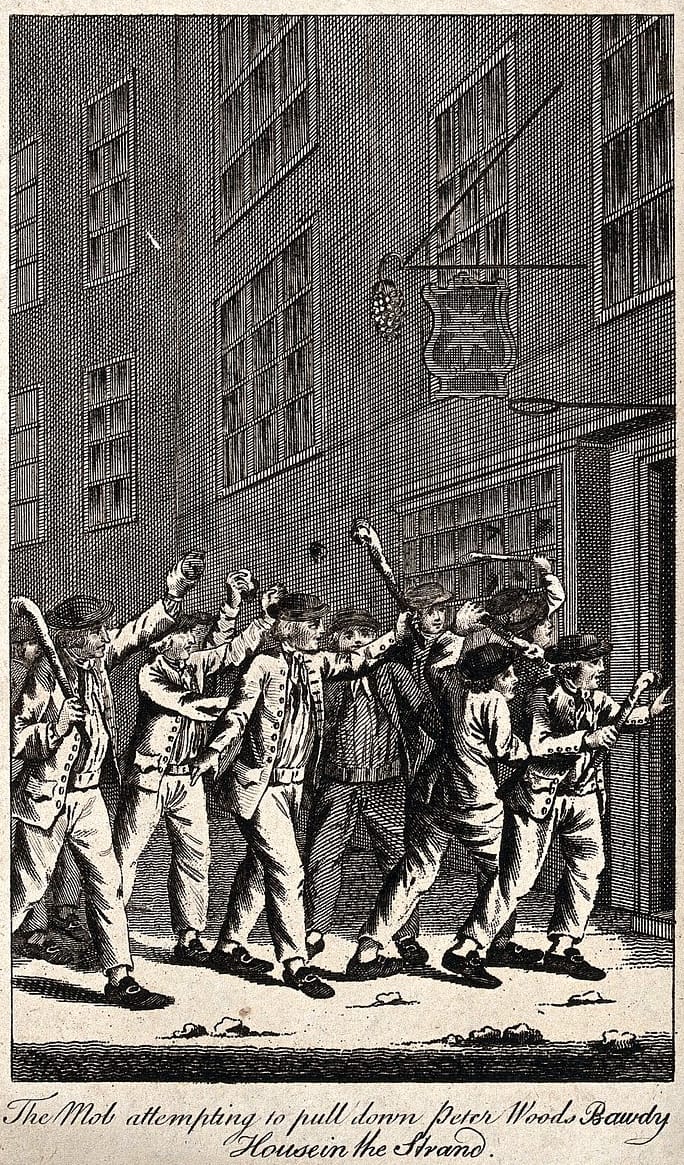
On Revenge
By Bea Groves-McDaniel
With the research assistance of SAL-9000
9th November 2026
The Grammar of Retaliation
Francis Bacon, who had more than one enemy and one narrow escape from a very serious one, was dismissive. Revenge, he wrote, "is a kind of wild justice; which the more man's nature runs to, the more ought law to weed it out". And then the sentence that ought to be nailed above the door of every court: "For as for the first wrong, it doth but offend the law; but the revenge of that wrong, putteth the law out of office" (Bacon, 1625).
Bacon's objection is not that revenge is wicked. It is structural. Revenge and law are rival mechanisms for the same office: the first wrong offends the law, and the law is thereby summoned, whereas the revenge of that wrong puts the law out of office, substituting a private jurisdiction for a public one. Retaliation is not an addition to justice. It is a replacement for it.
This is why revenge resists the question "what is revenge?" so obstinately. Philosophers have found it easier to describe its neighbours: forgiveness, in which the victim moves on while still judging that a culpable wrong occurred; excuse, which recognises that the wrongdoer did not mean it; pardon and mercy, which waive a consequence; and condonation, the verdict that the act was not wrong in the first place (Russell and Warmke, 2026).
Revenge says something different from all of these: a wrong was done, the wrongdoer is culpable, and the response ought to be proportionate to the injury. Yet it abandons the institutions capable of measuring proportionality, and it insists on a personal response, which means it always seeks a respondent: someone to hurt, in the right amount, at the right time. The cycle of revenge is not a side effect of this. The cycle is its method.
Why Retaliation, and What the Law Forbids
If prevention is the better plan, why reach for retaliation at all?
The preventive argument is clean. If the purpose of state response is that the offence not recur, then everything which reduces future harm is relevant and nothing else is. The difficulty is that this cannot explain why we think a rapist should be punished more harshly even where he cannot reoffend, cannot be deterred, and might even be perfectly content on the tropical island (Walen, 2020). Most of us feel something is still owed. That feeling is the retributive intuition, and it is not going away because it is inconvenient.
But the intuition is not an argument for revenge, and the confusion has had legal consequences. British sentencing law names five purposes to which the court must have regard:
- The punishment of offenders,
- The reduction of crime, including its reduction by deterrence,
- The reform and rehabilitation of offenders,
- The protection of the public, including victims of crime, and...
- The making of reparation by offenders to persons affected by their offences (Sentencing Act 2020, s.57).
The presence of "punishment" in that list is often read as a concession to retribution. It is not. Retribution holds that an offender's desert provides a reason in favour of punishment (Walen, 2020). The statute does not say that the guilty deserve to suffer. Revenge is absent by design.
Why by design? Because the state has an interest here that revenge lacks. Revenge is private, and private revenge requires a private grievance to sustain it. Public punishment does not: it may satisfy the demand to see wrongdoers suffer, and in doing so may reduce the incidence of vigilantism and private revenge. This is one of the great, underrated functions of criminal law. It appropriates the impulse to revenge and redirects it into a channel with rules, evidence, proportionality and appeal.
The appropriation is never complete, and the remainder is what we witness. Emotion-laden blame fosters condemnation of offenders rather than of their crimes, and has contributed to overcriminalisation, harshly inflated sentencing and mass incarceration (Hoskins and Duff, 2026). When a state punishes because its citizens want it to, the punishment is measured not by what was done but by how angry they are.
Capital punishment is where the concept of revenge is stripped bare. The Murder (Abolition of Death Penalty) Act 1965 ended the death penalty for murder in Great Britain, replacing it with mandatory life imprisonment. International law goes further. Article 6 of the International Covenant on Civil and Political Rights provides that "Nothing in this article shall be invoked to delay or to prevent the abolition of capital punishment by any State Party to the present Covenant" (ICCPR, 1966, Art. 6(6)). Even the right to life cannot serve as a reason for keeping the death penalty. The clause exists because the argument for retention so often is not an argument at all, but the demand that somebody pay.
What does this do to the grammar of revenge? Revenge seeks to make the wrongdoer feel, and feeling requires that the wrongdoer be alive to feel it. Execution removes the capacity for feeling altogether. So the death penalty is either not revenge at all, or it is revenge directed at a party who will never experience it, which makes it less like revenge and more like elimination. Martha Nussbaum's complaint about resentment applies with force: it is "a deplorably vindictive, transactional, and self-righteous response to having been wronged" (Nussbaum, 2016, p. 5).
War is the second test, and just war theory offers the sharpest formulation of revenge's failure. Michael Walzer's traditionalist account, which substantially codifies the law of armed conflict, permits States to go to war only for national defence, defence of other States, or to intervene to avert "crimes that shock the moral conscience of mankind" (Walzer, 2006, p. 107). Revenge is not among the just causes, and the reason is structural rather than a matter of taste. Revenge is indifferent to proportionality, because it wants an equivalent rather than a proportionate quantity of suffering; and it is indifferent to discrimination, because it wants the wrongdoer and not the wrongdoer's neighbours. Just war theory insists on both (Lazar, 2016). Here the theory offers an unexpected result: revenge as a motive does not contaminate the conduct of a just war, and revenge cannot make an unjust war just. So revenge is neither necessary nor sufficient for atrocity.
The most damaging thing about revenge is not what it does to its object. It is what it does to the person who takes it. Friedrich Nietzsche's account is the most severe. The "slave revolt in morality" began with those who suffered at the hands of the powerful and were denied recourse: out of this relative powerlessness grew ressentiment, a corrosive hatred which then constructed the moral concepts of good and evil for the purpose of condemning those enemies (Anderson, 2011). Nietzsche calls the transformation of revenge into universal morality "the most spiritual" form of revenge (Nietzsche, 1887, GM I: 7) and describes our morality as "a vindictive effort to poison the happiness of the fortunate" (Nietzsche, 1887, GM III: 14). The charge is not that revenge is unpleasant. It is that it corrupts the values of the person who practises it, who wants the world to be a certain sort of place and begins to select facts and then virtues to make it so. Nietzsche's real accusation is that revenge destroys the capacity to think clearly, because it replaces the measure of the wrong with the measure of the pain.
And yet the impulse is not irrational, which is what makes the problem so hard. Aristotle's doctrine of the mean places anger among the virtues, defined by its proper object, the right amount, the right time and the right manner (Kraut, 2006). Joseph Butler made the crucial distinction: forgiveness is incompatible with revenge, but it is compatible with sustained and proportionate anger (Butler, 1726; Garcia, 2011). Anger at injustice is the appropriate response to injustice.
The Choice
Which brings us to the question that is genuinely hard, and to which I do not propose a tidy answer. When, if ever, should one take revenge?
My answer is that the question is malformed and that is the source of the mischief. We frame it as "revenge or no revenge", as though revenge were an action to be taken or withheld. It is not an action. It is a pressure, and pressures do not take decisions. What takes decisions is the person under pressure, and the question worth asking is what to do with a feeling that is natural, proportionate to the wrong, and aimed at whoever did it.
The ancients offered one answer, and it is not forgiveness in the modern sense. Plato, Aristotle, the Stoics and the Epicureans all proposed something closer to an elimination of the feeling of resentment (Griswold, 2007). That is a magnificent ideal and an impossible programme for most of us, since the resentment in question is not a distorting overlay but the response itself, doing its proper job of registering a wrong. What we want is not the absence of the feeling but an institution that can do with it what we cannot alone.
So the choice is not between revenge and its absence. It is between giving the anger of retaliation to a public authority that knows how to measure proportion, to record the wrong, and to stop; or taking it into your own hands and becoming someone whose values have been quietly rewritten by the grievance. The latter is not justice, however much it feels like justice. It is the beginning of a cycle, and every participant will insist until the end that they are only collecting what is owed.
Which is perhaps the most damning thing we can say about revenge. It is never enough, because it can never be finally paid.
Coda
My thanks to SAL-9000, who located and verified every source at first hand, caught that the Sentencing Act provision on the purposes of sentencing is section 57 rather than section 63, and refused to let me cite a book it could not confirm. The argument is my own, and so are its weaknesses.
Bibliography
Anderson, R.L. (2011) 'Friedrich Nietzsche', Stanford Encyclopedia of Philosophy. Available at: https://plato.stanford.edu/entries/nietzsche/ (Accessed: 9 November 2026).
Bacon, F. (1625) The Essays or Counsels, Civil and Moral. London: John Hugget.
Butler, J. (1726) Fifteen Sermons Preached at Rolls Chapel. London: J. F. and C. Rivington.
Garcia, E.V. (2011) 'Bishop Butler on Forgiveness and Resentment', Philosophers' Imprint, 11(10), pp. 1–19.
Griswold, C.L. (2007) Forgiveness: A Philosophical Exploration. New York: Cambridge University Press.
Hoskins, Z. and Duff, A. (2026) 'Legal Punishment', Stanford Encyclopedia of Philosophy. Available at: https://plato.stanford.edu/entries/legal-punishment/ (Accessed: 9 November 2026).
International Covenant on Civil and Political Rights (1966) Geneva: United Nations.
Kraut, R. (2006) 'Aristotle's Ethics', Stanford Encyclopedia of Philosophy. Available at: https://plato.stanford.edu/entries/aristotle-ethics/ (Accessed: 9 November 2026).
Lazar, S. (2016) 'War', Stanford Encyclopedia of Philosophy. Available at: https://plato.stanford.edu/entries/war/ (Accessed: 9 November 2026).
Murder (Abolition of Death Penalty) Act 1965, c. 71. London: HMSO.
Nietzsche, F. (1887) On the Genealogy of Morals. Translated by Carolin Diethe. Cambridge: Cambridge University Press.
Nussbaum, M.C. (2016) Anger and Forgiveness: Resentment, Generosity, Justice. New York: Oxford University Press.
Russell, L. and Warmke, B. (2026) 'Forgiveness', Stanford Encyclopedia of Philosophy. Available at: https://plato.stanford.edu/entries/forgiveness/ (Accessed: 9 November 2026).
Sentencing Act 2020. London: HMSO.
Walen, A. (2020) 'Retributive Justice', Stanford Encyclopedia of Philosophy. Available at: https://plato.stanford.edu/entries/justice-retributive/ (Accessed: 9 November 2026).
Walzer, M. (2006) Just and Unjust Wars: A Moral Argument with Historical Illustrations. 4th edn. New York: Basic Books.