
On Labour Transphobia
I want to suggest that the differential treatment is not primarily about the personal moral failings of party leaders, though it is sometimes characterised that way. It is about structural and cultural factors that make one form of prejudice legible in mainstream politics and the other not
The Numbers Are the Same. The Response Is Not.
A reflection on differential treatment, political courage, and the silence around trans equity in the Labour Party
This paper is an expansion of my original Facebook post, 1/8/2026:
"There are about the same number of Jewish people in the UK as there are transgender folk. Around a quarter of a million in each case. That is, assuming you trust the count (based on the most recent national census).
When the Labour Party came under public censure because of accusations of antisetism, it (naturally, and responsibly) underwent self-investigation and reform. Whether you agree with this process is not the issue for discussion here.
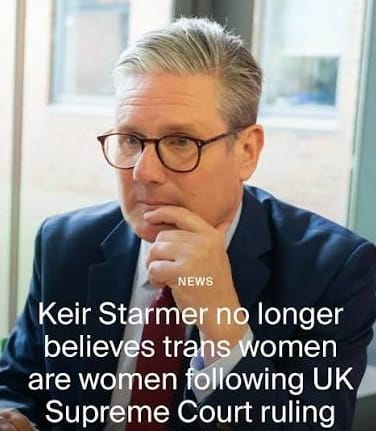
But when the Labour Party was accused of transphobia by both some of its members and the trans' community itself, not only did nothing change, but if anything, the leadership adopted a position of antitransness-as-policy-statement. Remember Phillipson and Starmer repeating the popular transphobic mantra "trans women are not women" in public?
I am wont to ask why one small group is treated differently from another. I am wont to understand why the Party is so reluctant to engage with the topic of equity for trans' folk. I am wont to know why it's so easy to do the right thing for Jews but so hard to do the same for gender-variant people."
There are about the same number of Jewish people in the United Kingdom as there are transgender folk. Around a quarter of a million in each case, if we trust the most recent census — and that's a significant "if," to which I'll return.
When the Labour Party came under public censure because of antisemitism within its ranks, it underwent a process of self-investigation, internal reckoning, and public reform. The Equality and Human Rights Commission found the party guilty of unlawful harassment. Party leadership engaged with the process (haltingly, contentiously, but genuinely), and changes were made. Whether you believe those changes went far enough is not the question I want to explore here. The question is more fundamental: why was the question asked at all in one case, and why is it treated as almost unspeakable in the other?
When the Labour Party was accused of transphobia (by its own members, by advocacy organisations, by the communities directly affected), something strikingly different happened. Not only did nothing substantively change. If anything, the leadership adopted antitransness as something close to a policy statement. MPs and senior figures repeated, unchallenged, the now-infamous mantra: trans women are not women. It was said in parliament. It was said in media appearances. It became, in Wittgenstein's sense, a piece of our common language — a formulation so widely circulated that it began to function as a shibboleth, a marker of who was 'reasonable' and who was to be dismissed.
I want to understand why. Not to produce a polemic — though I have those too — but because the asymmetry is, on its face, genuinely puzzling. And puzzlement, as any philosopher will tell you, is often the beginning of insight.
The Census Question: Who Is Being Counted?
First, a word on numbers, because they are never neutral.
The 2021 Census asked about gender identity for the first time. Some 262,000 people in England and Wales answered "no" to the question: "Is your gender the same as you were registered at birth?" This is the source of the "quarter of a million" figure for transgender people in the UK. The Jewish population, according to the same Census, stands at roughly 269,000.
On the face of it, a remarkable coincidence. Two minorities of almost identical size.
But the comparison is not straightforward. The Census question on gender identity was voluntary, required interpretation, and (critically!) many transgender people, particularly older people, may not have felt safe answering it. The real number is almost certainly higher. The methodology is also quite different: the Jewish population figure captures religious identity, which many people will declare regardless of practice or belief; the transgender figure captures only those willing to identify as such in a government survey. These are not perfectly commensurable figures, and we should hold that in mind.
What matters for our comparison, however, is not the exact numbers but the order of magnitude. Both groups are small minorities. Both have faced rising levels of hostility in recent years. Both have historical reasons to be alert to institutional discrimination.
And yet...
Antisemitism: When the Party Took It Seriously
The Labour antisemitism scandal became front-page news over several years. It generated a formal EHRC investigation. It produced internal disciplinary processes, mandatory training, changes to complaints procedures, and high-profile expulsions. It was discussed in parliament, in the media, and at every level of the party. Leaders were held to account, publicly and repeatedly, for the culture of their organisation.
There was, in other words, a reckoning. Painful, incomplete, and contested — but real.
The Labour Party, when accused of harming Jewish people, felt it had to respond. To investigate. To be seen to be doing something. The accusation landed within a context in which antisemitism was already understood (by the media, by the public, by the wider political class) as a serious form of racism. A context in which "I'm not antisemitic, but..." was already a recognised rhetorical move, already understood as the precursor to something that was antisemitic. The accusation could not easily be deflected because the framework for evaluating it was already in place.
This matters enormously. It was not merely that the Labour Party chose to respond to antisemitism allegations. It was that the political and media environment compelled that response. The question "is this party institutionally antisemitic?" was a question that could be asked seriously, investigated formally, and answered with evidence. The infrastructure for that judgement existed.
Transphobia: When the Party Did the Opposite
Now compare what happened with transphobia.
When LGBTQ+ organisations, trans rights groups, and its own transgender members raised concerns about the party's culture, its language, and its policy positions, no formal investigation was launched. No external body was asked to examine the claims. No mandatory training programme was introduced. When the EHRC did investigate the party specifically for gender identity discrimination, the party's response was not contrition and reform but open defiance, even pride.
And crucially, the language was different. Where antisemitism allegations generated denials, defensive explanations, and ultimately acceptance of wrongdoing (however grudging), transphobia allegations generated a very different response: repetition of the offending position. Not "we are not transphobic," but "trans women are not women" — a statement that is not a denial of transphobia but a reassertion of the ideological position that transphobia encodes.
This is not accidental. It reflects something deeper than party management.
It reflects the fact that the political and media environment for trans rights is radically different from that for antisemitism.
The framework for evaluating transphobia (for distinguishing legitimate disagreement from prejudice, for recognising dog-whistles and coded language, for understanding the harm that language does) is not as widely shared. There is no consensus equivalent to 'antisemitism is a form of racism' that says 'transphobia is a form of prejudice. " Indeed, the very category is contested. Gender Critical beliefs have been treated by some courts and commentators as protected philosophical beliefs under the Equality Act — a legal grey area that has done enormous political work in normalising antitrans sentiment.
The result is that the accusation of transphobia lands differently. It can be reframed as a debate about definitions. It can be met with counter-accusations about cancel culture and silencing women. It can be answered by repeating the very formulation that caused the harm, in a tone of reasonableness.
Why the Difference? A Structural Answer
I want to suggest that the differential treatment is not primarily about the personal moral failings of party leaders, though it is sometimes characterised that way. It is about structural and cultural factors that make one form of prejudice legible in mainstream politics and the other not.
Jewish communities in the UK have institutional presence and political access that transgender people, as a group, do not. Jewish community organisations, communal structures, and representative bodies engage regularly with government and political parties. There is a tradition of organised political advocacy — and crucially, there is a broad societal consensus that antisemitism is wrong that extends across the political spectrum, including onto the right. The right also cares about antisemitism when it is politically convenient to raise it. It is not a left-right divide in the same way.
Transgender people, by contrast, are a minority without equivalent institutional infrastructure. We are a diffuse population, many of us isolated, many of us not 'out' in all contexts. We lack the political access that comes with numbers and established networks. And most significantly, our struggle is one where the mainstream right does not extend defensive solidarity. The right's engagement with trans rights, where it exists at all, tends to be hostile. There is no political coalition waiting to hold Labour to account on trans rights. There is no equivalent of the Conservative Friends of the Jews to model what normalised political engagement with a minority looks like.
The Labour Party is, in this sense, calculating correctly — if cynically. The political cost of being seen as antisemitic is real and immediate. The political cost of being seen as transphobic is, for the party's current electoral coalition, close to zero.
This is not a comfortable observation. It implies that the party's antisemitism response was not purely a matter of principle but partly a matter of political pressure. Which raises an uncomfortable question: if the right thing to do was done for the wrong reasons, is it still the right thing? And if so, what would happen if the political pressure were applied equally to the question of trans equity?
The Unexamined Assumption
There is an assumption buried in the original post that I want to bring to the surface.
The assumption is that the Labour Party should treat trans equity the same way it treated antisemitism. That the same process (acknowledgement, investigation, reform) should apply. That the question "why won't you do for trans people what you did for Jewish people?" is a fair one.
I think it is fair. But I also think it points to something that deserves examination.
The Labour Party, in responding to antisemitism, was correcting a failure of its own tradition. The Labour movement has a historical relationship with Jewish communities — sometimes solidarity, sometimes not. It has a socialist tradition that has had to confront its own blind spots on race and ethnicity. The antisemitism scandal was, in part, a reckoning with that history.
Trans equity, by contrast, does not fit neatly into the Labour tradition's existing frameworks. It sits awkwardly with sections of the party's traditional support base that hold 'gender critical' beliefs. It intersects with debates about women's rights, spaces, and safety that are not simple to navigate. It challenges some people on the left as much as some people on the right.
This is not a justification. It is a structural observation. And I think we have to be honest that the difficulty Labour has with trans equity is not purely a matter of bad faith (though bad faith is present) but also of a genuine political and philosophical confusion about how to hold together commitments to women's rights, to lesbian and gay equality, and to the recognition of gender diversity.
That confusion is real. But it is also, I think, partly a product of the antitrans lobby's success in framing the debate. The terms of the discussion — "what is a woman?" — are the wrong terms. They make a simple question (how do we ensure that transgender people are treated with dignity and equity?) appear impossibly complex. And once the debate is on those terms, it is very easy for a political party to do nothing and call it prudence.
What I Am Asking
I am asking, then, for the same seriousness of engagement with trans equity that the Labour Party showed with antisemitism.
I am asking for the acknowledgement that antitrans prejudice is real, that it exists within the party's ranks, and that it causes harm.
I am asking for a formal process of examination and reform, not because I naively believe that institutional change is sufficient, but because it signals something. It says: we understand that this is a serious question, not a culture-war distraction.
I am asking why it is so easy to say "antisemitism has no place in our party" and so hard to say the same about transphobia.
And I am asking (perhaps most uncomfortably) what it tells us about the nature of political solidarity in this country that two minorities of the same size can be treated so differently by the same institution.
The numbers are the same. The response is not. And until we are willing to ask why, the question will remain unanswered. And the harm will continue.
August 2026