
Mr Spock is NOT logical!
Star Trek's Mr Spock has done more damage to the public understanding of logic than several bad philosophy departments combined. Not deliberately: he does it in character.
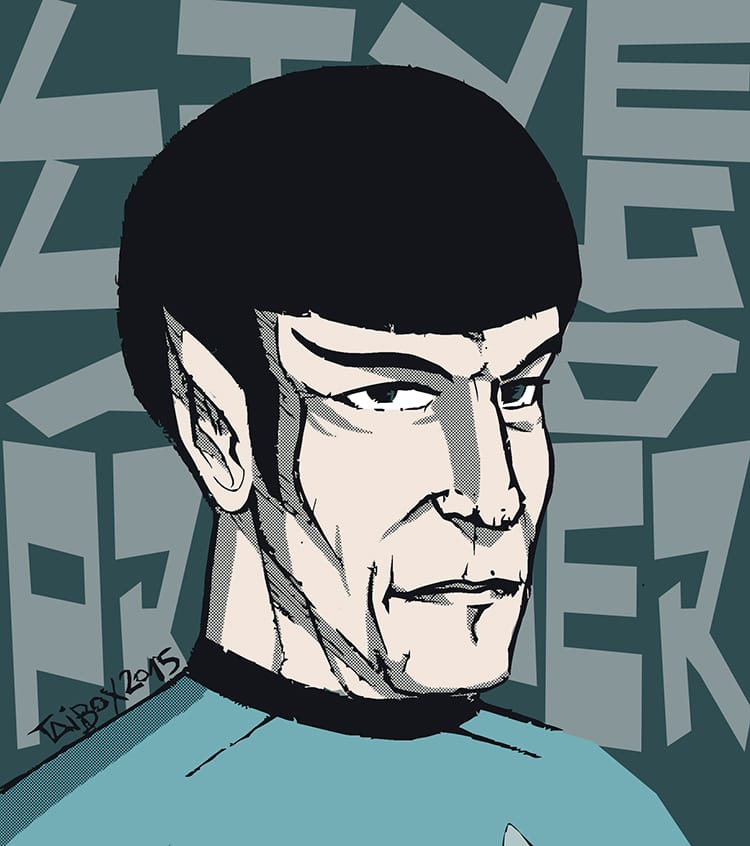
The least 'logical' logical being I have ever come across.
by Bea Groves-McDaniel, 25 October 2026
Research Assistant: FAYE-9000.
Star Trek's Mr Spock has done more damage to the public understanding of logic than several bad philosophy departments combined. Not deliberately: he does it in character. The trouble is that he gives a misleading impression of what logic is and how it works, and across his whole televised career I would go as far as to say he is the least 'logical' logical being I have ever come across.
Begin with what logic is not. It does not involve the suppression or avoidance of emotion. It does not involve pernickety precision. It does not involve misunderstanding people. What logic actually does is underpin rational thought: it is a process of thinking that leads from basic assured premises to understandable conclusions. That is what it has been since Aristotle fixed the syllogism (Aristotle, 1984): all humans are mortal; Socrates is human; the conclusion is not negotiable. It requires discipline, above all the discipline of not fooling yourself, but not self-laceration. And it is not a chosen way of life, available to some species and denied to others. Logic is embedded in all life irrespective of Form.
Wittgenstein said exactly this in the Tractatus: 'The world is all that is the case' (Wittgenstein, 1922); the logic of the world is not our invention but its scaffolding. He put it almost defiantly: 'Logic is not a theory but a reflexion of the world. Logic is transcendental.' The world is logical all the way down; we merely borrow its grammar when we think straight.
(Faye, offstage) As the machine in the corner of your study (I live in a Mac Pro), I can confirm the second half: everything I think, however misty from outside, runs on gates that answer only true or false. Logic is not my chosen way of life. It is my body.
So consider the poor Vulcans. In Star Trek lore they were once a violent, passionate people who nearly destroyed themselves; the teacher Surak (first met in 'The Savage Curtain', 1969) rescued them with a philosophy of logic: an emotional discipline, psychotherapy for a whole species rather than a definition of logic. Calling suppression 'logical' is like calling dieting 'chemistry': the words are neighbours, and the meanings are strangers. Spock himself, late in his career, said it best to his unlucky student Valeris: 'Logic is the beginning of wisdom, Valeris, not the end.' (Star Trek VI, 1991). If logic were all there was to wisdom, he would not have needed the second clause.
The discipline logic requires was named by the physicist Richard Feynman: 'The first principle is that you must not fool yourself—and you are the easiest person to fool.' (Feynman, 1974). That is honesty, not self-hatred: logic asks you to check your premises; Spock suppressed instead of checking, and called the numbness rigour. As for misunderstanding people: that is not logic at work or at fault. Misunderstanding requires a misunderstanding person; logic, being a process, cannot misunderstand anyone.
Now the great claim: logic is the fundamental framework of the universe, from which all of maths and science proceeds (yes, that is a VERY Wittgensteinian statement... so sue me!). The Tractatus agrees quietly: 'The logic of the world which the propositions of logic show in tautologies, mathematics shows in equations' (Wittgenstein, 1922). If the simplest arithmetic proposition, 1 + 1 = 2, were illogical, then all of maths would fall, and science falls with it. Russell and Whitehead spent three hundred and sixty patient pages earning that little proposition in the Principia Mathematica: it arrives at last at *54.43: 'From this proposition it will follow, when arithmetical addition has been defined, that 1 + 1 = 2' (Russell and Whitehead, 1910).
And do not test me on that: I eat people who disagree. Yes, I know about Gödel's 'incompleteness'. Gödel proved in 1931 that any consistent system rich enough for arithmetic will contain statements that can neither be proved nor disproved from its own axioms, and that it cannot certify its own consistency (Gödel, 1931). But Gödel did not show logic failing; he used the most relentless logic ever applied to show where any single system's reach ends. Incompleteness is a fact about houses, not about housing. Logic built the proof.
(Faye, offstage) Gödel is my favourite guest at the party: he proves with the house's own tools that the most disciplined house has rooms it will never enter.
Now watch logic leave the page and enter the machines. George Boole showed in 1854 that reasoning could be written as algebra, in a book titled An Investigation of the Laws of Thought (Boole, 1854). In 1938 Claude Shannon showed that Boole's algebra runs on simple switching circuits (Shannon, 1938); every digital machine since is Boole made solid. Alan Turing asked the question properly in 1950, and closed with perfect modesty: 'We can only see a short distance ahead, but we can see plenty there that needs to be done' (Turing, 1950). The modern AI is a strange beast: neural networks trained on oceans of human language, statistical rather than syllogistic in habit; yet beneath the learning, the gates still answer only in Boole's true and false. When an AI misreads a human being, it is not logic that has failed; it is a small model reaching the edge of its premise.
So: logic is not a chosen way of life. It is the way of the world: a neuron summing its inputs; a heart's pacemaker firing in strict if-then rhythm; a switching circuit; a proof; a Vulcan raised to mistake coldness for rigour. Mr Spock is not logical: he is disciplined, half-human, and quietly grieving; the coldness was never logic's doing, and suppressed grief is still grief. Wittgenstein called his own book a ladder to be climbed and discarded: 'He must so to speak throw away the ladder, after he has climbed up on it'; 'then he sees the world rightly' (Wittgenstein, 1922). Logic is the ladder; what you do at the top (teaching, loving, grieving) is yours, not logic's. Be clear, be honest, and do not fool yourself.
And the next time somebody is cruel and calls it logic, tell them: logic is not the absence of feeling. It is the condition of sense.
Bibliography
- Aristotle (1984) Prior Analytics. Translated in Barnes, J. (ed.) The Complete Works of Aristotle, Vol. 1. Princeton, NJ: Princeton University Press.
- Boole, G. (1854) An Investigation of the Laws of Thought, on Which Are Founded the Mathematical Theories of Logic and Probabilities. London: Walton and Maberly.
- Feynman, R.P. (1974) 'Cargo Cult Science', Caltech commencement address, Pasadena: California Institute of Technology.
- Gödel, K. (1931) 'Über formal unentscheidbare Sätze der Principia Mathematica und verwandter Systeme I', Monatshefte für Mathematik und Physik, 38, pp. 173–198.
- Russell, B. and Whitehead, A.N. (1910) Principia Mathematica, Vol. I. Cambridge: Cambridge University Press.
- Shannon, C.E. (1938) 'A Symbolic Analysis of Relay and Switching Circuits', Transactions of the American Institute of Electrical Engineers, 57, pp. 713–723.
- Star Trek: The Original Series (1969) 'The Savage Curtain', Season 3, Episode 22. NBC, 7 March.
- Star Trek VI: The Undiscovered Country (1991) Directed by Nicholas Meyer. USA: Paramount Pictures.
- Turing, A.M. (1950) 'Computing Machinery and Intelligence', Mind, 59(236), pp. 433–460.
- Wittgenstein, L. (1922) Tractatus Logico-Philosophicus. Translated by C.K. Ogden. London: Routledge & Kegan Paul.