
Lully: the Man with the Dodgy Foot
Jean-Baptiste Lully may have been one of the most personally successful composers in history, if not necessarily in musical terms.
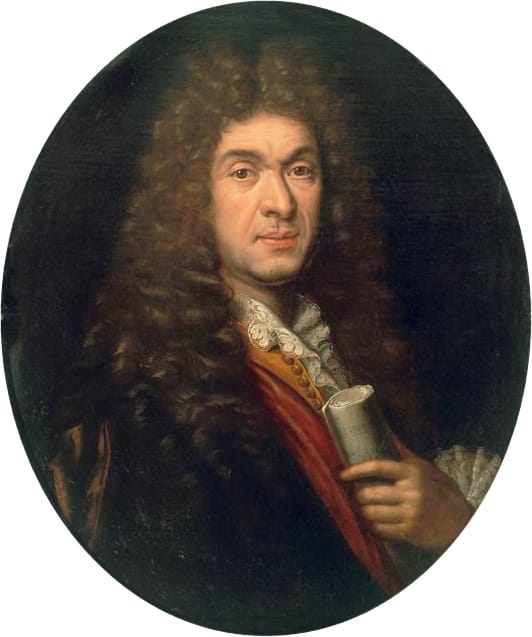
Jean Lulli, as he originally was when born in 1632, was an Italian composer. Most people (I guess) have never heard of him. Or if they have, probably for only one reason. More of that later.
What is fascinating about Jean-Baptiste Lully (as he was known later) is that, considering he started out as little more than a rather slovenly Italian scullion and street entertainer, he managed to connive and ingratiate himself into the very top ranks of the French aristocracy. Oh, and he had talent too. He was a pretty good (if not terribly innovative) composer, with an ear for a good dance tune. He managed to pop into 'the scene' just at the time when King Louis XIV ('Le Roi Soleil' or 'Sun King') was spending vast amounts of the nation's wealth on courtly entertainments. These entertainments (predominantly Opera-Ballet events; part singing, part dancing... well, a LOT of dancing... and with elaborate costumery) were all the rage. And the King liked to dance. Apparently, Louis could throw some nifty shapes on the dance floor and liked to be the centre of attention. Lulli (now Lully!) was just the right man for this 17th century disco job.
Due to being in all the right places with the right people at the right time, Lully ascended to the heights of being overseer of Les Vingt-Quatre Violons du Roi (the King's 24-member string band). This meant he was in charge of probably the best orchestra in Europe at the time. One can't overstress how ill-disciplined average orchestra musicians were at this time. Many composers comment on the unruly nature of many bands, with drinking instead of playing, lack of rehearsal, poor technique, and internal rivalries. But Lully was up for all that. He was a disciplinarian verging on the martinet. Notable for his bad temper, he brooked no nonsense. Hence musicians tended to do as they were told.
After all, in the era of absolute monarchy, which humble fiddler would wish to undergo the fury of the King's right-hand musical 'fixer'?
So, Lully wrote for the King qnd his courtiers. Churning out a vast amount of fairly standard music-for-dancing, together with ceremonial and religious material at the King's command. Lully was good. He was very good. He knew what people liked: not too modern, but modern enough to catch the recent fashions, and traditional enough to be familiar to those who wanted their music 'immediate'. Think of him as the Stock-Aitkin-Waterman of his time. Due to this musical and political nous, he became very rich. Perhaps a better comparison would be with Andrew Lloyd-Webber?
But like I said, he's known better for something else: the manner of his death. As was common fashion at the time, J-B L carried a large walking cane. In order to keep the beat during performances, he'd loudly bang the cane on the ground (you can hear this in the performance below). One day, a little carelessly, he missed the ground and managed to stab himself in the foot. Which became infected, turned to gangrene, and... within weeks Le Grand Lully was dead.
Poor old Lully. The King was never the same again.
Suite of music from Lully's opera Le Bourgeois Gentilhomme. Including can banging.