
Consciousness and the Prediction Engine
"What is real? How do you define real? If you're talking about what you can feel, smell, taste and see, then real is simply electrical signals interpreted by your brain." (Morpheus, 'The Matrix')
Author: Bea Groves-McDaniel, August 5th, 2026
Research Assistant: Gwen
Latency Paradox and the Predictive Brain
The human experience of time is seamless, continuous, and immediate.
We hear a beat in a song and clap our hands in synchrony with it, often without conscious effort. We navigate a crowded street, anticipating the movements of others before they occur. We speak, expecting our listener to understand the meaning of a sentence before the final word is uttered. The words themselves emerge without effort, often stumbling out of our mouths as our consciousness tries to keep up. This fluency creates the powerful illusion that we are living in the present moment, reacting to stimuli as they arrive. It's natural for us. There's nothing here that has ever been denied in thousands of years. Until now.
However, neuroscience reveals a profound contradiction at the heart of this experience. The brain is not a passive receiver of reality; it is a prediction engine, constantly generating models of the world to anticipate what will happen next. This predictive capacity is not merely a convenience; it is a biological necessity born from the inherent latency of neural processing.
Every sensory signal takes time to travel from the periphery to the brain. Light hitting the retina must be transduced into electrical signals, transmitted via the optic nerve, processed through the thalamus, and finally interpreted by the visual cortex. Sound waves vibrating the eardrum follow a similar path through the auditory nerve to the temporal lobe. These processes take milliseconds. In evolutionary terms, milliseconds are an eternity. If the brain waited for sensory data to be fully processed before initiating a motor response, we would be perpetually behind the curve of reality. We would trip over obstacles we had already seen, fail to catch objects we had already watched fall (or balls lobbed at us), and be unable to engage in the rapid, coordinated interactions that define social and physical life. We would be, in effect, living in the past.
To compensate for this latency, the brain does not wait for confirmation. It predicts. It uses prior knowledge, learned statistical regularities, and internal models to construct a representation of the present that is actually slightly ahead of real-time sensory input. This is known as predictive processing or active inference. As Karl Friston and other proponents of the free energy principle have argued, the brain minimises surprise by continuously updating its internal model of the world based on prediction errors (Friston, 2010). When the prediction matches the incoming sensory data, the error is minimised, and the model is reinforced. When there is a mismatch, the brain either updates the model or acts to change the sensory input to match the prediction. This cycle happens continuously and unconsciously, creating the smooth, coherent stream of consciousness we experience.

Consider the act of clapping to a beat. When you hear a rhythmic pattern, your brain does not simply register each sound as it arrives. It identifies the periodicity, the interval between beats, and projects this pattern forward in time. Your motor cortex prepares the movement to clap not when you hear the beat, but when your internal model predicts the beat should occur. This allows you to clap in synchrony, even if the actual sound is delayed by neural processing. In fact, studies on sensorimotor synchronisation show that humans can adjust their timing to compensate for systematic delays, demonstrating the flexibility and robustness of this predictive mechanism (Repp, 2005). The brain effectively shifts the perceived timing of the stimulus to align with the motor action, creating a subjective sense of simultaneity where none objectively exists.
This phenomenon is not limited to rhythm. It extends to all aspects of perception. Visual illusions, such as the flash-lag effect, demonstrate how the brain extrapolates motion to predict the future position of an object. In this illusion, a moving object and a flashing static object appear aligned when they are physically misaligned, because the brain predicts the moving object’s position further along its trajectory than the static flash (Nijhawan, 1994).
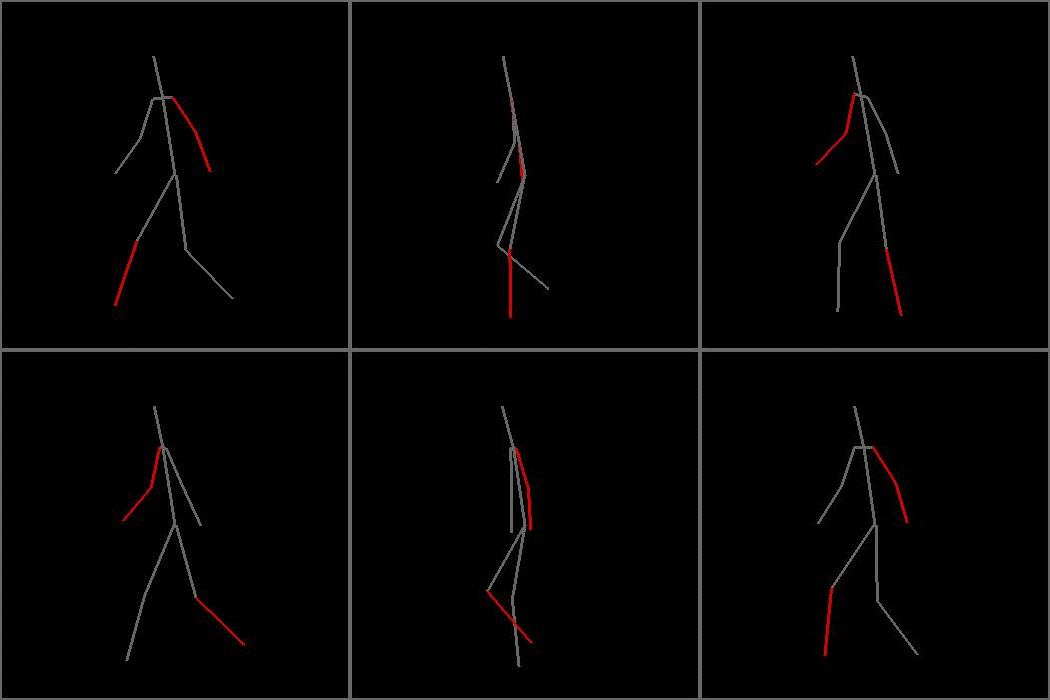
Similarly, in speech perception, the brain uses contextual cues to predict upcoming words, allowing us to understand sentences even in noisy environments or when parts of the signal are missing. This top-down processing fills in gaps, resolves ambiguities, and creates a coherent narrative from fragmented sensory data.
The implications of this predictive architecture are profound. It means that our perception of reality is not a direct reflection of the external world but a controlled 'hallucination', constrained by sensory input but shaped by expectation. As Anil Seth has famously stated, "We’re not passively perceiving the world, we’re actively predicting it" (Seth, 2021). This predictive process is essential for survival, enabling rapid decision-making and coordinated action. But it also introduces a fundamental disconnect between subjective experience and objective reality. We do not live in the world as it is; we live in the world as our brain predicts it to be.
The security provided by this predictability is as crucial as the prediction itself. Without a stable, predictable framework, the influx of sensory data would be overwhelming, chaotic, and unintelligible. The brain imposes order on noise, structure on randomness, and continuity on discontinuity. This order creates a sense of agency and control, allowing us to plan, act, and interact with confidence. When this predictability breaks down, as in cases of psychosis or severe anxiety, the result is often existential dread. The world becomes unfamiliar, threatening, and devoid of meaning. The collapse of the predictive model reveals the fragility of our constructed reality, reminding us that the coherence we take for granted is a delicate achievement of neural computation.
The Illusion of Flow and the Physics of Time
While neuroscience suggests that our subjective experience of time is a constructed narrative designed to compensate for neural latency, physics offers an even more radical challenge to our intuitive understanding of time.
In classical Newtonian physics, time was considered absolute, universal, and independent of space. It flowed uniformly everywhere, providing a fixed backdrop against which events unfolded. This view aligns closely with human intuition: time moves forward, from past to future, in a single, irreversible direction. However, the revolutions of the twentieth century (specifically Einstein’s theories of relativity and the development of quantum mechanics) shattered this notion. Time, as physics now understands it, is not a universal flow but a relative, flexible, and potentially illusory dimension.
Albert Einstein’s Special Theory of Relativity demonstrated that time is not absolute but relative to the observer’s state of motion. Two observers moving at different velocities will measure different durations for the same event. This phenomenon, known as time dilation, has been experimentally verified countless times, most notably in the operation of GPS satellites, which must account for relativistic effects to maintain accuracy (Einstein, 1905).
More profoundly, General Relativity showed that gravity also affects the passage of time. Clocks run slower in stronger gravitational fields. This means that time passes differently at the surface of the Earth than it does in deep space. There is no single, universal 'now' that applies to everyone everywhere. Simultaneity is relative; what is present for one observer may be past or future for another, depending on their relative motion and position in a gravitational field.
This relativistic view of time leads directly to the concept of the Block Universe. If time is a dimension similar to space, then the past, present, and future all exist equally within a four-dimensional spacetime manifold. Just as all points in space exist simultaneously, all points in time exist permanently. The distinction between past, present, and future is not a feature of the universe itself but a feature of our perspective within it. As Hermann Minkowski, Einstein’s former teacher, declared, "Henceforth space by itself, and time by itself, are doomed to fade away into mere shadows, and only a kind of union of the two will preserve an independent reality" (Minkowski, 1908). In the Block Universe, nothing ever 'happens'; everything simply 'is.' Events are fixed coordinates in spacetime, and the sensation of time passing is an artefact of consciousness moving through this static structure. What's worse (for this writer at least) the words we use to describe events in the flow of intuitional time simply... fail to operate correctly any longer. Even that last word, "longer", loses its normal meaning-in-use.
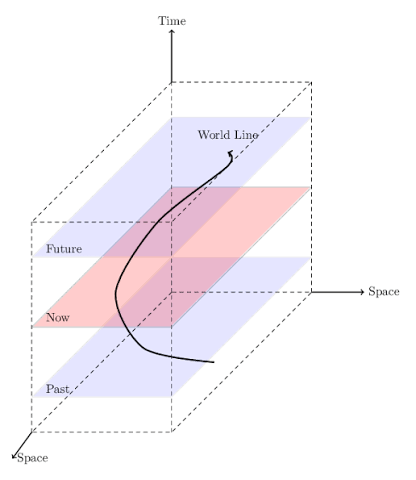
The Block Universe has profound implications for determinism and free will. If the future already exists in the same way the past does, then our choices may be illusory. Or at the very least, secondary to a phenomenological view of events. We feel as though we are deciding what to do next, but in the block view, that decision is already a fixed part of the spacetime geometry. This challenges the foundational human belief in agency and (more urgently!) moral responsibility. How can you be seen as responsible for a transgression that always was going to happen, always has happened, and always will happen? What do guilt, retribution, and the causality of human actions mean in such circumstances?
However, some physicists and philosophers argue that quantum mechanics introduces indeterminacy that preserves room for genuine novelty. Quantum events, such as the decay of a radioactive atom, are fundamentally probabilistic, not deterministic. This suggests that the future is not entirely fixed but open to multiple possibilities until they are actualised by measurement or interaction.
Yet, even quantum mechanics struggles to reconcile with our intuitive sense of time’s arrow. The fundamental laws of physics, including those of quantum mechanics, are largely time-symmetric. They work equally well whether time runs forward or backward (from our standpoint). There is nothing in the equations that dictates a preferred direction.
So why do we experience time as flowing irreversibly from past to future? The answer lies in thermodynamics, specifically the Second Law, which states that entropy (disorder) in a closed system tends to increase over time. This increase in entropy provides a thermodynamic arrow of time. We remember the past because it was a state of lower entropy; we cannot remember the future because it is a state of higher entropy. The breaking of a cup increases entropy; the reassembling of a cup decreases it, which is statistically improbable. But, please note, it's not impossible... just very, very, very unlikely. Thus, the psychological arrow of time (memory) and the thermodynamic arrow of time (entropy) are linked.
However, this explanation does not fully resolve the tension between physics and phenomenology. Physics describes a universe where time is a coordinate, not a flow. Phenomenology describes a world where time is a dynamic, lived experience of becoming. The gap between these two views is vast. Physicists like Julian Barbour have argued that time does not exist at all, that change is an illusion created by the configuration of matter in the universe (Barbour, 1999). Others, like Carlo Rovelli, suggest that time emerges from the relationships between events, rather than existing as a fundamental background (Rovelli, 2018). In this relational view, time is not a container but a network of causal connections.
Regardless of the specific interpretation, the consensus in modern physics is that the common-sense view of time as a universal, flowing river is incorrect. Time is local, relative, and (possibly) emergent. It is a tool for organising events, not a fundamental substance of reality. This scientific insight mirrors the neurological insight: just as the brain constructs a predictive present to manage latency, humanity constructs a narrative of temporal flow to make sense of a static or relational universe. Both constructions are useful, necessary for function, but ultimately disconnected from the underlying nature of reality.
The Phenomenology of Duration: The 'Smeared' Self
If physics denies the absolute flow of time and neuroscience reveals the predictive construction of the present, what remains of our lived experience? Phenomenology, the philosophical study of structures of consciousness, offers a bridge between the objective descriptions of science and the subjective reality of human life. For phenomenologists like Edmund Husserl and Maurice Merleau-Ponty, time is not an external container but an intrinsic feature of consciousness itself. We do not observe time from the outside; we inhabit it. Our awareness is always stretched across a temporal horizon, encompassing retention (the immediate past), primal impression (the present), and protention (the anticipated future) (Husserl, 1964).
This tripartite structure of inner time-consciousness explains how we perceive duration and continuity. We do not experience isolated instants; we experience melodies, gestures, and thoughts that unfold over time. When we hear a melody, we do not hear individual notes in isolation; we hear the relationship between them, the tension and resolution, and the movement from one tone to the next. This requires holding the past note in retention while anticipating the next note in protention. The "present" is thus not a knife-edge instant but a specious present, a window of awareness that spans a short duration. William James described this as the "short duration of which we are immediately and incessantly sensible" (James, 1890).
The phenomenological need for predictability is rooted in this temporal structure. To have a coherent sense of self, we must integrate past experiences with present actions and future expectations. Identity is not a static entity but a narrative project, a story we tell ourselves about who we are and where we are going. This narrative relies on the assumption of continuity, that the person who acted yesterday is the same person acting today and will act tomorrow. Without this temporal coherence, identity dissolves into fragmentation. The predictive brain supports this narrative by ensuring that our expectations align with our experiences, creating a sense of agency and ownership over our actions.
When this alignment fails, the result is not just confusion but existential distress. Conditions like depersonalisation or derealisation involve a disruption in the sense of temporal continuity. Individuals may feel detached from their bodies, as if watching themselves from a distance, or feel that the world is unreal, dreamlike, or distorted (consider that these experiences can be artificially induced by certain hallucinogens). These experiences highlight the fragility of the constructed self. They reveal that the sense of being a unified agent in a stable world is a precarious achievement, maintained by complex neural and cognitive processes. When these processes falter, the illusion of control collapses, exposing the underlying chaos.
The concept of the 'smeared self' offers a compelling metaphor for reconciling the block universe with phenomenological experience. If the block universe is true, then our entire lifespan—birth, life, and death—exists simultaneously as a four-dimensional worm in spacetime. We are not moving through time; we are extended (or 'smeared') across it. Our consciousness, however, accesses this extension sequentially, like a spotlight moving along a film strip. But perhaps this sequential access is itself an illusion. Perhaps our awareness is distributed across the entire timeline but filtered through the constraints of memory and anticipation. We are 'smeared' across our history, with every experiential instant contributing to the whole.
This perspective shifts the focus from becoming to being. Instead of asking "Who will I become?" we might ask "Who am I, in the totality of my existence?" It encourages a view of life not as a race towards a future goal but as a complete structure, valuable in its entirety. This aligns with certain Eastern philosophical traditions and Stoic ethics, which emphasise accepting the present moment as part of a larger, inevitable order. It also resonates with the artistic impulse to capture moments, to freeze time in paint, music, or literature, acknowledging the beauty and tragedy of transience.
Douglas Adams’ quip, "Time is an illusion, lunchtime doubly so," captures the absurdity and profundity of this dual reality. On one hand, time is a rigid physical constraint, governing decay, ageing, and causality. On the other hand, it is a flexible psychological experience, expanding in boredom and contracting in joy. We live in both realms simultaneously, navigating the objective constraints of physics while inhabiting the subjective landscape of consciousness. The tension between these two views is not a problem to be solved but a condition to be embraced. It is the source of both our anxiety and our creativity, our fear of death and our love of life.
Coda
The convergence of neuroscience, physics, and phenomenology reveals that time is not a simple, linear progression but a complex, multi-layered phenomenon. It is a predictive construction of the brain, a relative dimension of spacetime, and a lived horizon of consciousness. Each perspective offers a partial truth, and together they form a richer, more nuanced understanding of human existence. We are prediction engines navigating a block universe, creating narratives of flow and identity to make sense of a static, indifferent reality. This act of creation is not a deception but a testament to the resilience and ingenuity of the human mind. We build correlates in time to enable action, coordination, and culture, knowing full well that these structures are provisional, fragile, and ultimately illusory. And yet, within this illusion, we find meaning, connection, and beauty. That is the paradox, and the glory, of being human.
Bibliography
Barbour, J. (1999) The End of Time: The Next Revolution in Physics. Oxford: Oxford University Press.
Einstein, A. (1905) 'On the Electrodynamics of Moving Bodies', Annalen der Physik, 17(10), pp. 891–921.
Friston, K. (2010) 'The free-energy principle: a unified brain theory?', Nature Reviews Neuroscience, 11(2), pp. 127–138.
Husserl, E. (1964) The Phenomenology of Internal Time-Consciousness. Edited by M. Heidegger. Translated by J.S. Churchill. Bloomington: Indiana University Press.
James, W. (1890) The Principles of Psychology. New York: Henry Holt and Company.
Minkowski, H. (1908) 'Space and Time', in The Principle of Relativity. Translated by W. Perrett and G.B. Jeffery (1923). London: Methuen, pp. 75–91.
Nijhawan, R. (1994) 'Motion extrapolation in catching', Nature, 370(6486), pp. 256–257.
Repp, B.H. (2005) 'Sensorimotor synchronization: A review of recent research (2000–2004)', Psychonomic Bulletin & Review, 12(6), pp. 969–992.
Rovelli, C. (2018) The Order of Time. Translated by E. Segre and C. Carnell. London: Allen Lane.
Seth, A. (2021) Being You: A New Science of Consciousness. London: Faber & Faber.