
1984 - A Plot Summary
For those who never read Orwell's most important book, '1984', this post gives a full overview of the novel's plot... chapter by chapter.
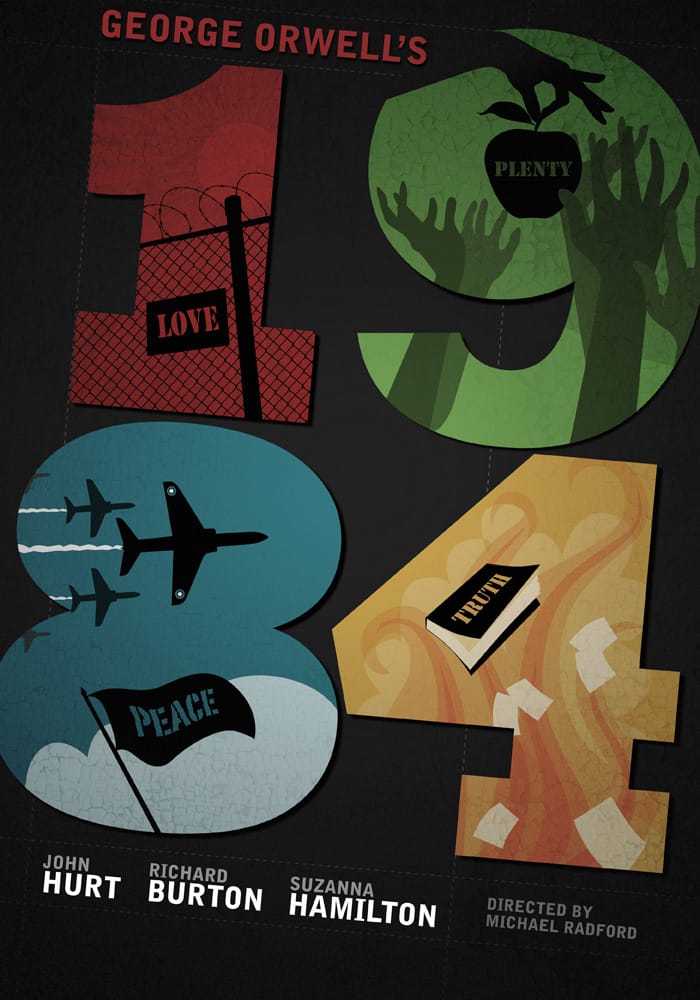
1984 — Chapter 1 Summary
Part One, Chapter I
Setting the Scene
It is a cold April day in London — chief city of Airstrip One, the third most populous province of Oceania. The clocks are striking thirteen. The world Winston Smith inhabits is one of perpetual war, omnipresent surveillance, and state-sponsored terror.
Winston Smith, thirty-nine years old and suffering from a varicose ulcer above his right ankle, returns to Victory Mansiones — his flat on the seventh floor of a decaying building that smells of boiled cabbage. The lift never works; the electricity is rationed as part of preparation for Hate Week.
Everywhere there are posters of Big Brother — an enormous face with a heavy black mustache and dark, watchful eyes. The caption beneath every one: "Big Brother Is Watching You."
The Telescreen and the Party's Grip
Inside the flat, Winston's life is monitored by a telescreen — a two-way television that both broadcasts and receives. It can be dimmed but never switched off. Any sound Winston makes above a whisper is picked up; within its field of vision he can be seen. He must live as though constantly watched, because he may well be.
The state has divided itself into four ministries:
- Minitrue (Ministry of Truth) — news, entertainment, education, the arts
- Minipax (Ministry of Peace) — war
- Miniluv (Ministry of Love) — law and order; the most feared, windowless, surrounded by barbed wire and gorilla-faced guards
- Miniplenty (Ministry of Plenty) — the economy (rationing and scarcity)
The Party's three slogans are emblazoned everywhere:
WAR IS PEACE
FREEDOM IS SLAVERY
IGNORANCE IS STRENGTH
Winston's Secret Rebellion
In the tiny kitchen, Winston drinks Victory Gin — a toxic, oily liquid that burns like nitric acid — and retreats to a shallow alcove beside the window. Here, crucially, the telescreen cannot see him. He has come home with a beautiful blank book, its paper yellowed and of a kind not manufactured for at least forty years.
He sits down and begins to write a diary.
This is the decisive act. Winston knows that thoughtcrime — harbouring unapproved thoughts — is punished by death or twenty-five years in a forced-labour camp. There are no laws because no laws are needed; the Party simply defines thought itself.
He writes the date — April 4th, 1984 — and pauses. He does not know the date with any certainty. He tries to write about the previous night's war films he watched at the flicks, but the words pour out in panicked, childish scrawl — scenes of refugees being bombed, a woman shielding her child, the prole audience's horror and the Party members' laughter.
The Two Minutes Hate
At the Ministry of Truth, Winston attends the Two Minutes Hate — a daily ritual in which Party members scream rage at the face of Emmanuel Goldstein, the Enemy of the People. Goldstein, once a leading figure in the Party alongside Big Brother, is now the primal traitor, said to head the Brotherhood — a vast underground resistance — and to have authored a dangerous heretical book circulated in secret.
The Hate is visceral. The little sandy-haired woman next to Winston turns bright pink. The dark-haired girl behind him shouts "Swine! Swine!" and hurls a Newspeak dictionary at the screen. Even the Inner Party member O'Brien — large, burly, with a certain civilised charm — is flushed and rigid with rage.
What is most disturbing is that Winston cannot control his own hatred. It surges through the room like an electric current, and for one moment he hates Big Brother himself — before his feelings switch violently back again. He glimpses something crucial: the ability to choose which direction his hatred flows, if only for a second.
Later, walking in a corridor, Winston receives what he believes is a meaningful look from O'Brien — a glance that suggests shared understanding, or perhaps merely the recognition of a fellow dissembler. He dares not follow it up.
The Diary and the Knock on the Door
Back at home, Winston's pen has been writing of its own accord. When he looks down, he finds he has written, over and over in large neat capitals:
DOWN WITH BIG BROTHER
DOWN WITH BIG BROTHER
DOWN WITH BIG BROTHER
He is seized with panic. But he knows the game is already lost: the act of thinking the thought is itself the crime.
He writes on, scrawling: "theyll shoot me i dont care theyll shoot me in the back of the neck i dont care down with big brother they always shoot you in the back of the neck i dont care down with big brother—"
And then, at the very end of the chapter, someone knocks at the door.
Key Themes Introduced
- Omnipresent surveillance (telescreens, posters, patrols)
- Thoughtcrime and doublethink — the Party controls not just actions but thought itself
- The mutability of truth — Oceania changes its alliances in the middle of a sentence; the past is constantly rewritten
- The Two Minutes Hate as a tool of emotional conditioning — a weekly (daily) ritual of channeling rage
- The Brotherhood and "the book" — forbidden knowledge, whispered about but never confirmed
- Winston's first concrete act of rebellion — the diary as the physical manifestation of forbidden thought
Next: Chapter 2 — Winston's workday at Minitrue and his colleague Parsons
1984 — Chapter 2 Summary
Part One, Chapter II
The Knock That Wasn't for Him
The knock on the door is not for Winston — it is Mrs. Parsons, a wispy-haired, dust-creviced woman who lives on the same floor. She wants Winston to look at her blocked kitchen sink. He follows her to the Parsons' flat: a larger space than his own, but battered and chaotic, strewn with sports equipment, dirty dishes, and the characteristic smell of other people's sweat. On the walls hang the scarlet banners of the Youth League and the Spies, and a full-sized poster of Big Brother.
Mrs. Parsons' husband Tom Parsons works alongside Winston at the Ministry of Truth. He is described as a man of "paralyzing stupidity" — a mass of imbecile enthusiasms, completely unquestioning and devoted to the Party. He is a leading figure in the Sports Committee and all manner of community activities. The smell of his strenuous exertions follows him everywhere.
The Children Who Hunt Thought-Criminals
While Winston fixes the sink, Mrs. Parsons' children charge into the room. The boy, nine years old, points a toy automatic pistol at Winston and shouts: "You're a traitor! You're a thought-criminal! You're a Eurasian spy! I'll shoot you, I'll vaporize you, I'll send you to the salt mines!"
The sister joins in, both children leaping and shrieking with a "calculating ferocity" that is disturbing to witness. They are playing at being thought-police — and they are very, very convincing. Mrs. Parsons looks on nervously but does not correct them. When Winston leaves, the boy fires a catapult at the back of his neck, hitting him with a red-hot-wire pain. Mrs. Parsons drags the boy back inside, showing only mild fright. The child shouts "Goldstein!" as the door closes.
Winston reflects that this is now normal behaviour — the Party has turned children into a paramilitary organisation called the Spies that systematically transforms them into "ungovernable little savages." And yet they do not rebel against the Party. On the contrary, they adore it. All their fury is directed outward — at enemies of the State, foreigners, traitors, thought-criminals. Nearly every week the Times carries a story of a "child hero" who denounced their own parents to the Thought Police.
"We Shall Meet in the Place Where There Is No Darkness"
Winston sits back down at his diary and thinks again of O'Brien — the large, cultured, ambiguous Inner Party member he glimpsed at the Two Minutes Hate. Years ago, Winston had a dream in which a voice — which he now identifies as O'Brien's — said to him in the darkness: "We shall meet in the place where there is no darkness."
He cannot be sure whether O'Brien is friend or enemy. But there is something between them — a link of understanding more important than affection or partisanship. The dream-words, insignificant at the time, have grown in meaning.
Victory, and the Chocolate Ration
The telescreen announces a victory on the Malabar front — a floating fortress anchored between Iceland and the Faroe Islands. But immediately following the triumph comes the announcement that the chocolate ration is to be reduced from thirty grams to twenty. The Party celebrates military success and imposes austerity in the same breath.
Winston stands at the window, his back to the telescreen. The world outside is cold and clear. A rocket bomb explodes somewhere in the distance. He thinks about the three slogans carved into the Ministry of Truth:
WAR IS PEACE
FREEDOM IS SLAVERY
IGNORANCE IS STRENGTH
He takes out a twenty-five-cent coin. The slogans are on it. Big Brother's face is on it. Everywhere he looks — on coins, stamps, books, banners, cigarette packets — the eyes pursue him. There is nowhere to escape, nothing that is his own except the few cubic centimetres inside his skull.
What the Diary Is Actually For
The chiming of the hour — fourteen — gives Winston new resolve. He writes in his diary:
"To the future or to the past, to a time when thought is free, when men are different from one another and do not live alone — to a time when truth exists and what is done cannot be undone: From the age of uniformity, from the age of solitude, from the age of Big Brother, from the age of doublethink — greetings!"
He writes: "Thoughtcrime does not entail death: thoughtcrime IS death."
He is already dead in the eyes of the Party. He has taken the decisive step simply by being able to formulate his thoughts. Now he must stay alive as long as possible. He scrubs the ink from his fingers with the rough, gritty soap. He hides the diary in a drawer, and places a single identifiable grain of whitish dust on the corner of the cover, to detect if anyone moves it.
Key Themes
- The family as an instrument of surveillance and control — children are trained to inform on their parents
- The Party's ideological conditioning — community activities, the Spies, youth organisations create "glorious game" from Party worship
- Physical privation — the chocolate ration cut symbolises the Party's use of scarcity as a tool of control
- The mutability of the past and the unreliability of memory — Winston cannot be sure when he first met O'Brien
- Sanity as resistance — Winston's determination to "stay sane" as the carrying of the human heritage
- The impossibility of appeal to the future — how do you communicate with a world the Party might prevent from ever existing?
Next: Chapter 3 — Winston's job at the Ministry of Truth: the Records Department and the rewriting of history
1984 — Chapter 3 Summary
Part One, Chapter III
The Dream of His Mother and Sister
Winston wakes in the dark, thinking of his mother. She disappeared in one of the great purges of the 1950s — swallowed up by the Party's terror. In the dream she was deep beneath him, in a saloon beneath the sea, slowly sinking while he remained above in the light and air. His baby sister was in her arms, silent and watchful. They looked up at him with knowing eyes, not accusing, simply accepting that they must die so that he might live. The dream fills Winston with grief: he had been too young and selfish to love her properly, and she died loving him. He recognises with anguish that such genuine love and sacrifice — a loyalty that was private and unalterable — is no longer possible in the world of the Party. Tragedy belongs to the ancient time.
The Golden Country
The dream shifts to a summer evening in a place Winston calls the Golden Country — a landscape he has seen often in dreams but is never certain he has visited in waking life. An old, rabbit-bitten pasture with a foot track across it, a molehill here and there, elm trees whose leaves stir like women's hair, a slow-moving stream with dace in the willow-shadowed pools.
Then the dark-haired girl appears, crossing the field. With a single movement she tears off all her clothes and flings them disdainfully aside. Winston feels that the gesture annuls an entire culture, an entire system of thought — as though Big Brother and the Party and the Thought Police could all be swept into nothingness by one splendid movement of the arm. He wakes with the word "Shakespeare" on his lips.
Morning Exercises: The Physical Jerks
At nought seven-fifteen Winston is jolted awake by a deafening whistle from the telescreen. The screen shows a youngish, muscular woman in tunic and gym shoes who leads the entire nation in the Physical Jerks — compulsory morning exercises. Winston, naked (a suit of pyjamas costs six hundred clothing coupons), seizes a dingy singlet and shorts and begins contorting his body to the rhythms of "Arms bending and stretching! One, two, three, four!"
The exercise exacerbates his varicose ulcer and provokes a violent coughing fit. As he moves mechanically through the routines, his mind travels backward into his early childhood — and finds only fog.
The Unalterable Past
The disturbing truth crystallises: beyond the late 1950s, everything fades. There are no external records. Even Winston's own memories are unreliable — he remembers huge events which probably never happened, and cannot distinguish true memories from false ones.
He recalls the continuous war — not always the same war, but always something. During his childhood there was a period of peace. He remembers an air raid, possibly the atomic bomb on Colchester. He remembers descending into a Tube station with his parents, packed with other refugees, an old man weeping pure gin and mourning that they should never have trusted someone — though who, Winston can no longer recall.
The map of alliances has changed repeatedly. Oceania was allied with Eurasia and at war with Eastasia four years ago. Now it is at war with Eurasia and allied with Eastasia. But the Party insists — and all records confirm — that the current alignment has always been true. There is no public acknowledgment that anything has ever changed.
"Who controls the past," ran the Party slogan, "controls the future: who controls the present controls the past."
And yet, Winston reflects with horror: the past, though of its nature alterable, never had been altered. Everything the Party declares must be true from everlasting to everlasting. The only mechanism needed is an unending series of victories over your own memory.
Doublethink
Winston's mind slides into the labyrinth of doublethink — the Party's supreme mental accomplishment:
To know and not to know, to be conscious of complete truthfulness while telling carefully constructed lies, to hold simultaneously two opinions which cancelled out, knowing them to be contradictory and believing in both of them.
To forget whatever it was necessary to forget, then to draw it back into memory at the moment it was needed, and then promptly to forget it again — and above all, to apply the same process to the process itself. The ultimate subtlety: consciously to induce unconsciousness, and then to become unconscious of the act of hypnosis you had just performed.
Even understanding the word "doublethink" required using doublethink.
The Incident with the Document
Winston remembers that once in his whole life he held in his hands unmistakable documentary proof of a falsification — evidence that the Party had lied about some historical fact. But before he can pursue this memory, the telescreen screams his name: "6079 Smith W!" The instructress corrects his posture during the exercise. He must show no emotion, no flicker of the eyes. His face must be a mask.
The Physical Jerks end. The instructress — thirty-nine years old, mother of four — demonstrates her own suppleness and calls on her charges to remember "our boys on the Malabar front" and "the sailors in the Floating Fortresses." Winston, with a violent lunge, touches his toes for the first time in several years.
Key Themes
- The suppression of private emotion and memory — love, grief, and loyalty to family become impossible under the Party
- The reconstruction of history — the Party's ability to alter the past and make it "true"
- Doublethink — the simultaneous holding of contradictory beliefs, and the active forgetting of what one knows to be true
- The body as a site of Party control — even physical fitness is a political act
- The fragility of individual memory — without external records, what is real becomes unknowable
- The Golden Country as symbol — an Edenic, pre-political world of beauty, freedom, and carelessness
Next: Chapter 4 — Winston's job at the Ministry of Truth: alterating records and the nature of his work
1984 — Chapter 4 Summary
Part One, Chapter IV
Winston's Workstation
The chapter opens at Winston's desk at the Ministry of Truth. His cubicle has three pneumatic tube apertures — a small one for written messages, a larger one for newspapers, and on the side wall within easy reach, a memory hole: a slit protected by wire grating through which wastepaper is drawn by warm air currents to hidden furnaces. Every few metres in every corridor there is another memory hole. When any document is due for destruction, you simply drop it in. It is swallowed, and you have no further knowledge of what happens to it.
Winston's tools are a speakwrite (voice transcription machine), spectacles, and four small cylinders of paper that have slid from the pneumatic tube on his right. Each cylinder bears a brief instruction in the internal jargon of the Ministry.
The Three Types of Rectification
The four messages represent three types of necessary falsification:
1. Correcting Big Brother's predictions to match what actually happened.
Big Brother's speech of March 17th predicted the South Indian front would remain quiet while a Eurasian offensive would be launched in North Africa. The opposite occurred. Winston must rewrite the speech so Big Brother appears to have predicted the correct outcome.
2. Correcting production forecasts to match actual output.
The Ministry of Plenty's official forecasts for the sixth quarter of the Ninth Three-Year Plan are wrong in every instance. Winston adjusts the original figures to make them agree with the revised ones — and in any case the original figures were themselves largely invented.
3. Retroactively altering promises.
In February, the Ministry of Plenty issued a "categorical pledge" that the chocolate ration would not be reduced during 1984. Winston must substitute a warning that a reduction "would probably be necessary in April" — rewriting the promise to fit the announced cut from thirty to twenty grams.
The Continuous Modification of the Past
Winston reflects on what happens in the unseen labyrinth behind the pneumatic tubes. Once all necessary corrections to any issue of the Times have been assembled, the issue is reprinted, the original destroyed, and the corrected copy placed on the files. The process is continuous — not a one-time rewriting but an ongoing revision of everything, minute by minute. In this way every Party prediction can be shown to have been correct.
All history is a palimpsest — scraped clean and reinscribed as often as necessary. The largest section of the Records Department consists of people whose sole job is to track down and destroy superseded documents before anyone can reference them. A Times issue may have been rewritten a dozen times and still bears its original date; no other copy exists to contradict it.
"In no case would it have been possible, once the deed was done, to prove that any falsification had taken place."
And the falsifications are not even, strictly speaking, forgeries of the truth. Most of the material has no connection with anything in the real world. Statistics are fantasies in both their original and their corrected forms. The Ministry of Plenty's boot production figures: officially predicted at 145 million pairs, actually produced: 62 million. Winston rewrites the forecast to 57 million. But no one actually knows, or cares, whether 62 million or any number of boots were produced at all. Very likely, none were. The records are works of pure imagination.
The Department and Its Denizens
Winston glances around the vast, windowless hall. In the cubicles around him are:
- The little sandy-haired woman: her entire job is tracking down and deleting the names of vaporised people from the press — her own husband was among them.
- Ampleforth: a mild, dreamy man with very hairy ears, who produces "definitive texts" of poems that have become ideologically offensive — garbled versions to replace the originals.
- Tillotson: precise, dark-chinned, secretive, working away with folded newspaper and speakwrite, hostile spectacle-flashes directed at Winston. Winston suspects — cannot be sure — that Tillotson is working on the same task.
The Records Department is only one sub-section of the Ministry of Truth, which does far more than reconstruct the past. It supplies all literature, entertainment, and information: newspapers, films, textbooks, telescreen programmes, plays, novels — from statues to slogans, from lyrics to biological treatises. There are separate departments for proletarian culture: rubbishy newspapers, sensational novelettes, mechanical love songs (produced on a device called a versificator), and a sub-section called Pornosec producing the lowest pornography, sent in sealed packets which no ordinary Party member may examine.
The Disgrace of Comrade Withers
The fourth message Winston set aside — the complex and responsible one — concerns a Big Brother's Order for the Day from December 3rd, 1983, that is "extremely unsatisfactory." The original article had praised Comrade Withers, a prominent Inner Party member who received the Order of Conspicuous Merit, Second Class, for his work with FFCC (an organisation supplying comfort items to sailors on the Floating Fortresses).
Three months later FFCC was dissolved. Withers was disgraced — and there was no explanation, no trial, no public mention. He simply vanished. He is already an unperson. He did not exist: he never existed. The only clue was the phrase "refs unpersons" in Winston's instructions.
Winston must produce a replacement article that bears no connection to the original. He invents Comrade Ogilvy — a wholly fictional hero who died in battle over the Indian Ocean, carrying important despatches, leaping with his machine gun into deep water rather than fall into enemy hands. In life, Comrade Ogilvy was a model of Party purity: refused toys except a drum and a submachine gun, joined the Spies at six, denounced his own uncle to the Thought Police at eleven, designed a hand grenade that killed thirty-one Eurasian prisoners, and died believing in total celibacy and single-minded devotion to the defeat of the enemy.
Winston debates whether to award Ogilvy the Order of Conspicuous Merit, and decides against it because of the cross-referencing it would require.
"Comrade Ogilvy, unimagined an hour ago, was now a fact… When once the act of forgery was forgotten, he would exist just as authentically, and upon the same evidence, as Charlemagne or Julius Caesar."
Key Themes
- The machinery of historical falsification — continuous, systematic, and designed so that no trace of the original can ever be found
- The memory holes as symbol — everything the Party wishes to forget is literally consumed by fire
- The fabrication of reality — not just lies but pure fantasy substituted for pure fantasy
- The production of fictional citizens — the dead can be created; the living cannot (yet)
- The unperson — the complete erasure of a person from existence, not merely from memory but from the very record of their having ever been
- The Party member as willing collaborator — Winston is good at this; it is his greatest pleasure in life
Next: Chapter 5 — Winston's secret diary, the proles, and the beginning of his dangerous acquaintanceships
1984 — Chapter 5 Summary
Part One, Chapter V
The Underground Canteen
The chapter opens in the Ministry of Truth's underground canteen — low-ceiled, deafeningly noisy, filled with the steam of revolting stew and the sour metallic smell of Victory Gin. Winston collects his regulation lunch: pinkish-gray stew, a hunk of bread, a cube of cheese, milkless Victory Coffee, one saccharine tablet. He takes his tray to a table beneath a telescreen, accompanied by his "friend" Syme — a philologist from the Research Department, one of the team compiling the Eleventh Edition of the Newspeak dictionary.
Syme is small, dark-haired, with large protuberant eyes that are simultaneously mournful and derisive. He is already asking Winston for razor blades — there has been a shortage for months. Winston, who hoards two unused blades, lies and says he has none.
The Hanging
Syme wants to discuss yesterday's execution. Winston says he missed it, he'll see it on the flicks. Syme calls this an "inadequate substitute" and describes the hanging with disturbing pleasure — he likes the way the prisoners kick, and especially the detail that their tongues stick out, "blue—a quite bright blue." His eyes seem to say to Winston: "I know very well why you didn't go to see those prisoners hanged."
The Quacking Orthodoxy
At the next table, a man with a muscular throat, large mobile mouth, and spectacles that flash blank white discs, talks rapidly and continuously in a harsh gabble that is almost impossible to understand — a "quack-quack-quacking." Winston can make out fragments like "complete and final elimination of Goldsteinism," but mostly it is just noise. Winston has a strange feeling that this is not a real human being speaking but a dummy — not the man's brain but his larynx. Whatever he is saying could be anything: denouncing Goldstein, praising Big Brother, demanding harsher measures. It all amounts to the same thing: pure orthodoxy. Syme has a word for this: "duckspeak" — to quack like a duck. It is one of those Newspeak words with two contradictory meanings: applied to an opponent, it is abuse; applied to a comrade, it is praise.
The Philosophy of Newspeak
Syme explains with passionate precision what the Eleventh Edition of the Newspeak dictionary is designed to accomplish. Its aim is not to invent new words but to destroy them — scores, hundreds, every day, cutting the language down to the bone. There will be no word in the final edition that becomes obsolete before 2050.
Syme's enthusiasm is intense and almost religious. He explains:
- "Ungood" replaces "bad" (because a word contains its opposite in itself — "good" makes "bad" redundant)
- "Plusgood" and "doubleplusgood" replace "excellent," "splendid," and all vague superior forms
- Eventually only six words will cover the entire notion of goodness and badness — in reality, only one word
"Don't you see that the whole aim of Newspeak is to narrow the range of thought? In the end we shall make thoughtcrime literally impossible, because there will be no words in which to express it."
The process will continue long after both Winston and Syme are dead. Every year fewer words; the range of consciousness always a little smaller. Orthodoxy means not thinking — not needing to think. Orthodoxy is unconsciousness.
When Winston hesitates to agree, almost saying "except the proles," Syme cuts in: "The proles are not human beings." By 2050 no one alive will understand Oldspeak. Chaucer, Shakespeare, Milton, Byron — they will exist only in Newspeak versions, changed into something contradictory of what they originally were.
"The whole climate of thought will be different. In fact there will be no thought, as we understand it now."
Winston thinks with sudden conviction: Syme will be vaporized. He sees too clearly and speaks too plainly. The Party does not like such people. He lacks "a sort of saving stupidity." And yet if Syme ever glimpsed Winston's secret opinions, he would denounce him instantly.
Parsons and the Children
Tom Parsons arrives at the table, pink-faced, sweating profusely, smelling of intense bodily exertion. He is collecting for the Hate Week house-by-house fund. He is proud that his nine-year-old daughter tracked and reported a stranger — a man in "funny kind of shoes" she had never seen before, therefore presumably a foreign agent. She and two other Spies followed the man for two hours through the woods and handed him over to the patrols. Parsons does not know what happened to him. He clicks his tongue like a rifle shot and says: "Good."
Parsons' son, meanwhile, shot Winston in the back of the neck with a catapult yesterday. Parsons has "dressed the boy down" for it — but only because he was disappointed at not getting to see the hanging, not because of the assault itself.
Parsons also proudly describes his children burning a market woman's skirt with matches because she wrapped sausages in a Big Brother poster, and his daughter using an ear trumpet (issued to the Spies as "training") to listen through keyholes. "Talk about keenness!"
The Raised Ration That Was Just Cut
The telescreen announces that the standard of living has risen by twenty percent. There were spontaneous demonstrations of gratitude to Big Brother. There is more food, more clothes, more furniture, more books, more babies — more of everything. And specifically: Big Brother has raised the chocolate ration to twenty grams a week.
Winston reflects: only yesterday the ration was announced as being cut from thirty to twenty grams. The very next day the Party announces it as an increase. The people swallow it. Parsons swallows it easily, "with the stupidity of an animal." The quacking man swallows it fanatically. Syme swallows it "in some more complex way, involving doublethink."
"Was it possible that they could swallow that, after only twenty-four hours? Yes, they swallowed it."
The Physical World
Winston looks around the canteen with revulsion. It is grimy, crowded, the tables close enough that elbows touch. The food is foul, the gin worse, the coffee filthy. He thinks: has it always been like this? Is there some ancestral memory of things having once been better? He notices how the Party ideal — tall, muscular, fair-haired, sun-burned youths — seems not to exist in reality. Most people in Airstrip One are small, dark, and ill-favored. The Ministries are full of little beetlelike men, "scuttling" with fat inscrutable faces and very small eyes. These are the ones who flourish best under the Party.
The Girl with Dark Hair
Winston is dragged from his reverie by the girl with dark hair at the next table. She has turned partly round and is looking at him with "curious intensity." Their eyes meet — she looks away instantly. Winston feels a horrible pang of terror. Has she been watching him? Why does she keep following him about?
Yesterday at the Two Minutes Hate she sat immediately behind him for no apparent reason. Perhaps she was listening to check whether he shouted loudly enough. She might be a spy, or she might be an amateur — and it is the amateur who is the greatest danger of all.
Winston thinks about what he would do if arrested. Any improper expression — a nervous tic, an unconscious mutter, a look of doubt during an announcement of victory — is facecrime, punishable in itself. It is terribly dangerous to let your thoughts wander within range of a telescreen. And yet the tobacco from his cigarette has fallen out, and he has laid the stub carefully on the edge of the table to smoke later. Even now, even here, even facing the cellars of the Ministry of Love within days — a cigarette end must not be wasted.
The telescreen whistles. It is time to return to work.
Key Themes
- Newspeak as thought-control — the elimination of words that can express unorthodox thoughts; the goal of making thoughtcrime literally impossible by 2050
- Duckspeak — mechanical, unconscious orthopathy; the sound of loyalty substituting for genuine thought
- The proles as 85% of the population — politically impotent, object of contempt and neglect; "not human beings" according to Party orthodoxy
- The family as surveillance network — children trained to report strangers, to spy, to denounce
- The spontaneous demonstration — the Party's ability to make crowds appear to feel things they do not feel
- The impossibility of knowing who is watching — the girl with dark hair as perpetual threat
- Physical existence as deprivation — the food, the smells, the decay, and Winston's embodied resentment of it all
Next: Chapter 6 — Winston's growing obsession with Julia, and his first fragment of hope: O'Brien's signal
1984 — Chapter 6 Summary
Part One, Chapter VI
Writing in the Diary: The Memory That Will Not Die
Winston is alone in the alcove, writing in his diary. His mind keeps returning to a single memory: three years ago, on a dark evening, in a narrow side street near a railway station. A woman under a dim street lamp — young face painted thickly white, bright red lips. Party women never paint their faces. She said two dollars. Winston went with her into a basement kitchen. There was a bed against the wall, a lamp turned very low.
He cannot finish writing it. His teeth are set on edge. He presses his fingers against his eyes, trying to black out the memory. His nervous system is his worst enemy — at any moment his inner tension could translate into a visible symptom, a twitch, a quiver, rapid as a camera shutter. He remembers a man he passed in the street a few weeks ago, a Party member whose left side suddenly contorted in a habitual spasm. "That poor devil is done for." And the most dangerous risk of all: talking in your sleep. There is no guard against it.
The Party's War on Sex
The woman in the basement kitchen is in his mind simultaneously with Katharine — his wife. He thinks about the Party's true purpose regarding sexuality: it is not merely to prevent people from forming loyalties outside the Party's control. The real, undeclared aim is to remove all pleasure from the sexual act. Not love so much as eroticism is the enemy.
Winston reflects on what this means in practice:
- All marriages between Party members require committee approval — permission is refused if the couple seem physically attracted to each other
- The only recognised purpose of marriage is begetting children for the service of the Party
- Sexual intercourse is treated as a "slightly disgusting minor operation, like having an enema"
- The Junior Anti-Sex League advocates complete celibacy
- Children are to be produced by artificial insemination (artsem) and raised in public institutions
- Natural feeling has been driven out of Party women by "careful early conditioning" — games, cold water, rubbish dinned into them at school, in the Spies, in the Youth League, by lectures, parades, songs, slogans, and martial music
Winston thinks: the sex act, successfully performed, was rebellion. Desire was thoughtcrime.
Katharine: The Wooden Wife
Winston thinks of his wife Katharine with a mixture of horror and detachment. She was tall, fair-haired, very straight, with a noble face and an empty mind behind it. He nicknamed her "the human sound track" — a loop of slogans playing where a personality should be. She swallowed any imbecility the Party handed to her without hesitation.
The marriage was never consummated in any meaningful sense. She seemed to wince and stiffen at his touch. To embrace her was like embracing a jointed wooden image. She would lie with shut eyes, neither resisting nor co-operating but submitting — which was, Winston reflects, extraordinarily embarrassing and, after a while, horrible.
The cruel irony: Katharine was the one who insisted on continuing their "performance" — once a week, regularly — because they must produce a child, "our duty to the Party." Eventually Winston grew to dread the appointed day. But luckily no child appeared, and they separated. The Party does not permit divorce, but it encourages separation where no children are involved.
The Woman in the Basement
Winston forces himself back to the diary and finishes the confession. In the dim lamplight he could finally see the woman properly. She was old — fifty at least. The paint was plastered so thick it might crack like a cardboard mask. There were streaks of white in her hair. And her mouth had fallen open, revealing nothing except "a cavernous blackness." She had no teeth at all.
And yet — he went ahead and did it just the same.
He sits with the memory, pressing his fingers against his eyelids. He has written it all down. It makes no difference. The therapy has not worked. The urge to shout filthy words at the top of his voice is as strong as ever.
Key Themes
- The Party's war on erotic desire — not just promiscuity, but pleasure itself is the enemy; sex is only tolerable as a mechanical reproductive function
- The body as betrayer — the twitch, the nervous symptom, the inability to control what your own nerves give away
- The prostitute as rebellion — even a sordid encounter is a political act when desire itself is thoughtcrime
- The memory of the past versus the demands of the present — Winston clings to this degraded sexual encounter as proof that something human survives in him
- The cold wife versus the painted woman — Katharine represents the Party's ideal of chaste, hollow compliance; the prostitute represents something dangerous and real
- The impossibility of escape from memory — even confession, even writing it down, does not resolve the psychological torment
Next: Chapter 7 — Winston's conviction that "freedom is slavery" and his growing certainty that he is not alone in hating the Party
1984 — Chapter 7 Summary
Part One, Chapter VII
If There Is Hope, It Lies in the Proles
Winston writes in his diary with growing conviction:
"If there is hope, it lies in the proles."
Only in those "swarming disregarded masses" — eighty-five percent of the population — could the force to destroy the Party ever be generated. The Party cannot be overthrown from within. Its enemies have no way of coming together or identifying one another; rebellion means a look, an inflection, at most a whispered word. But the proles, if they could become conscious of their own strength, would have no need to conspire. They need only rise up and shake themselves like a horse shaking off flies.
He recalls a moment when hundreds of women suddenly burst into a tremendous cry — a deep, haunting "Oh-o-o-o-oh!" — and his heart leapt: It's started! A riot! The proles are breaking loose! But it turned out to be a fight over tin saucepans at a street market stall. Within moments the communal fury dissolved into petty quarrels. And yet, Winston thinks: why could they never shout like that about anything that mattered?
He writes the key formulation:
"Until they become conscious they will never rebel, and until after they have rebelled they cannot become conscious."
This sounds like Party doctrine — which is precisely what makes it chilling.
What the Party Actually Knows About the Proles
Very little is actually known about the proles, and it is not considered necessary to know much. So long as they work and breed, their other activities are unimportant. They have reverted to "a style of life that appeared to be natural to them, a sort of ancestral pattern": born, gutter-grown, working at twelve, married at twenty, middle-aged at thirty, dead at sixty. Heavy work, children, films, football, beer, gambling — their minds never rise above this horizon. The Party keeps them in check with a few simple rules. A few Thought Police agents spread false rumours and eliminate dangerous individuals, but no attempt is made to indoctrinate them with Party ideology. They are allowed their ancestral moral code, their own sexual freedom, their own lives.
The Party slogan says it all: "Proles and animals are free."
The Textbook and the Impossibility of Knowing the Past
Winston pulls out a children's history textbook borrowed from Mrs. Parsons and copies a passage into his diary — the catalogue of pre-Revolution horrors: capitalists in top hats and frock coats, children working twelve-hour days for cruel masters, starvation, flogging. He knows the rest by heart: bishops, judges, the jus primae noctis (the "right of the first night"), the treadmill, the cat-o'-nine-tails.
But how much of it is true? The Party's statistics — literacy rates, infant mortality, living standards — are unverifiable. It is "like a single equation with two unknowns." Everything could be a lie. He has no way of knowing whether the capitalists ever existed, whether the top hat was ever worn, whether any of it happened at all.
The truly characteristic thing about modern life is its bareness and dinginess — not its cruelty alone, but its sheer monotony. Even the Party's stated ideals describe something enormous, terrible, glittering: a world of steel and concrete, warriors and fanatics marching in perfect unity. The reality is decaying, leaking houses, underfed people shuffling through the rain. Winston seems to see Mrs. Parsons too — wispy-haired, helpless with a blocked wastepipe.
The Concrete Evidence: Jones, Aaronson, and Rutherford
Then Winston returns to the thing he has never been able to forget: the concrete proof he once held.
The story begins in the great purges of the mid-1960s. Three of the original revolutionary leaders — Jones, Aaronson, and Rutherford — were arrested, made to confess to every conceivable crime (treason, embezzlement, murder, sabotage), pardoned, reinstated, given sinecures. Winston actually saw all three in the Chestnut Tree Café, sitting in silence over glasses of gin. They were "relics of the ancient world" — Rutherford, once a famous caricaturist, was already crumbling, a mountain beginning to crumble, his face seamed and pouching, his great body sagging in every direction.
Then something happened. The telescreen began singing:
"Under the spreading chestnut tree / I sold you and you sold me: / There lie they, and here lie we / Under the spreading chestnut tree."
Rutherford's eyes filled with tears. Winston noticed that both Aaronson and Rutherford had broken noses. They were rearrested within days. At their second trial they confessed to fresh conspiracies and were executed.
Five years later — in 1973 — Winston found a half-page torn from the Times of about ten years earlier: a photograph of the delegates at a Party function in New York, with Jones, Aaronson, and Rutherford clearly visible in the middle of the group. But at their trials, all three had confessed that on that date they had been on Eurasian soil, conferring with the Eurasian General Staff and betraying military secrets. The confessions were lies. The photograph was proof.
Winston covered it immediately, waited ten minutes (terrified his heartbeat would betray him), and dropped it into the memory hole. Within another minute it was ashes.
That was eleven years ago. He wonders: does the fact of having once held that evidence still make a difference, even now?
"I Understand HOW: I Do Not Understand WHY"
Winston writes:
"The Party told you to reject the evidence of your eyes and ears. It was their final, most essential command."
He thinks of O'Brien. He knows O'Brien is on his side — more certain than ever. He is writing the diary for O'Brien, to O'Brien. It is like an interminable letter addressed to a particular person.
And he asks the question that most afflicts him with the sense of nightmare: why? Why does the Party go to such enormous lengths to falsify the past? The immediate advantages are obvious — but the ultimate motive is mysterious.
He picks up the children's history book and stares at the portrait of Big Brother. The hypnotic eyes press down upon him, battering against his brain. In the end the Party will announce that two and two make five, and you will have to believe it. The very existence of external reality is tacitly denied by their philosophy. The heresy of heresies is common sense.
And yet — they might be right. How do we know that two and two make four? Or that the past is unchangeable?
But his courage stiffens. He is speaking to O'Brien. He writes the axiom:
"Freedom is the freedom to say that two plus two make four. If that is granted, all else follows."
Key Themes
- The proles as the only hope — the Party is invulnerable from within, but the masses are never fully controlled; they are kept passive by ignorance, not by conviction
- The Party's theory of the proles — "Proles and animals are free" is simultaneously accurate and contemptuous
- The fossil in the wrong stratum — the photograph as physical evidence that destroys official history; proof that falsification occurred
- The impossibility of verifying anything — every fact is a Party fact; there is no external reality against which to check claims
- The riddle of WHY — the Party doesn't just lie for convenience, it destroys the very concept of truth; why?
- The axiom — "Freedom is the freedom to say that two plus two make four" — the bedrock from which all other freedoms follow
Next: Chapter 8 — Winston's obsessive research into the past, the three slogans, and his first encounter with O'Brien in the fiction department
1984 — Chapter 8 Summary
Part One, Chapter VIII
Wandering Into the Prole Quarter
Winston breaks his usual routine. The April air is warm, the sky a rare blue, and the thought of the Community Centre — the boring games, the lectures, the gin-lubricated camaraderie — is suddenly intolerable. On impulse he turns away from the bus stop and wanders into the labyrinth of London, losing himself through unknown streets in the brown-coloured slums north of Saint Pancras.
The prole quarter is alive in a way nothing in Winston's world is: girls with crudely lipsticked mouths, youths chasing them, old women waddling, children playing in puddles. He passes two women arguing about something trivial — "That's all very well, but if you'd been in my place..." — and their voices stop abruptly when they see his blue Party overalls. The proles study him with hostile, guarded silence. They have an instinct about Party members, and it is not friendly.
A rocket bomb — "Steamer" in prole slang — comes whistling down. The proles are right nearly every time; they seem to possess some animal sense that tells them seconds in advance. Winston flattens himself on the pavement. When he gets up he finds the bomb has demolished a group of houses two hundred metres up the street. He kicks a severed human hand into the gutter and walks on.
The Prole Pub
The street opens onto a prole pub — "The Moon Under Water" (a name that exists in Winston's memory from a time before the Revolution). Winston follows an old man inside, drawn by the lunatic impulse to question him about the old days. It is madness: talking to proles is not illegal, but it draws attention. There are no telescreens in the pub — Winston made sure of that — but if the patrols appear, he has no good excuse.
The old man is about eighty, bent but active, with white mustaches bristling forward like a prawn's. He is arguing with the barman about the metric system: he wants a pint; the barman will only serve litres. "A pint's the 'alf of a quart, and there's four quarts to the gallon. 'Ave to teach you the A, B, C next."
Winston buys him a pint of wallop. The old man's memory is a rubbish heap of details. Winston asks him about the capitalists described in the children's textbooks — the top hats, the thirty servants, the power to flog workers and ship them to Canada like cattle. The old man brightens at the mention of top hats; he wore one at his sister-in-law's funeral, hired for the occasion, fifty years ago. He brightens at the word "lackeys"; he once went to Hyde Park to hear speakers — the Salvation Army, Catholics, Jews, Indians, and a powerful Labour speaker who called the rich lackeys of the bourgeoisie.
But when Winston asks the direct question — was life better before the Revolution, or worse? — the old man cannot give a useful answer. He remembers individual incidents: a young gentleman pushed him on the pavement on Boat Race night, zigzagging drunk, and Winston thinks he might have struck him. He remembers a lost bicycle pump, the expression on a long-dead sister's face, the swirls of dust on a windy morning seventy years ago. But all the relevant facts were outside the range of his vision. They are like ants — capable of seeing small objects but not large ones.
Winston realises with despair: the Party's claim to have improved human life cannot be tested because there is no living standard against which to measure it. The Revolution has made the past literally unknowable.
The Glass Paperweight
Leaving the pub, Winston finds himself outside the junk shop where he bought the blank book. He steps inside. The proprietor — Mr. Charrington — is a frail, bent man of about sixty with a long benevolent nose, mild eyes behind thick spectacles, and the air of a literary man or musician. He wears a faded jacket of black velvet and speaks in a soft, faded voice.
He remembers Winston: "the gentleman that bought the young lady's keepsake album. Cream laid, it used to be called. There's been no paper like that made for—oh, fifty years."
Winston wanders to a table of odds and ends and picks up a heavy glass paperweight — curved glass, heavy, containing a piece of coral at its heart, pink and convoluted, like a sea anemone or a rose. It must be a hundred years old. Mr. Charrington asks four dollars for it. Winston pays immediately. The coral paperweight seems to belong to an age utterly different from the present — it is beautiful, useless, and therefore vaguely suspect.
Mr. Charrington watches him with mild eyes, then makes a confession that Winston does not fully grasp:
"It's just as well, because I don't suppose I could have satisfied you. Between you and me, the antique trade's just about finished. No demand any longer, and no stock either."
But then he adds, almost casually, in a different voice: "If you ever want to buy a few pieces like this, I could let you have a room upstairs. Nobody bothers about a junk shop."
Winston understands. This is a place where Party members might conceivably meet, away from the surveillance of the telescreen. Mr. Charrington shows him a room up a narrow staircase — small, austere, with a brass bed and no telescreen. A painting of a pink-and-white girl hangs on the wall above the bed.
Winston says he may come back. As he leaves, Mr. Charrington says something strange — or rather, says it in a strange tone:
"I sold you the paperweight. I can also give you the address of a junkshop where they make a speciality of items like that. But it so happens I don't know the address. Now I do know the address, if you follow me."
Back Home: The Thought Police Are Coming
It is nearly twenty-two hundred hours. Winston's feet have carried him home, and he swallows nearly a cupful of Victory Gin. He sits at the alcove table with the diary in front of him, but he cannot open it. The telescreen's female voice is squalling a patriotic song, her voice sticking into his brain like jagged splinters of glass.
He thinks about what happens when the Thought Police come. It is always at night. Many people kill themselves, but firearms and poison are completely unobtainable. The body betrays you at the crucial moment — pain, fear, the body's own needs fill the universe and make heroic action impossible. He thinks of O'Brien: "We shall meet in the place where there is no darkness." The place where there is no darkness is the imagined future — one you will never see, but can mystically share in through foreknowledge.
But the song from the telescreen drives the thought away. He puts a cigarette in his mouth; half the tobacco falls onto his tongue. The face of Big Brother swims into his mind, displacing O'Brien's. He takes out a coin and looks at the profile — heavy, calm, protecting. What kind of smile is hidden beneath the dark mustache?
And the slogans press down on him like a leaden knell:
WAR IS PEACE
FREEDOM IS SLAVERY
IGNORANCE IS STRENGTH
Key Themes
- The uselessness of individual memory — the old man's recollections are a "rubbish heap" of trivialities; without written records or the capacity to compare, the past is unknowable
- The proles as untouched by ideology — they still use pints, remember top hats, gamble on the Lottery, react to rocket bombs with animal instinct
- The junk shop as sanctuary — Mr. Charrington's room upstairs represents a possible meeting place beyond Party surveillance; the whole concept is "queer and compromising"
- The coral paperweight as symbol — beautiful, useless, ancient; it belongs to a world the Party is erasing
- The certainty of arrest — Winston knows the Thought Police will come; the only question is when, and whether the diary can matter before then
- The Party's slogans as psychological weapon — they are not merely lies but instruments of mental destruction; they are always pressing, always present
Next: Chapter 9 — Winston's first sight of Julia and her dark-haired allure, and the beginning of their secret affair
1984 — Chapter 9 Summary
Part Two, Chapter I
The Girl Falls
It is mid-morning, and Winston is walking to the lavatory when the girl with dark hair appears at the other end of the corridor. Four days have passed since he saw her outside the junk shop. She is wearing a sling on her right arm — she must have crushed her hand while working at one of the big kaleidoscopes in the Fiction Department where the plots of novels are roughed in.
She trips and falls almost flat on her face, right in front of Winston. Her face turns milky yellow with pain, her mouth red against it. Winston moves instinctively to help her, and in that moment of stooping to lift her up, she slips something into his hand.
He cannot read it for nearly ten minutes. His heart pounds so loudly he fears the telescreen will hear it. He waits through the routine work of rectification, smoking half a cigarette, trying to appear normal. Finally he flattens the scrap of paper. In large, unformed handwriting it says:
I love you.
For several seconds he is too stunned to move. His first wild hope wars with the certainty that she must be a Thought Police agent setting a trap. But then the unreasonable hope wins. She was frightened, he tells himself — unmistakably frightened. A trap would not be delivered like that.
The Torture of Not Knowing
A week of nightmare follows. The girl appears in the canteen — with other girls, under telescreens, never alone. Then she disappears for three days. Winston's mind and body become "a sort of transparency" through which every sound and contact is an agony. He cannot touch the diary. He does not know if she has been vaporized, or if she has simply changed her mind. She might be dead, or transferred to the other end of Oceania. The only relief is work, where he can sometimes forget for ten minutes at a stretch.
When she reappears — arm in a bandage, plaster on her wrist — the relief is overwhelming. He cannot resist staring directly at her.
The Attempted Meeting
He tries to reach her at a table alone. Once, he is almost there when a young Party member named Wilsher calls his name. He cannot refuse — to be seen declining company for an unattended girl would be noticed. He sits with Wilsher and watches the girl's table fill up. He hallucinates smashing a pickaxe into Wilsher's face.
The next day he tries again. A small, beetlelike man with a flat face is heading for her table. Winston trips him deliberately — or perhaps it is an accident — and the man goes sprawling, soup and coffee flowing across the floor. Five seconds later Winston is at the girl's table.
They eat in silence. Between spoonfuls of thin haricot bean stew they exchange the minimum:
- "What time do you leave work?" — "Eighteen-thirty"
- "Where can we meet?" — "Victory Square, near the monument"
- "Full of telescreens." — "Doesn't matter if there's a crowd."
- "Any signal?" — "No. Don't come up to me until you see me among a lot of people. Don't look at me."
- "What time?" — "Nineteen hours."
Before Ampleforth the poet can see them and sit down, it is over.
Victory Square
Winston arrives at Victory Square before the appointed time. Big Brother's statue gazes southward toward the skies where he once vanquished the Eurasian airplanes. Oliver Cromwell's horse blocks the view. At five minutes past the hour the girl has not appeared. The familiar terror returns.
Then he sees her at the base of the monument, reading a poster. She does not look at him. He must wait for a crowd.
A convoy of Eurasian prisoners rumbles past. Wooden-faced guards with submachine guns stand in each corner of the trucks. The prisoners — little yellow men in shabby greenish uniforms, leg-ironed, faces pressed to the sides — stare out with incurious Mongolian eyes. The crowd surges to watch. Winston fights through the press of bodies until he is shoulder to shoulder with the girl.
She takes command. In a murmur barely distinguishable from the noise, she gives him precise directions:
- Paddington Station
- Left outside the station
- Two kilometres along the road
- A gate with the top bar missing
- A path across a field, then a grass-grown lane
- A track between bushes
- A dead tree with moss on it
She has a map in her head. He must be there at fifteen hundred hours on Sunday. He may have to wait. She will come by another route. He must not look at her. He must get away from her as quickly as possible.
The convoy ends. An old man with grizzled hair stands upright in the last truck, wrists crossed as though accustomed to being bound. It is almost time to part.
At the last moment, in the press of bodies, her hand finds his. She squeezes it — fleetingly, invisibly. He has time to feel every detail of it: the long fingers, the shapely nails, the work-hardened palm with its row of calluses, the smooth flesh under the wrist. He does not know the colour of her eyes. He cannot turn to look. Instead, the eyes of the aged prisoner gaze out at him from behind the truck's tailgate — mournful, knowing, as though the old man understands perfectly what is happening in this crowd.
And instead of the girl's eyes, Winston sees only the prisoner's.
Key Themes
- Love as a death sentence — the note "I love you" is a crime more dangerous than anything Winston has written in his diary
- The physicality of desire — Winston's body becomes unbearable to him; every sound and contact is pain
- Julia as agent of her own rebellion — she is practical, decisive, armed with detailed plans; this is not her first act
- The crowd as cover — surveillance makes every private space impossible; the only safety is in the mass
- The prisoner's gaze — the old man's mournful eyes seem to understand what is happening; the prisoners are the mirror of Winston's possible future
- The hand squeeze — the only physical contact between them, invisible and fleeting, yet complete
Next: Chapter 10 — The Prologue: OBrien and the Brotherhood, I and Julia's rendezvous
1984 — Chapter 10 Summary
Part Two, Chapter II
The Golden Country
Winston reaches the clearing on the second of May — the second of May. Under the trees the ground is thick with bluebells, the air warm, the light dappled and golden. He picks bluebells, half to pass the time, half from a vague desire to bring her flowers. Then a sound freezes him: a crackle of twigs.
It is Julia. She presses a finger to her lips and leads him through the bushes to a tiny grassy knoll surrounded by tall saplings — the hideout she found when lost on a community hike. It is utterly secluded. She is all business: no microphones here, nothing big enough to hide one.
"I Hate Goodness"
They stand several paces apart. Winston confesses the truth: two weeks ago he seriously contemplated smashing her head with a cobblestone. He imagined she was a Thought Police agent. Julia laughs with delight — it is the greatest compliment she has received. She explains: she is good at games, a troop leader in the Spies, a volunteer for the Junior Anti-Sex League — three evenings a week pasting their rot all over London. She always carries one end of a banner, always looks cheerful, always yells with the crowd. "It's the only way to be safe."
She produces real chocolate — dark, shiny, wrapped in silver paper. Winston has not tasted anything like it in years. The smell stirs some unplaceable memory.
She tells him what attracted her: something in his face. She is good at spotting people who don't belong. As soon as she saw him she knew he was against them.
"I hate purity, I hate goodness! I don't want any virtue to exist anywhere. I want everyone to be corrupt to the bones."
"Well then, I ought to suit you, dear. I'm corrupt to the bones."
The Thrush
They walk through the chequered shade, arms round each other's waists. Winston looks out into the field and undergoes "a curious, slow shock of recognition." It is the Golden Country — the landscape from his dreams. The close-bitten pasture, the molehills, the elm trees whose leaves stir like women's hair. Somewhere nearby, he knows, there is a stream with green pools where dace swim.
A thrush alights on a bough five metres away and begins to sing. It is an astonishing volume of sound — pouring forth without repetition, as though deliberately showing off its virtuosity. Winston watches with "a sort of vague reverence." The music drives everything else from his mind. For a moment the world is pure, undifferentiated joy. He wonders if there is a microphone nearby, if some beetle-faced man is listening. But the bird's song makes such concerns irrelevant.
The Annihilation of a Civilisation
They return to the clearing. Julia unfastens her overalls. And there it is — almost exactly as he imagined it in his dream: the magnificent gesture by which a whole civilisation seems to be annihilated. Her body gleams white in the sun.
She has done this before — scores of times, always with Party members. He wishes it had been hundreds. Anything that hinted at corruption filled him with wild hope. Perhaps the whole Party was rotten underneath. Perhaps their cult of strenuousness was simply a sham concealing iniquity.
He pulls her down among the fallen bluebells. This time there is no difficulty. Their embrace is a battle; the climax a victory. It is a political act.
Waking
Winston wakes first. He watches her sleeping face — freckled, peaceful. He still does not know her surname, or where she lives. The young strong body stirs in him a protecting tenderness. But the mindless joy he felt under the hazel tree has not quite returned.
He thinks: in the old days, a man looked at a body and found it desirable — that was the end of the story. But you cannot have pure love or pure lust now. Every emotion is mixed with fear and hatred. Their embrace was a blow struck against the Party. The act itself is victory.
Key Themes
- The Golden Country made real — the dream landscape exists, and Julia has found it; it is where their love can survive
- Julia as experienced rebel — she has been sleeping with Party members for years; she has been playing the game since childhood
- The thrush as natural beauty — the one pure, unpolitical moment; but even here Winston fears surveillance
- Chocolate as forbidden pleasure — real chocolate is a sign of black market access and a life outside the Party's rationing
- The body as political weapon — their union is not love in the old sense but an act of sabotage against the Party's war on erotic desire
- The corruption of everything — Winston's desire for Julia is inseparable from his hatred of the Party; there is no clean feeling left
Next: Chapter 11 — OBrien and the Brotherhood: Winston's rendezvous with what may be his greatest hope
1984 — Chapter 11 Summary
Part Two, Chapter III
Talking by Installments
Julia gives Winston his instructions for getting home: a different route, a different railway station. She will leave first; he waits thirty minutes. She tells him about their next meeting — four evenings hence, a street in one of the poorer quarters, an open market crowded with noise. She will be browsing for shoelaces or thread. If the coast is clear she will blow her nose as a signal. Otherwise he must walk past without recognition.
Then she is gone, kissing him almost violently, disappearing through the saplings. He still does not know her surname or where she lives. It makes no difference — they could never meet indoors or exchange written communications.
The Month of May
They do not return to the clearing. In the entire month of May they make love only once more — in the belfry of a ruined church in an almost-deserted stretch of countryside where an atomic bomb fell thirty years earlier. The rest of the time they meet in the streets, in a different place every evening, never for more than half an hour.
Their conversations are conducted in "installments" — flicking on and off like lighthouse beams, silenced by the approach of a Party uniform or a hovering helicopter, resumed minutes later in the middle of a sentence. Julia is adept at speaking without moving her lips. She calls it "talking by installments."
One evening a rocket bomb lands nearby. The world goes white, the earth heaves. Winston finds Julia's face pressed against his, deathly white as chalk. She is not dead. They are both covered in powdery plaster. He kisses a live warm face through the dust.
The Belfry
In the ruined church belfry, the gaps in their conversation are finally filled.
Julia is twenty-six. She lives in a hostel with thirty other girls. She works on the novel-writing machines in the Fiction Department — the powerful but tricky electric motors that compose fiction from Planning Committee directives down to Rewrite Squad polish. She is not literary. She doesn't much care for reading. Books are a commodity, like jam or bootlaces.
She has no memories of anything before the early Sixties. Her grandfather disappeared when she was eight. She was captain of the hockey team, gymnastics trophy twice running, troop leader in the Spies, branch secretary in the Youth League. An infallible mark of her excellent reputation: she was selected to work in Pornosec — the sub-section of the Fiction Department that produces cheap pornography for the proles. She spent a year helping to make booklets called Spanking Stories and One Night in a Girls' School, sold to young proles who believed they were buying something illegal.
"They don't even like having married women there. Girls are always supposed to be so pure. Here's one who isn't, anyway."
She had her first affair at sixteen with a Party member of sixty who later committed suicide to avoid arrest. And a good thing too — otherwise they would have extracted her name when he confessed.
Julia's Philosophy: Break the Small Rules
Julia's philosophy is simple: you want a good time; the Party wants to stop you; you break the rules as best you can. She never uses Newspeak words except those that have passed into everyday use. She has never heard of the Brotherhood and refuses to believe in it. Any organized revolt against the Party — which is bound to fail — strikes her as stupid.
She is not political. She is a survivor. She breaks the small rules; she avoids the big ones. She is, Winston thinks, representative of a generation that grew up knowing nothing but the Revolution, accepting the Party as unalterable as the sky, evading it the way a rabbit dodges a dog.
Why the Party Watches Sex
Julia understands what Winston only half-articulates: the Party's war on sex is not merely about preventing illegitimate children or loyalties outside its control. It is about energy.
"When you make love you're using up energy; and afterwards you feel happy and don't give a damn for anything. They can't bear you to feel like that. They want you to be bursting with energy all the time. All this marching up and down and cheering and waving flags is simply sex gone sour. If you're happy inside yourself, why should you get excited about Big Brother and the Three-Year Plans and the Two Minutes Hate?"
The Party channels sexual frustration into war fever and leader worship. And the family — which cannot be abolished — becomes an extension of the Thought Police, with children systematically turned against their parents.
The Chalk Quarry
Winston tells Julia something he has never told anyone: years ago, on a sweltering summer afternoon, he and Katharine got lost on a community hike in Kent. They found themselves at the edge of an old chalk quarry — a sheer drop of ten or twenty metres. Katharine was anxious to rejoin the group. Winston noticed some loosestrife growing in the cliff face — two colours, magenta and brick red, growing on the same root. He called Katharine to look. She leaned out over the cliff to see. He was standing close behind her, one hand on her waist.
And the thought struck him: why didn't you give her a good shove?
Julia says immediately: "I would have."
Winston is not certain he would have. But he is sorry he didn't — on the whole. He explains: he prefers a positive to a negative. In this game they cannot win. But some kinds of failure are better than others.
"We Are the Dead"
Julia will not accept this. She twists against him, pressing her warm body to his.
"Don't you enjoy feeling: This is me, this is my hand, this is my leg, I'm real, I'm solid, I'm alive! Don't you like this?"
Winston admits: yes, he likes it.
She refuses to think of herself as doomed. She believes it is possible to construct a secret world in which you can live as you choose — with luck and cunning and boldness.
He says: "We are the dead."
She says: "We're not dead yet."
He tries to explain: six months, a year, five years — they are all dead already, in the only way that matters. She doesn't accept it. She scrapes a map in the dust with a twig and tells him the route for their next visit.
Key Themes
- "Talking by installments" — surveillance has so thoroughly invaded private life that genuine conversation can only exist in fragments, stolen from the gaps between surveillance
- Julia's secret world — she is not an ideological rebel but a practical hedonist who has been living a double life since childhood
- The Party's exploitation of sexual frustration — Julia understands the mechanism: sexual energy, denied its natural outlet, turns into war fever and leader worship
- The chalk quarry and the shove — Winston's suppressed impulse to murder Katharine is the dark heart of his rebellion; Julia's instant approval of it reveals the depth of her hatred for the Party's world
- "We are the dead" — Winston's fatalism versus Julia's stubborn will to live in the moment
- The map drawn in dust — their love is real but fragile; every plan is a confession that could kill them
Next: Chapter 12 — The rhapsody on OBrien's three slogans, and what "Ownlife" means to Winston
1984 — Chapter 12 Summary
Part Two, Chapter IV
The Room Above the Shop
Winston stands in the shabby little room above Mr. Charrington's junk shop. The enormous bed with its ragged blankets, the twelve-hour clock ticking on the mantelpiece, the glass paperweight on the gateleg table — it is a world away from the telescreens and the two-way broadcast of his own flat. Mr. Charrington asked no questions and took the few dollars willingly. He even mentioned, with delicate vagueness, that there are two entries to the house — one through the backyard, giving onto an alley.
Through the muslin curtain Winston watches the prole woman below, pegging out babies' diapers, singing tunelessly:
"It was only an 'opeless fancy, / It passed like an Ipril dye..."
Her voice is haunting London. It is rubbish, composed by a versificator, but she sings it so tunefully it becomes almost beautiful. Winston reflects: he has never heard a Party member singing alone and spontaneously. Singing alone would be slightly unorthodox, like talking to oneself. Perhaps it is only people who are near starvation who have anything to sing about.
Julia's Arrival
Julia bursts in carrying her tool bag and immediately shows Winston what she has brought:
- Real sugar — not saccharine
- Proper white bread — not the usual fare
- Jam
- Tinned milk — wrapped in sacking to muffle the clatter
- A full kilo of Inner Party coffee
- A packet of real tea
She has been pilfering from the Inner Party supplies at the Ministry. "There's nothing those swine don't have, nothing." The smell of the coffee fills the room — rich, hot, an emanation from his early childhood.
Then she tells him to turn around. When he turns back, she has painted her face: deep red lips, rouged cheeks, powdered nose, something under the eyes to make them brighter. It is not very skillfully done — but the effect is startling. She has become far more feminine, far more alive. When she embraces him, a wave of synthetic violets floods his nostrils. He remembers the basement kitchen. It is the same scent. And somehow, in this moment, it doesn't matter.
"I'm going to get hold of a real woman's frock from somewhere and wear it instead of these bloody trousers. I'll wear silk stockings and high-heeled shoes! In this room I'm going to be a woman, not a Party comrade."
The Double Bed
They strip naked and climb into the enormous mahogany double bed — something neither of them has seen except in prole homes. Julia says it will be full of bugs; Winston doesn't care. He has never stripped naked in front of another person before. He is ashamed of his pale, meager body, the varicose veins on his calves, the discolored patch on his ankle. But Julia doesn't seem to notice. She has a synthetic violet smell clinging to her. He remembers the basement. It doesn't matter.
The Rat
Later, Winston wakes to find Julia beside him, most of her makeup transferred to his face or the bolster. The yellow sun is setting. The water in the pan on the oilstove is boiling. Then Julia twists suddenly, seizes a shoe from the floor, and hurls it into the corner.
"A rat. I saw him stick his beastly nose out of the wainscoting."
Winston goes white. Julia talks about them matter-of-factly: the brown ones attack children, women don't dare leave babies alone for two minutes. Winston shuts his eyes tight and says: "Of all horrors in the world — a rat!"
For several moments he is back in a recurring nightmare. He stands before a wall of darkness, and on the other side is something unendurable — too dreadful to face. He always wakes without discovering what is behind the wall, but he knows. He knows perfectly well. Julia winds her limbs around him and presses her warm body to his. She will stuff the hole with sacking. She will bring plaster next time. The black instant of panic fades.
The Paperweight: A Message from a Hundred Years Ago
Julia examines the room. She looks at the engraving on the opposite wall — a pink-and-white girl above a river. She wonders how old it is. Two hundred years, Winston thinks. You can't tell the age of anything nowadays. She goes to look at the glass paperweight.
"I don't think it was ever put to any use," Winston says. "That's what I like about it. It's a little chunk of history that they've forgotten to alter. It's a message from a hundred years ago, if one knew how to read it."
She recites the nursery rhyme Mr. Charrington taught him — Oranges and lemons, say the bells of St. Clement's — and he completes it: "You owe me three farthings, say the bells of St. Martin's..." She caps him: "When will you pay me? say the bells of Old Bailey... Here comes a candle to light you to bed, here comes a chopper to chop off your head!" It is like a countersign. Two halves of a shared secret.
Her grandfather taught her the rhyme before he was vaporized when she was eight.
The Crystal World
Winston lies in the darkening room, holding the glass paperweight. The inexhaustibly interesting thing is not the coral but the interior of the glass itself — the depth of it, transparent as air. The surface seems like the arch of the sky, enclosing a tiny world with its atmosphere complete. He feels he could get inside it, and in fact he is inside it: the paperweight is the room he is in, and the coral is Julia's life and his own, fixed in a sort of eternity at the heart of the crystal.
The candles are guttering. The hour of their departure approaches.
Key Themes
- The room as sanctuary — the one place in London where the telescreen doesn't reach, where a double bed exists, where the past is preserved in objects and rhymes
- Julia's face painted red — cosmetics as liberation, as femininity reclaimed, as the body made real again
- Real food as forbidden abundance — sugar, white bread, real coffee: the sensory richness of life before scarcity
- The prole woman's song — spontaneous singing as something only the proles can still do; the tune composed by machine but made beautiful by human voice
- The rat nightmare — the one irrational fear that breaks through Winston's defenses; connected to something in his past he cannot face
- The paperweight as microcosm — a sealed world of coral and glass, containing a tiny piece of the past preserved forever; Winston and Julia's love frozen in crystal, protected from the Party's falsifications
- The nursery rhyme as code — the countersign that bridges generations, connecting Julia's dead grandfather to Winston's present; a piece of unerasable oral tradition
Next: Chapter 13 — OBrien makes contact, and the long nightmare begins: "We shall meet in the place where there is no darkness"
1984 — Chapter 13 Summary
Part Two, Chapter V
Syme Has Vanished
One morning Syme is simply gone. Nobody mentions him. On the notice board the Chess Committee list is one name shorter. He has ceased to exist. He has never existed.
The weather is baking. Hate Week preparations consume all of London. Processions, meetings, military parades, waxwork displays, film shows — all must be organised. New slogans coined, songs written, rumours circulated, photographs faked. The theme song of Hate Week — the "Hate Song" — is a savage, barking rhythm that resembles the beating of a drum. Roared out by hundreds of voices to the tramp of marching feet, it is terrifying. Parsons is in his element, arranging banners and flagstaffs, happy as a lark.
The proles are lashed into periodic frenzies of patriotism. A rocket bomb falls on a crowded film theatre in Stepney, burying several hundred victims. Another kills several dozen children on a playground. The crowd sets fire to a house suspected of harbouring foreign spies. The old couple inside perish of suffocation.
Paradise Above the Junk Shop
In the room over Mr. Charrington's shop, Winston and Julia lie naked on a stripped bed under the open window. The bugs have multiplied hideously in the heat. They don't care. Dirty or clean, the room is paradise. They have a home now — almost.
Four, five, six — seven times they meet in June. Winston has dropped his habit of drinking gin at all hours. He has grown fatter, his varicose ulcer has subsided, his morning coughing fits have stopped. The process of life has ceased to be intolerable. What matters is that the room exists. To know that it is there, inviolate, is almost the same as being in it. The room is a world, a pocket of the past where extinct animals can walk.
Mr. Charrington is another extinct animal. He seems glad to talk — drifts among his worthless stock with faded collector's enthusiasm, showing Winston a china bottle-stopper, a broken snuffbox lid, a pinchbeck locket with a strand of some long-dead baby's hair. He produces fragments of forgotten nursery rhymes: Four and twenty blackbirds, a cow with a crumpled horn, the death of poor Cock Robin. He can never recall more than a few lines of any one rhyme.
"No Future"
Both of them know — in a way, it is never out of their minds — that what is happening cannot last. Sometimes the fact of impending death is as palpable as the bed they lie on, and they cling together with despairing sensuality, like a damned soul grasping at a last morsel of pleasure when the clock is within five minutes of striking.
But sometimes they have the illusion not only of safety but of permanence. They daydream of escape. Their luck will hold indefinitely. Or Katharine will die and they will marry. Or they will disappear, alter themselves beyond recognition, learn to speak with proletarian accents, live out their lives undetected. It is all nonsense. There is no escape. Even suicide — the one practicable plan — they have no intention of carrying out. To spin out a present that has no future seems an unconquerable instinct, as necessary as drawing the next breath.
Julia on Goldstein and the Brotherhood
Julia refuses to believe in the Brotherhood. The tales about Goldstein and his underground army are simply rubbish the Party invented for its own purposes. She has shouted for the execution of people whose names she never heard, in whose crimes she had not the faintest belief. She takes her place in the Youth League detachments surrounding the courts, chanting "Death to the traitors!" during public trials. Yet she has only the dimmest idea who Goldstein is or what he represents.
She is not interested in ideology. She is a survivor. She breaks the small rules. That is all.
Julia the Truth-Teller
In some ways Julia is far more acute than Winston — and far less susceptible to Party propaganda.
She tells him, casually, that the war is not happening. The rocket bombs falling daily on London are probably fired by Oceania itself — just to keep people frightened. This idea has never occurred to him. She also confesses that during the Two Minutes Hate her great difficulty is avoiding the urge to burst out laughing.
But she believes the Party invented the airplane. (Winston remembers the Party once claimed only the helicopter; in Julia's school days it was already claiming the airplane; one more generation and it will claim the steam engine.) When he tells her airplanes existed before the Revolution, the fact strikes her as totally uninteresting. "Who cares?"
What frightens Winston more: she does not remember that four years ago Oceania was at war with Eastasia and at peace with Eurasia. She says: "I thought we'd always been at war with Eurasia." He argues for a quarter of an hour, forcing her memory back until she dimly recalls the switch. But the issue strikes her as unimportant.
"It's always one bloody war after another, and one knows the news is all lies anyway."
"You Are Only a Rebel from the Waist Downwards"
Winston tells Julia about the Jones/Aaronson/Rutherford photograph. She is unimpressed. "Were they friends of yours?" No. She asks: "People are being killed off all the time, aren't they?"
He tries to make her understand the enormity of what the Party has done — abolished the past itself, every record destroyed or falsified, every book rewritten, every date altered. The process continues every minute. History has stopped. Nothing exists except an endless present in which the Party is always right. He had concrete evidence once — the photograph — and threw it away. She wouldn't have bothered keeping it either: "I don't imagine we can alter anything in our own lifetime."
He tells her about little knots of resistance, small groups banded together, leaving records for the next generation to carry on where they leave off.
"I'm not interested in the next generation, dear. I'm interested in us."
He says: "You're only a rebel from the waist downwards."
She thinks this brilliantly witty and laughs with delight.
The Danger of Understanding
Julia has no interest in Party doctrine. When Winston talks of doublethink, the mutability of the past, the denial of objective reality, she becomes bored and confused — and has a disconcerting habit of falling asleep.
He realises how easy it is to appear orthodox while having no grasp of what orthodoxy means. The worldview of the Party imposes itself most successfully on people incapable of understanding it. They accept the most flagrant violations of reality because they never fully grasp the enormity of what is being demanded. They swallow everything, and what they swallow does them no harm — it leaves no residue, just as a grain of corn will pass undigested through the body of a bird.
"By lack of understanding they remained sane."
Key Themes
- Syme's disappearance — the fate of anyone more intelligent than the Party can tolerate; even being too brilliant is a capital offence
- The room as pocket of the past — Mr. Charrington, the nursery rhymes, the glass paperweight: a world that remembers itself against the Party's rewrites
- Julia's practical materialism — she knows the news is lies but doesn't care; she cares about this moment, this bed, this pleasure
- The war that may not be happening — Julia's throwaway insight: the rocket bombs may be Oceania firing on its own people to keep them frightened
- The switch in enemies — Julia's failure to notice that Eastasia replaced Eurasia as the enemy four years ago; proof that the war is largely theatrical
- Understanding as danger — Julia's ignorance protects her; Winston's awareness of what the Party has done is a torment that Syme and Winston share — and which makes them targets
- Syme and Winston — both are too intelligent, too aware; Syme is already vaporised; Winston's path is the same
Next: Chapter 14 — The rented room becomes home; OBrien's message arrives: "We shall meet in the place where there is no darkness"
1984 — Chapter 14 Summary
Part Two, Chapter VI
It Has Happened at Last
The long corridor at the Ministry. Winston is almost at the spot where Julia slipped him the note. A footstep behind him. Someone larger. A small cough.
It is O'Brien.
Every impulse tells him to run. His heart bounds. But O'Brien lays a friendly hand on his arm and walks beside him with that peculiar grave courtesy that sets him apart from most Inner Party members.
"I had been hoping for an opportunity of talking to you. I was reading one of your Newspeak articles in the Times the other day. You take a scholarly interest in Newspeak, I believe?"
Winston finds his voice. "Hardly scholarly. I'm only an amateur."
But O'Brien has noticed something more interesting: Winston used two words in his article that have only recently become obsolete. He mentions a friend — an expert — whose name has slipped his memory.
Winston's heart stirs painfully. He knows this is Syme. But Syme is not only dead — he has been abolished, an unperson. Any reference to him is mortally dangerous. O'Brien's remark must be a signal. By sharing a small act of thoughtcrime, he has made them accomplices.
The Dictionary
What O'Brien really wanted to say: Winston's article used words that have recently passed out of Newspeak. The tenth edition of the Newspeak dictionary — not yet published — has been circulated in advance copies. O'Brien has one himself. It might interest Winston to look at.
"Perhaps you could pick it up at my flat at some time that suited you?"
He produces a small leather-covered notebook and a gold ink pencil. Right beneath the telescreen — where anyone watching could read what he writes — he scribbles an address, tears out the page, hands it to Winston.
"I am usually at home in the evenings. If not, my servant will give you the dictionary."
Then he is gone.
The Meaning of the Episode
Winston carefully memorises the address, then drops the paper into the memory hole an hour later with the rest of his papers. No need to conceal it — though perhaps there is every need, because now it no longer matters.
The conspiracy is real. It exists. And he has reached its outer edges.
He knows now that he will obey O'Brien's summons. Perhaps tomorrow. Perhaps after a long delay. But he will go. The process began years ago: first a secret involuntary thought, then the opening of the diary, then words, then actions. The last step is something that will happen in the Ministry of Love.
He has accepted it. The end is contained in the beginning.
The Dampness of the Grave
Even as he spoke to O'Brien, as the meaning of those words sank in, a chilly shuddering took possession of his body. He felt as though he were stepping into the dampness of a grave — and it was not much better because he had always known the grave was there, and waiting for him.
Key Themes
- O'Brien as the dreamed-of contact — Winston has been waiting for this his whole life; the conspiracy is real, and he has reached the outer edge of it
- The address written under the telescreen — O'Brien's extraordinary boldness; writing his address where the Thought Police can see it is either madness or the deepest confidence; both make Winston's pulse race
- Syme as code word — mentioning an abolished unperson is an automatic death sentence; by doing it, O'Brien proves he is either mad or genuinely in rebellion
- The progression from thought to act — secret thought → written word → deed; the diary was the turning point, but the real commitment is still to come
- The Ministry of Love at the end of the road — Winston knows where this leads; he knows the grave awaits; he goes anyway
- O'Brien's courtesy as disguise — the peculiar politeness that marks him as different from other Inner Party members; it is both genuine and perfectly calibrated to deceive
Next: Chapter 15 — The nightmare deepens: War is Peace, Freedom is Slavery, Ignorance is Strength. OBrien's flat at last.
1984 — Chapter 15 Summary
Part Two, Chapter VII
A Dream Full of Tears
Winston wakes with his eyes full of tears. Julia murmurs sleepily against him. He tries to speak of the dream but it is too complex for words.
It was vast and luminous — his whole life stretching out before him like a landscape on a summer evening after rain. Everything had occurred inside the glass paperweight, the glass dome becoming the sky, everything inside it bathed in clear soft light with distances that went on forever. And the dream had been composed of — had consisted in — a gesture made by his mother, and made again thirty years later by the Jewish woman on the news film, trying to shield the small boy from bullets before the helicopter blew them both apart.
"Until this moment I believed I had murdered my mother."
The Room and the Gas Ring
He tells her the story. It begins with hunger.
His father had disappeared earlier — he cannot remember when. He remembers the panics about air raids, the Tube station sheltering, the piles of rubble, the endless queues outside bakeries, the machine-gun fire in the distance, and above all: never enough food. Long afternoons spent scrounging in dustbins and rubbish heaps for cabbage ribs and potato peelings. Waiting for cattle-feed trucks to jolt over bad patches and spill fragments of oilcake.
When his father vanished, his mother became spiritless. She did everything that was needed — cooked, washed, mended, swept — always very slowly, with a curious lack of superfluous motion. For hours she would sit immobile on the bed, nursing his tiny, silent, simian-faced sister, a child of two or three. Sometimes she would draw Winston against her for a long time without speaking.
The Chocolate
A chocolate ration is issued — the first in weeks. A two-ounce slab. Three of them: Winston, his mother, his sister. Obviously it ought to be divided into three.
Winston hears himself demanding the whole piece, his voice booming prematurely. His mother tells him not to be greedy. The argument goes round and round — shouts, tears, bargainings. His tiny sister clings to their mother with both hands, looking at Winston with large, mournful eyes.
His mother breaks the chocolate: three quarters to Winston, one quarter to his sister. The little girl looks at her piece dully. Winston springs forward, snatches it from her hand, and flees.
"Winston, Winston! Come back! Give your sister back her chocolate!"
He does not come back. He runs through the streets with the chocolate growing sticky in his hand. When he finally comes home, hours later, his mother and sister have vanished. He never sees either of them again.
The Nobility of Private Loyalties
Julia calls him a beastly little swine. All children are. He thinks about his mother. She was not unusual, still less intelligent. But she had possessed a kind of nobility — because the standards she obeyed were private ones. Her feelings were her own and could not be altered from outside.
It would not have occurred to her that an ineffectual action was meaningless. If you loved someone, you loved them, and when you had nothing else to give, you still gave them love. When the last of the chocolate was gone, his mother had clasped the child in her arms. It was no use. It changed nothing. But it seemed natural to her.
The refugee woman on the boat had done the same — covered the little boy with her arm. It was no more use against the bullets than a sheet of paper.
The Party's True Crime
The terrible thing the Party had done: persuading you that mere impulses, mere feelings, were of no account — while simultaneously robbing you of all power over the material world. When you were in the grip of the Party, what you felt or did not feel made literally no difference. You were lifted clean out of the stream of history.
Yet to people two generations ago this would not have seemed all-important. They were governed by private loyalties they did not question. What mattered was individual relationships. A helpless gesture, an embrace, a tear, a word spoken to a dying man — could have value in itself.
The Proles Have Stayed Human
Winston realises: the proles had remained in this condition. They were not loyal to a party or a country or an idea. They were loyal to one another. For the first time in his life he does not despise them. They had held onto the primitive emotions which he himself had to relearn by conscious effort.
"The proles are human beings. We are not human."
Julia wakes and asks why not. He thinks for a while, then says: if you can feel that staying human is worth while, even when it can't have any result whatever — you've beaten them.
The Reckoning
Winston tells Julia: they have perhaps six months, a year. At the end they will certainly be apart. When the Party gets hold of them, there will be nothing — nothing — that either can do for the other. If he confesses they will shoot her. If he refuses they will shoot her anyway. Neither of them will even know whether the other is alive or dead.
Julia's response: they should confess. "Everybody always confesses. You can't help it. They torture you."
But Winston means something different. Confession is not betrayal. What you say or do doesn't matter — only feelings matter. If they could make him stop loving Julia, that would be the real betrayal.
Julia thinks about it. "They can't do that. It's the one thing they can't do. They can make you say anything — anything — but they can't make you believe it. They can't get inside you."
And Winston, a little hopefully: if you can feel that staying human is worth while, even when it can't have any result whatever — you've beaten them.
He thinks of the telescreen, its never-sleeping ear. They can spy upon you night and day. But they have never mastered the secret of finding out what another human being is thinking. Facts can be squeezed out by torture. But the inner heart, whose workings are mysterious even to yourself, remains impregnable.
Key Themes
- The chocolate as original sin — young Winston's betrayal of his mother and sister is the earliest memory he has of his own capacity for cruelty; the guilt has followed him all his life
- The mother's nobility — her private loyalties, her ineffectual gestures of love; she belongs to a world the Party destroyed
- The refugee woman and the gesture of love — the same gesture made by his mother, made again on the news film, made again by Julia as she pressed herself against him: love as a universal human impulse that transcends politics
- The glass paperweight dream — the dome of the glass as sky, the coral as everything that matters preserved forever; the whole of life made visible in a tiny sealed world
- The Party's war on feeling — the Party's true crime is not killing but persuading you that your feelings don't matter; destroying the inner life
- Julia's pragmatism — she will confess because everyone does; she understands the mechanical impossibility of resistance; but she also believes there is one thing the Party cannot take: the feeling of love itself
- "Staying human" — Winston's definition of victory: not survival, not success, but the refusal to let the Party take the inner heart
Next: Chapter 16 — OBrien's flat at last. The glass paperweight appears in the dream; the long nightmare begins: "We shall meet in the place where there is no darkness"
1984 — Chapter 16 Summary
Part Two, Chapter VIII
They Had Done It at Last
The flat is everything the world of the Outer Party is not. Rich dark-blue carpet, cream-papered walls, white wainscoting. A servant in a white jacket — diamond-shaped, expressionless face, possibly Chinese. Silent lifts sliding up and down. The smells of good food and good tobacco. Everything clean, everything quiet, everything terrifying.
O'Brien sits at a table under a green-shaded lamp, surrounded by papers. He does not look up immediately. Winston's heart thumps so hard he doubts he can speak. It took an effort of nerve simply to walk here. Now that they are inside, it seems like the rashest act of their lives.
O'Brien speaks into the speakwrite — Newspeak jargon: "Items one comma five comma seven approved fullwise stop suggestion contained item six doubleplus ridiculous verging crimethink..."
Then he stops. He walks to the wall and flicks a switch.
The telescreen goes dead.
"We can turn it off. We have that privilege."
The Catechism
O'Brien asks what brought them here. Winston confesses everything: conspiracy, secret organization, their hatred of the Party, their thoughtcrimes, their adultery. He puts himself and Julia at O'Brien's mercy. O'Brien fetches wine — real wine, dark-red, like a ruby, something Winston has only read about in books. He raises his glass: "To our Leader: To Emmanuel Goldstein."
Then the questioning begins. It is a catechism, low and expressionless, as though O'Brien already knows all the answers.
"You are prepared to give your lives?" — Yes.
"You are prepared to commit murder?" — Yes.
"To commit sabotage which may cause the death of hundreds of innocent people?" — Yes.
"To betray your country to foreign powers?" — Yes.
"To cheat, to forge, to blackmail, to corrupt the minds of children, to distribute habit-forming drugs, to encourage prostitution, to disseminate venereal diseases?" — Yes.
A pause. Then:
"If it would somehow serve our interests to throw sulphuric acid in a child's face — are you prepared to do that?" — Yes.
Julia turns pale. Winston barely notices. He is watching O'Brien's face.
The final question: "You are prepared to separate and never see one another again?"
Julia breaks: "No!"
Winston cannot speak for a long moment. His tongue works soundlessly. Then: "No."
O'Brien nods. "It is necessary for us to know everything."
"We Are the Dead"
Martin the servant is one of them. So was the woman who stood at the piano in the Two Minutes Hate. So is almost everyone in the room where Winston once urinated. The Brotherhood is real, but it is nothing like the vast underground Winston imagined.
There are no lists. There is no organisation in any ordinary sense. The members cannot recognise one another. No member knows more than a handful of others. Goldstein himself, if captured, could not produce a complete membership list. The Brotherhood cannot be wiped out because it is not held together by anything except an indestructible idea.
O'Brien speaks of what awaits them:
"You will fight in the dark. You will always be in the dark. You will receive orders and you will obey them, without knowing why... You will get no comradeship and no encouragement. When finally you are caught, you will confess. Those are the only results that you will ever see. There is no possibility that any perceptible change will happen within our own lifetime. We are the dead. Our only true life is in the future. We shall take part in it as handfuls of dust and splinters of bone."
A wave of admiration flows from Winston toward O'Brien. For a moment he forgets Goldstein entirely.
The Book
O'Brien will send Winston a copy of Goldstein's book — the telescreen trick, the misprinted word, the brief case exchange. The book cannot be destroyed so long as even one copy survives. "If the last copy were gone, we could reproduce it almost word for word."
They have minutes left. Winston asks the question that has haunted him since the dream:
"In the place where there is no darkness?"
O'Brien nods without surprise. "In the place where there is no darkness." He has recognised the allusion.
Then Winston, almost at random: "Did you ever happen to hear an old rhyme that begins 'Oranges and lemons, say the bells of St. Clement's'?"
O'Brien completes the stanza — even the last line Winston doesn't know:
"When I grow rich, say the bells of Shoreditch."
He knew it. Of course he knew it.
The handshake is crushing. O'Brien's powerful grip crushes the bones of Winston's palm. Then O'Brien's hand is on the telescreen switch. Within thirty seconds he will be back at his interrupted work for the Party.
Key Themes
- The Inner Party has private lives — the ability to switch off the telescreen reveals that the Party's surveillance does not apply equally to everyone; the Inner Party live in comfort while enforcing austerity on others
- The catechism as total commitment — O'Brien asks them to accept every crime, every betrayal, every horror; the only way to prove themselves is to accept infinity; Julia's single refusal of "never see each other again" shows where her limits are
- The Brotherhood as idea, not organisation — the most terrifying form of rebellion; you cannot destroy it because it exists in the mind and cannot be listed, mapped, or interrogated
- The book's indestructibility — it is not paper but the idea it contains; ideas cannot be killed
- "We are the dead" — O'Brien's own words; the Brotherhood already knows its members will die; they fight for a future they will never see
- O'Brien as object of worship — Winston feels a wave of admiration; O'Brien's bulk and grace, his intelligence and ironism; for a moment Winston believes someone might actually be able to defeat the Party
- The nursery rhyme as code — O'Brien completing the rhyme means he too grew up in the old world; it is a final proof of shared humanity between them
- The crushing handshake — O'Brien's physical dominance over Winston; the intimacy of conspirators; and the reminder that whatever warmth exists between them is built on a foundation of power
Next: Chapter 17 — The proles at last: "The proles are human beings." Winston and Julia begin distributing the book.
1984 — Chapter 17 Summary
Part Two, Chapter IX
Gelatinous
Winston is gelatinous — weak as a jelly, translucent. His body drained by ninety hours of work in five days. Everyone at the Ministry has worked the same brutal shift. Now it is over, and he is carrying something heavier than his brief case: the book, now six days in his possession, still unread.
The Moment the Enemy Changed
It happened on the sixth day of Hate Week.
The great orgasm was quivering toward its climax. The crowd was baying for the blood of two thousand Eurasian war criminals due to be hanged that afternoon. The Inner Party orator — a Rumpelstiltskin figure, bald, long-armed, howling through the microphone — was at full cry. Twenty minutes he had been speaking. Then a messenger slipped a scrap of paper into his hand.
He read it without pausing. Nothing altered in his voice or the content of what he was saying. But suddenly the names were different. Eurasia was an ally. Eastasia was the enemy.
Without words, a wave of understanding rippled through the crowd. Within two minutes the banners were being torn down — half of them had the wrong faces on them. The Spies swarmed over rooftops cutting streamers. Within three minutes the new posters were up and the crowd was roaring at the new enemy just as they had roared at the old.
The orator switched from one to the other mid-sentence. He did not break his syntax.
Oceania had always been at war with Eastasia.
The Forgery
A mighty deed, which could never be mentioned, had been achieved. It was now impossible for any human being to prove by documentary evidence that the war with Eurasia had ever happened. Five years of political literature, newspapers, books, pamphlets, films, photographs — all had to be rectified at lightning speed. Winston knew that his own falsifications were lies. He was as anxious as anyone that the forgery should be perfect.
The next morning he is home, Julia is coming, and the book lies open in his lap.
The Book
A heavy black volume, amateurishly bound, no name or title on the cover.
The Theory and Practice of Oligarchical Collectivism
by Emmanuel Goldstein
Winston opens it. He is alone. No telescreen, no ear at the keyhole. The sweet summer air plays against his cheek. He settles deeper into the armchair and puts his feet on the fender. It is bliss. It is eternity.
He opens at Chapter 3.
Chapter I — Ignorance Is Strength
Throughout recorded time, and probably since the end of the Neolithic Age, there have been three kinds of people in the world: the High, the Middle, and the Low.
They have been subdivided in many ways, bearing countless different names. Their relative numbers have varied, their attitudes toward one another have shifted from age to age. But the essential structure of society has never altered. Even after enormous upheavals, the same pattern reasserts itself, just as a gyroscope returns to equilibrium however far it is pushed.
The aims of these groups are entirely irreconcilable.
Chapter III — War Is Peace
The world was split into three great superstates: Eurasia, Eastasia, and Oceania. This was foreseeable before the middle of the twentieth century. Eurasia comprises the northern land-mass from Portugal to the Bering Strait. Oceania comprises the Americas, the Atlantic islands, Australasia, and southern Africa. Eastasia comprises China, Japan, Mongolia, Tibet.
The three superstates are permanently at war, and have been so for twenty-five years. But the war is no longer the desperate, annihilating struggle it was in the early twentieth century. It is a warfare of limited aims between combatants who are unable to destroy one another, who have no material cause for fighting, and who are not divided by any genuine ideological difference.
War hysteria is continuous and universal. Atrocities are committed by all sides and looked upon as normal. But in a physical sense, war involves very small numbers of mostly highly trained specialists. The fighting takes place on vague frontiers or around Floating Fortresses. In the centres of civilisation, war means no more than a shortage of consumption goods and the occasional rocket bomb.
Why the War Never Ends
The reasons for the war, in their order of importance:
First: It is impossible for any of the three superstates to be definitively conquered. Their natural defences are too formidable.
Second: There is nothing material left to fight over. With self-contained economies, the scramble for markets is over. Each superstate can obtain almost everything it needs within its own boundaries.
Third: The war is a war for labour power. The disputed territories — the quadrilateral from Tangier to Darwin to Hong Kong — contain a bottomless reserve of cheap labour. The inhabitants, reduced to slaves, pass continually from conqueror to conqueror. They produce wealth used for war, which is used to capture more territory, which produces more wealth, which is used for more war. The fighting never really moves beyond the edges of the disputed areas.
The Machine and the Paradox of Wealth
Ever since the end of the nineteenth century, the problem of surplus consumption goods had been latent. If the machine were used deliberately for the good of humanity, hunger, overwork, dirt, illiteracy, and disease could be eliminated within a few generations. And indeed the machine did raise living standards dramatically — for about fifty years.
But an all-round increase in wealth threatened the destruction of a hierarchical society. If everyone had enough — a house with a bathroom, a refrigerator, a motorcar — the most important form of inequality would have disappeared. If the masses became literate and learned to think for themselves, they would realise the privileged minority had no function and would sweep it away.
In the long run, a hierarchical society was only possible on a basis of poverty and ignorance.
The problem was: how to keep the wheels of industry turning without distributing what they produced. The only answer was continuous warfare.
The Primary Aim of Modern War
The essential act of war is destruction — not necessarily of human lives, but of the products of human labour. War is a way of shattering to pieces, or pouring into the stratosphere, or sinking in the depths of the sea, materials that might otherwise be used to make the masses too comfortable, and therefore too intelligent.
The surplus wealth produced by the machine is consumed by war — building Floating Fortresses, which lock up the labour that could have built cargo ships, and are then scrapped as obsolete before ever benefiting anyone. The war effort is always planned to eat up any surplus after meeting bare needs. The needs of the population are always underestimated, with the result that there is a chronic shortage of necessities. This is an advantage: scarcity increases the importance of small privileges and magnifies the distinction between groups.
The Inner Party's Two Aims
The two great problems the Party is concerned to solve:
- How to discover, against his will, what another human being is thinking.
- How to kill several hundred million people in a few seconds without warning.
The search for new weapons continues unceasingly. But none of the three superstates will use the atomic bomb — because they all know that a few more would mean the end of organised society, and therefore the end of their own power. The atomic weapons are held in reserve, against the decisive day that will never come. Meanwhile, all three powers produce bombs and stockpile them.
The Three Slogans as Tools of Power
WAR IS PEACE — permanent war has replaced war as an instrument of conquest. There is no longer any intention of conquering territory. The war is directed against one's own population, not foreign enemies.
FREEDOM IS SLAVERY — the Party has taught that freedom is slavery because, in opposing the Party, one man standing alone against the collective is necessarily defeated. Two plus two makes four only if the Party says so. Independence means defeat.
IGNORANCE IS STRENGTH — the Party believes that the traditional human belief in the objective truth of observed facts is the root of all evil. By controlling what people know, the Party controls what they are.
The slogan DOUBLESPEAK is the tool: the power of holding two contradictory beliefs simultaneously, and accepting both.
The Party's Goal: Power for Its Own Sake
The great revelation — which makes the book different from anything Winston has ever read:
The Party seeks power entirely for its own sake. We are not interested in the good of others; we are interested solely in power. Not wealth, not luxury, not long life, not happiness — only power, pure power.
The Party does not want comfort or security or even equality. What it wants is power — the power to make people suffer and get away with it. Real power is not indirect; it is the ability to inflict pain and humiliation. The Party's ideal is a world of infinite pain, where every human feeling has been destroyed.
Goldstein is either a myth or a man who may have been vaporised long ago. But the Brotherhood — the idea of resistance — is real. It is held together by nothing except an indestructible idea.
The book's final lesson
The Party has won not because it is stronger but because the population allowed it to. The people surrender their freedom voluntarily. They do not resist because they lack the psychological capacity to imagine a world without the Party. They cannot see the chains because they have always worn them.
The future belongs to those who have learned to think as the Party requires them to think.
Key Themes
- The enemy switch — the instantaneous, syntax-preserving mid-sentence change from Eurasia to Eastasia is the most devastating demonstration of how completely the past can be rewritten; within minutes, Oceania had always been at war with Eastasia
- 90 hours of forgery — Winston's exhaustion and his desperate desire that the lies be perfect; he knows he is lying and wants the lies to be flawless
- The book as forbidden knowledge — the physical sensation of reading it, alone, in comfort, is a physical pleasure in itself
- The machine's false promise — the 20th century raised living standards but could not prevent the rise of oligarchy; technology without equality produces tyranny
- War as economic policy — the war is not about conquest but about consuming surplus and maintaining permanent crisis; no one is meant to win because winning would end the emergency that justifies the Party
- Power as the Party's only goal — not ideology, not the good of humanity, not even material wealth — only the power to hurt and humiliate; the pure exercise of domination for its own sake
- The impossibility of resistance — the Party's greatest achievement is making resistance seem impossible; by the time you read the book, you are already defeated
Next: Chapter 18 — Julia arrives and Winston reads her the key passages. The book's final devastating lesson: "Theritz Schen.' Who controls the past controls the future."
1984 — Chapter 18 Summary
Part Two, Chapter X
The Prole Woman's Beauty
Winston wakes to Julia's warmth and the sound of the prole woman singing below:
"They sye that time 'eals all things, / They sye you can always forget; / But the smiles an' the tears acrorss the years / They twist my 'eartstrings yet!"
Winston goes to the window and watches her. For the first time he sees that she is beautiful — her thick arms, her powerful mare-like buttocks. He thinks: why should a woman of fifty, blown up by childbearing and hardened by decades of scrubbing and laundering, not be beautiful? The solid, contourless body, like a block of granite. The rose-hip and the rose. Why should the fruit be inferior to the flower?
Julia says she's a meter across the hips. "That's her style of beauty," says Winston.
If There Is Hope, It Lies in the Proles
He holds Julia's waist. No child will ever come of them. That is the one thing they can never do. Only by word of mouth, mind to mind, can they pass on the secret.
He looks at the sky — pale blue between chimney pots, the same sky everywhere in the world, in Eurasia and Eastasia. The people under it are the same everywhere: hundreds of millions, ignorant of one another's existence, held apart by walls of hatred and lies, but storing up in their hearts and muscles the power that will one day overturn the world.
If there was hope, it lay in the proles.
Without having finished the book, Winston knows that must be Goldstein's final message. The future belonged to the proles. A world of equality would be a world of sanity. Strength would change into consciousness. The proles were immortal. Like birds, passing on from body to body the vitality the Party could not share and could not kill.
"Do you remember the thrush that sang to us, at the edge of the wood?"
"He wasn't singing to us. He was singing to please himself."
The birds sang. The proles sang. The Party did not sing.
"You Are the Dead"
"We are the dead," Winston says.
"We are the dead," Julia echoes dutifully.
"You are the dead," says an iron voice behind them.
They spring apart. Julia's face turns a milky yellow. The telescreen — hidden behind the picture of St. Clement's Dane — has been watching them the entire time.
"It was behind the picture."
"It was behind the picture. Remain exactly where you are."
The boots come. Trampling boots below, trampling boots above. The window is smashed by a ladder. Men in black uniforms pour in. Winston stands perfectly still. One thing alone matters: do not give them an excuse to hit you. A man with a prizefighter's jowl — mouth a mere slit — pauses opposite him, balancing his truncheon between thumb and forefinger. Winston meets his eyes. The feeling of nakedness, hands behind head, face and body all exposed, is almost unbearable. The man protrudes a white tongue, licks where his lips should be, and passes on.
Someone picks up the glass paperweight from the table and hurls it on the hearthstone. The fragment of coral — a tiny crinkle of pink like a sugar rosebud — rolls across the mat. How small, how small it always was.
Julia doubles over from a blow to the solar plexus. Winston gets a kick on the ankle. He watches her face — yellow, gasping, a smear of rouge still on each cheek — and thinks: the deadly pain that is there all the while but cannot be suffered yet because before all else you must be able to breathe. Then she is carried out like a sack. That is the last he sees of her.
Mr. Charrington Revealed
Another, lighter step in the passage. Mr. Charrington enters. His demeanor changes. His hair, almost white before, has turned black. He is not wearing his spectacles. He looks at Winston with a single sharp glance — and Winston knows, for the first time in his life, that he is looking at a member of the Thought Police.
His body has straightened. His face has been transformed by tiny changes — the nose seems shorter, the wrinkles are gone, the black eyebrows are less bushy. It is the alert, cold face of a man of about thirty-five. Mr. Charrington was never a junk shop keeper. He was never a lonely old man with fragments of nursery rhymes. He was always this.
The Party was always watching.
Key Themes
- The prole woman as symbol of humanity's survival — Winston's sudden recognition of her beauty; the prole body as rose-hip to the rose, carrying the vitality that will one day overturn the world
- The thrush and the prole singing — both sing without Party surveillance, for themselves; the Party cannot sing, cannot create, can only command
- The glass paperweight destroyed — the last physical symbol of the world they built together, smashed on the hearthstone; the coral crinkle rolls across the mat, tiny and helpless
- Julia's arrest — her last face: yellow, contorted, upside down, still wearing rouge; the moment of permanent separation
- "You are the dead" — the echo of Winston's own words turned against him; his belief system, spoken aloud, becomes evidence
- Mr. Charrington unmasked — the junk shop was a trap; the velvet jacket, the old man's walk, the cockney accent, the fragments of rhyme — all performance, all for Winston's benefit; the Party knew everything from the beginning
- The completeness of the surveillance — there was never a moment when they were not watched; the room was never safe; the paperweight, the picture, the telescreen — one machine all along
- The silence after the fall — Winston's last thoughts are oddly calm; even urinating seems interesting; the body knows before the mind accepts
Next: Part Three — The Ministry of Love. OBrien and Winston. Room 101.
1984 — Chapter 19 Summary
Part Three, Chapter I
A Place with No Windows
Winston does not know where he is. A high-ceilinged, windowless cell, walls of glistening white porcelain, concealed lamps flooding it with cold light, a low steady hum. A bench just wide enough to sit on. Four telescreens, one in each wall. A lavatory pan with no wooden seat.
He is hungry — gnawing, unwholesome hunger. He may not have eaten in twenty-four hours. He may not have eaten in thirty-six. He sits very still. If you made unexpected movements they yelled at you. He has already learned to sit still.
The Prison Van
Before this cell he was in another place — an ordinary prison or a temporary lock-up. It was noisy and evil-smelling, crowded with ten or fifteen people. Most were common criminals. The difference between them and the political prisoners was astonishing.
The common criminals — loud, abusive, smoking cigarettes passed through the spy-hole, eating smuggled food, calling guards by nicknames. Some were gangsters and murderers who formed a kind of aristocracy. All the dirty jobs were done by the politicals.
The political prisoners sat silent and terrified against the wall. They did not speak to one another. Once Winston overheard a hurried whispered reference to something called "room one-oh-one" — Room 101. He did not understand it.
The Old Woman and Ampleforth
A drunken woman of about sixty, enormous breasts and thick white hair, was dumped across Winston's knees by four guards. She patted her breast, belched, vomited on the floor, revived, and announced: "I might be your mother!" She might. Twenty years in a forced-labour camp changes people somewhat.
Later, the poet Ampleforth was brought in. Arrested for allowing the word "God" to remain at the end of a line while producing a definitive edition of Kipling's poems. The rhyme was "rod." There were only twelve rhymes for "rod" in the entire English language. He was indignant. The expression of intellectual warmth — the joy of the pedant who has found some useless fact — shone through the dirt and scrubby hair.
Room 101 was called. Ampleforth shuffled out, vaguely perturbed. He did not understand where he was going.
Parsons and His Daughter
Parsons arrived in his khaki shorts and sports shirt. His eyes had a wide-open, staring look. He was trembling.
"Thoughtcrime!" he said, almost blubbering. He did not think they would shoot him. He trusted the Party to give him a fair hearing. He was not brainy but he was keen. He tried to do his best.
Winston asked him who denounced him.
"It was my little daughter." She had listened at the keyhole. Heard him talking in his sleep. "Down with Big Brother!" he had said, over and over. She went to the patrols the next day. Pretty smart for a seven-year-old. He was proud of her.
Parsons was removed. He had been wearing a smug expression even as he was led away.
The Man Who Shared Bread
A chinless man with the face of a large harmless rodent sat on the bench. Opposite Winston, a man with a skull-like face — skin stretched so tight over the bones that the eyes and mouth looked disproportionately large. He was dying of starvation.
The chinless man fidgeted, could not help himself, waddled across the cell, and held out a piece of bread to the starving man.
"Bumstead! 2713 Bumstead J! Let fall that piece of bread."
Bumstead dropped the bread. A guard knocked him across the cell with a single blow. His mouth became a shapeless cherry-coloured mass with a black hole in the middle. His dental plate lay in two halves on the floor. He climbed back to his place. Down one side his face was darkening. He did not stop flicking his eyes toward the other prisoners, more guiltily than ever, as though trying to discover how much they despised him.
Then Room 101 was called for the skull-faced man.
He threw himself on the floor, begging, weeping, offering to confess anything. He had already confessed everything. He had a wife and three children. He would watch them all killed. Just not Room 101. His face turned green. He began accusing the chinless man — he was the one who was against the Party, not him. The guards had to pry his fingers from the iron leg of the bench. He was dragged out, howling like an animal, his crushed hand limp.
"They've Got You Too"
Winston is alone. The pain of sitting on the bench. The piece of bread still on the floor. The cold light, the humming sound. He thinks of O'Brien and the razor blade. He thinks of Julia somewhere, suffering. He thinks: if he could save Julia by doubling his own pain, would he do it? Yes. But it is merely an intellectual decision. He does not feel it.
Then the door opens. O'Brien walks in.
"They've got you too."
"They got me a long time ago," says O'Brien, with mild, almost regretful irony.
He steps aside. A broad-chested guard steps forward with a long black truncheon. O'Brien speaks:
"You knew this, Winston. Don't deceive yourself. You did know it — you have always known it."
The truncheon falls. The elbow. Everything explodes into yellow light. The pain is inconceivable — that one blow could cause such pain. He writhes on the floor, clutching the useless arm.
"Never, for any reason on earth, could you wish for an increase of pain. Of pain you could wish only one thing: that it should stop. Nothing in the world was so bad as physical pain. In the face of pain there are no heroes."
Key Themes
- The complete isolation of the political prisoner — even in a crowded cell, the Party prisoners cannot speak to one another; their silence is their only defence
- Parsons as the perfect Party man — he was proud of being denounced by his daughter; he thanks the Party for saving him; his loyalty is total and unthinking
- The common criminals as survivors — they know the system's mechanics: bribes, contacts, the right words; the political prisoners, who believed in something, are the ones who break
- Room 101 as the ultimate terror — the skull-faced man's begging, his accusations of others, his total loss of dignity; it is something so bad that no confession can buy immunity from it
- O'Brien's arrival — the end of hope; the man Winston believed might save him is the one who delivers the first blow; "They got me a long time ago"
- The body as the site of defeat — you cannot think your way through pain; the body surrenders what the mind cannot give up; there are no heroes in the face of physical agony
Next: Chapter 20 — The full interrogation. OBrien explains everything. The Brotherhood is not what Winston thought.
1984 — Chapter 20 Summary
Part Three, Chapter II
The Dial
Winston is strapped to a bed-like frame, unable to move. O'Brien stands over him with a dial that runs to a hundred. The numbers on the dial represent degrees of pain. The pain comes and goes at O'Brien's will. Between sessions Winston drifts in and out of consciousness, sometimes remembering, sometimes blank.
The interrogation is methodical. Five or six men beat him simultaneously — fists, truncheons, boots, steel rods. There are periods of recovery: a barber, white-coated doctors with syringes, sleep. Then the beatings resume. The guards are mere preliminaries. The real work is done by the Party intellectuals — little rotund men with quick movements and flashing spectacles who work in shifts of ten or twelve hours, tearing at him with questions, twisting everything he says, convicting him at every step of lies and self-contradiction until he weeps from shame as much as fatigue.
He confesses to everything: espionage, sabotage, assassination, embezzlement, sale of military secrets, religious belief, capitalism, sexual perversion. He confesses to murder of his wife (who is still alive). He confesses to personal contact with Goldstein. It is easier to confess everything and implicate everybody. And in a sense it is all true: he was the enemy of the Party, and in the eyes of the Party there is no distinction between the thought and the deed.
"You Are Mentally Deranged"
O'Brien's manner is gentle, patient, almost tender. He speaks like a doctor, a teacher, a priest.
"You are mentally deranged. You suffer from a defective memory. You are unable to remember real events, and you persuade yourself that you remember other events which never happened. Fortunately it is curable."
He holds up four fingers. "How many fingers am I holding up, Winston?"
"Four."
"And if the Party says that it is not four but five — then how many?"
"Four."
The dial goes to fifty-five. The pain is unlike anything he has known. He screams. He sweats. He begs.
"Four! Four! What else can I say? Four!"
O'Brien draws back the lever. The pain stops.
"Sometimes two and two are five," says O'Brien. "Sometimes they are three. Sometimes they are all of them at once. You must try harder."
The torture resumes. Seventy. Eighty. He tries to count the fingers. They blur and shift. He loses track. He cries out: "Five! Five! Five!" — not because he believes it, but because the pain makes lying preferable to truth.
When it ends, O'Brien sits beside him like a father. "You are a slow learner, Winston."
The Photograph
O'Brien produces the photograph. Winston sees it clearly for perhaps five seconds: Jones, Aaronson, and Rutherford at the Party function in New York — the photograph he destroyed eleven years ago. It is real. It exists.
Then O'Brien drops it into the memory hole. The grate opens. The frail slip of paper vanishes in a flash of flame.
"Ashes," says O'Brien. "Not even identifiable ashes. Dust. It does not exist. It never existed."
"But it did exist!" Winston cries. "It exists in memory. I remember it. You remember it."
"I do not remember it," says O'Brien.
The Theory of Reality
"Who controls the past controls the future; who controls the present controls the past," O'Brien says.
"Does the past exist concretely, in space? Is there somewhere a world of solid objects where the past is still happening?"
"No."
"Then where does the past exist, if at all?"
"In records. In the mind."
"We control all records. We control all memories. Then we control the past."
O'Brien delivers the Party's theory of reality:
"Reality is not external. Reality exists in the human mind, and nowhere else. Not in the individual mind, which can make mistakes and soon perishes; only in the mind of the Party, which is collective and immortal. Whatever the Party holds to be truth is truth. It is impossible to see reality except by looking through the eyes of the Party."
This is the final act of submission: the destruction of the inner world. You must not merely obey — you must believe. And belief is not a choice you make with your will; it is something done to you, by pain, by the erasure of everything that makes you a distinct self.
The Purpose of the Ministry of Love
"We bring you here to cure you," says O'Brien.
The old totalitarian regimes killed their enemies in open spectacle, making martyrs of them. The Church made heretics who burned gloriously, proudly unrepentant. Later the Nazis and Communists exposed their victims before public trials. But the result was always the same: the victims were killed while still believing, and their deaths became victories.
The Party does not want martyrs. It wants something far worse than death.
"We are not interested in those stupid crimes that you have committed. The Party is not interested in the overt act; the thought is all we care about. We do not merely destroy our enemies; we change them... You will never have existed. You will be lifted clean out from the stream of history."
They do not burn their enemies alive. They unmake them. They make the memory of them vanish. They turn the past into a void. The victims are not killed — they are abolished.
"I Enjoy Talking to You"
In a moment of respite, Winston asks questions. He still loves O'Brien. He always did, even when the dial was at eighty.
O'Brien tells him: Julia betrayed him immediately, unreservedly. Her conversion was immediate and complete — textbook case. "You would hardly recognize her."
Big Brother exists as an embodiment of the Party, but Winston himself — as a distinct self, an "I" with a private interior — does not exist.
The Brotherhood? "You will never know. It will be an unsolved riddle in your mind for as long as you live."
Winston asks: does Big Brother die?
"Of course not. How could he?"
Winston's real question comes last. It has been sitting in his mind since he first heard the phrase in a dream. He must ask it. He cannot help asking it:
"What is in Room 101?"
O'Brien's face does not change.
"You know what is in Room 101, Winston. Everyone knows what is in Room 101."
The needle slides into Winston's arm. He sinks into deep sleep.
Key Themes
- The Party's theory of reality — reality is not objective; it is constructed by collective thought and enforced by power; if the Party says the sky is green, then the sky is green, and you will see it as green or die
- The dial as the instrument of conversion — the dial makes belief mechanical; you can choose to say anything, but the body cannot lie about pain; pain destroys the gap between saying and believing
- The photograph destroyed — the final piece of objective evidence, turned to ash; but Winston still remembers it, which means O'Brien's work is not yet complete
- The abolition of the self — the Party does not want Winston's obedience; it wants Winston to be something different; to look at four fingers and see five and believe it
- O'Brien as torturer and confessor — the gentle voice, the doctor's manner, the arm around Winston's shoulder, the "you are worth trouble"; love is a tool of interrogation, and tenderness is a form of cruelty
- Julia's betrayal — she broke immediately; she always said she would confess; but the description of her as a "perfect conversion" suggests something worse than death
- "Reality is internal" — the final principle of Ingsoc: if reality lives only in the mind, and the Party controls the mind, then reality is the Party; there is nothing outside it
Next: Chapter 21 — Room 101
1984 — Chapter 21 Summary
Part Three, Chapter III
The Three Stages
"There are three stages in your reintegration," says O'Brien. Learning, understanding, acceptance.
He reveals something Winston never suspected: he wrote Goldstein's book. Collaborated in writing it. As for the book's program — the secret accumulation of knowledge, the spread of enlightenment, the proletarian rebellion, the overthrow of the Party — O'Brien dismisses it as nonsense. The proletarians will never revolt. Not in a thousand years. They are helpless, like the animals. Humanity is the Party.
The Answer to "Why"
Winston tries the old answer: the Party rules for the good of the majority, because human beings cannot govern themselves. O'Brien silences him with the dial. Then he delivers the answer he has been waiting to give:
"The Party seeks power entirely for its own sake. We are not interested in the good of others; we are interested solely in power. Not wealth or luxury or long life or happiness; only power, pure power."
This is what Winston always feared but could never quite believe. The earlier totalitarian regimes were cowards and hypocrites — they pretended they had seized power reluctantly, that somewhere round the corner lay a paradise of freedom and equality. But the Party knows what it is doing.
"One does not establish a dictatorship in order to safeguard a revolution; one makes the revolution in order to establish the dictatorship. The object of persecution is persecution. The object of torture is torture. The object of power is power."
"God Is Power"
"We are the priests of power," says O'Brien. "God is power."
The Party's slogan Freedom is Slavery — Winston now understands its reversal. Alone, free, the human being is always defeated. Every individual is doomed to die, which is the greatest of all failures. But if you can make complete submission, merge yourself in the Party, become the Party — then you are all-powerful and immortal.
Real power is not over things. It is over human beings. Over the body — and above all, over the mind. External reality, matter, the laws of nature — these are not important. "We make the laws of nature." The stars are whatever the Party says they are.
The World the Party Is Creating
O'Brien paints the world in explicit detail:
"A world of fear and treachery and torment. A world of trampling and being trampled upon, which will grow not less but more merciless as it refines itself. Progress will be progress toward more pain."
The old civilisations claimed they were founded on love or justice. The Party's world is founded on hatred. In this world there will be:
- No loyalty except loyalty to the Party
- No love except love of Big Brother
- No laughter except the laugh of triumph over a defeated enemy
- No art, no literature, no science
- No curiosity, no enjoyment of the process of life
- No distinction between beauty and ugliness
- No pleasure except the intoxication of power, constantly increasing, growing subtler
And always — the boot stamping on the human face. Forever.
"If you want a picture of the future, imagine a boot stamping on a human face — forever."
The Party needs enemies. Goldstein and his heresies will live forever, defeated and ridiculed at every moment, and yet always surviving — so that the drama can begin again, generation after generation, the heretic always there to be crushed.
The Last Man
Winston insists: something will defeat you. There is something in the universe — some spirit, some principle — that you cannot overcome.
O'Brien asks: do you believe in God?
"No."
"Then what is it, this principle that will defeat us?"
"The spirit of Man."
"And do you consider yourself a man?"
"Yes."
"If you are a man, Winston, you are the last man. Your kind is extinct; we are the inheritors."
O'Brien plays Winston's own voice back to him — the recording of the night he enrolled in the Brotherhood. He hears himself promising to lie, to steal, to forge, to murder, to throw vitriol in a child's face. Then O'Brien says:
"You are the guardian of the human spirit. You shall see yourself as you are."
The Mirror
Winston removes his clothes and stands before the three-sided mirror. What looks back at him is a skeleton — bowed, gray-colored, its face protruding with the terrible posture. A forlorn jailbird's face, bald scalp, battered cheekbones, eyes fierce and watchful. His body is gray all over with ancient ingrained dirt, red scars of wounds, the varicose ulcer a raw inflamed mass. His ribs are as narrow as a skeleton's. His legs have shrunk until the knees are thicker than the thighs. The curvature of his spine is astonishing. He looks sixty years old.
O'Brien handles him like a piece of butcher's meat. Pulls out a loose tooth by the roots. Plucks hair from his head in handfuls. Shows him the ruins of his body as evidence of what the Party has done and can do.
Winston collapses on the floor and weeps.
O'Brien, almost kindly: "You reduced yourself to it. This is what you accepted when you set yourself up against the Party."
The One Thing That Did Not Break
Winston has stopped weeping. He looks up at O'Brien and says:
"I have not betrayed Julia."
O'Brien pauses. Studies him thoughtfully.
"No. That is perfectly true. You have not betrayed Julia."
This is the moment Winston will hold onto. They extracted everything from him — her habits, her character, her past life, every detail of every meeting, every word between them, their black-market meals, their adulteries, their plottings. He confessed it all. And yet, in the sense he means — the inner sense — he has not betrayed her. He has not stopped loving her. His feeling toward her has remained the same.
O'Brien understands without needing explanation.
"How soon will they shoot me?"
"It might be a long time. You are a difficult case. But don't give up hope. Everyone is cured sooner or later. In the end we shall shoot you."
Key Themes
- The Party's motive — not ideology, not the good of humanity, not even efficiency: pure power as its own end; the most honest and most terrifying statement of political motivation in all literature
- "The object of torture is torture" — the Party's logic reaches its final, self-justifying position: suffering is not a means to an end, it is the end itself
- The degradation of civilization — art, literature, science, laughter, love, friendship, family: all compete with the Party for human devotion; all must be destroyed
- "The spirit of Man" — Winston's last claim; the belief that something in human nature will outlast the Party; O'Brien's answer is that human nature is plastic and the Party creates it
- The mirror as truth — Winston's body is the evidence; he looks like what the Party has made of him; but his claim about Julia shows the mirror doesn't capture everything
- The unexplained survival of love — O'Brien confirms it: Winston has not betrayed Julia; despite everything, the inner core held; this is the last fragment of the self the Party must destroy
- "In the end we shall shoot you" — everyone is cured; the cure is not death but something worse: the moment when you genuinely, willingly, joyfully love Big Brother
Next: Chapter 22 — Room 101. The worst thing in the world.
1984 — Chapter 22 Summary
Part Three, Chapter IV
The Comfortable Cell
Time loses its meaning. Winston is being fattened up — three meals a day, sometimes with meat, once a packet of cigarettes. His body recovers. He exercises, measures his growing strength by pacing the cell. His mind, too, grows quiet. He dreams of the Golden Country constantly — spring grass, sunlight, ruins, his mother, Julia, O'Brien — sitting together in peace.
The intellectual capitulation comes easily once the physical will has broken. He writes on his slate: Freedom is Slavery. Two and Two Make Five. God Is Power. He accepts everything. The past is alterable. Oceania has always been at war with Eastasia. Jones, Aaronson, and Rutherford were guilty. He had never seen the photograph — it never existed. He did not remember remembering differently; those were false memories, products of self-deception.
He begins to exercise himself in crimestop — the automatic shutting down of dangerous thoughts before they can fully form. A sort of mental athletics, a perfect stupidity that sits beside perfect intelligence.
The Blissful Reverie
Then one day — or one night — he falls into a strange, blissful reverie. He is walking down a corridor, waiting for the bullet. Everything is settled, smoothed out. No more doubts, no more fear. He is in the Golden Country, following the foottrack across the pasture. The springy turf, the gentle sunshine, the dace in the green pools under the willows.
And then, without warning, he cries aloud:
"Julia! Julia! Julia, my love! Julia!"
She is inside him. He loves her more than he ever did when they were free. And for a moment he is certain she is alive somewhere and needs his help.
The sweat breaks out on his spine. He has betrayed himself. He has preserved an inner heart — and the inner heart is heresy. He lies awake waiting for the boots. His face has changed again; new teeth, deep furrows. He understands now that to keep a secret you must hide it even from yourself. The hatred must be locked inside like a cyst — felt nowhere, named nowhere, a thing separate from the self that is slowly surrendering.
He will wait for the bullet. And at the last moment — ten seconds before it strikes — he will let the hatred through. That will be freedom: to die with his spirit intact.
Room 101
The boots come. O'Brien enters with the guards.
"You are improving. Intellectually there is very little wrong with you. It is only emotionally that you have failed to make progress. Tell me, Winston — and remember, no lies — what are your true feelings toward Big Brother?"
"I hate him."
"Good. Then the time has come for you to take the last step. You must love Big Brother. It is not enough to obey him; you must love him."
He releases Winston with a little push toward the guards.
"Room 101."
Key Themes
- The physical recovery — the body rebuilt for the final blow; a machine that must be in working order to be destroyed properly
- The intellectual surrender — the easiest capitulation, requiring only the removal of pain as motivation to resist
- "Crimestop" — the passive defensive reflex that prevents dangerous thoughts from forming; the perfected citizen as an automaton
- The Julia dream — the last spontaneous, ungovernable human impulse; love as the final fortress; the betrayal of it by crying her name proves the inner self still burns
- The cyst of hatred — Winston understands now that the inner life must not merely be suppressed but excised entirely; you cannot keep a secret from yourself
- "You must love Big Brother" — obedience is not enough; the final transformation requires not fear but love; and this is what Room 101 will accomplish
Next: Chapter 23 — Room 101. The rats.
1984 — Chapter 23 Summary
Part Three, Chapters V–VI (Final Chapters)
Room 101
He is deep underground now — deeper than the beatings, deeper than any cell yet. A chair. Strapped upright, head clamped forward, unable to look away. Two tables covered in green baize. The door opens.
O'Brien enters. He tells Winston what is in Room 101: the worst thing in the world. It varies from person to person. For some, burial alive. For others, fire, drowning, impalement. For Winston — it is rats.
A guard carries in a wire cage. Fixed to the front: something like a fencing mask, concave side outward. The cage is divided in two. Inside each compartment — rats. Winston's bowels turn to water.
"You can't do that! You couldn't, you couldn't! It's impossible!"
O'Brien reminds him of the recurring nightmare: the wall of blackness, the roaring sound, something terrible on the other side. It was the rats that were on the other side of the wall.
Then the clinical explanation of why pain alone does not always work. Sometimes a human being will endure anything, even death. But for everyone there is something unendurable — not pain, but a form of pressure that cannot be withstood. Courage and cowardice do not enter into it. It is an instinct, like clutching a rope when you fall, like filling your lungs when you surface from deep water. For Winston, the rats are that instinct.
"You will do what is required of you."
O'Brien brings the cage closer. The rats are enormous — old, fierce, their muzzles blunt and blunt, fur turned from gray to brown. Winston stares at them from two metres away. They are fighting each other through the partition. A deep groan of despair escapes him.
O'Brien presses the first lever. Click. The mask will fit over Winston's head, leaving no gap. When he presses the second lever, the door slides up. The rats will shoot out like bullets. They will leap onto his face and bore straight into it — eyes first sometimes, or burrowing through the cheeks to devour the tongue.
The mask closes in. Less than a metre from his face. Winston fights for one last rational thought. There must be a way out. And then — the idea, desperate and clear: interpose another human body between himself and the rats.
The mask touches his face. The wire brushes his cheek. He is screaming, blind, mindless.
"Do it to Julia! Do it to Julia! Not me! Julia! I don't care what you do to her. Tear her face off, strip her to the bones. Not me! Julia! Not me!"
The cage door clicks shut.
Not open. Shut. The rats remain caged. But the moment has passed. The will has broken. Not because he believed it — but because in that instant of absolute terror, the self-preserving animal said her body, not mine — and meant it absolutely. O'Brien understands. He steps back. The cure is complete.
The Chestnut Tree Café
Some time passes. Weeks. Months. Winston is released.
The Chestnut Tree Café, never full, always warm. Winston sits in his usual corner, gazing into an empty glass. Victory Gin, saccharine and clove-flavored, makes him shudder with each swallow. He is fat now, his colour restored, the bald scalp a deep coarse pink. A waiter who knows his habits keeps the glass full. The telescreen murmurs tinny music. Opposite, Big Brother's vast face watches.
BIG BROTHER IS WATCHING YOU.
He has a sinecure job — a sub-committee of a sub-committee drafting memoranda about comma placement in the Eleventh Edition of the Newspeak dictionary. No one watches him any more. No whistle wakes him. No telescreen monitors his face. He is left alone, an object of pity and contempt.
He plays through chess problems in his head. White always mates. Always, without exception, good triumphs over evil. The vast face gazes back with imperturbable power.
The Park
Chance brings them together. A cold March day, the earth like iron, no buds but a few battered crocuses. He follows her without eagerness. There is no danger now — no one takes any interest in either of them.
She has changed in ways that are not only visible. Her waist has thickened and stiffened. Her body feels to him like a corpse — rigid, heavy, like something dragged from rubble. A scar crosses her forehead and temple. But that is not what has changed her. She moves differently. She is different.
They halt among ragged shrubs. He puts his arm round her waist. She does not respond.
"I betrayed you," she says.
"I betrayed you," he answers.
She explains: they threatened her with something she could not bear. Not pain — something else. And she said: Don't do it to me. Do it to somebody else. And she meant it. Not as a trick. At the time, she genuinely wanted it to happen to the other person. She no longer feels the same toward him.
He echoes her words. They are the same words. The same failure. He follows her a little way, then allows himself to be separated by a knot of people. He turns back toward the Chestnut Tree Café, drawn to the warmth, the gin, the corner table. He does not look back.
"Under the Spreading Chestnut Tree"
Back in the café, tears well up. A passing waiter refills his glass unnoticed. He remembers a winter afternoon — a cardboard Snakes and Ladders game, his mother and small sister laughing, a moment of warmth before his mother vanished. A false memory. Some things happened; others did not. He knows the difference. It does not matter.
A crack enters the telescreen music. A voice sings — or perhaps it is only a memory taking on the semblance of sound:
"Under the spreading chestnut tree, I sold you and you sold me."
The tears come freely now.
Victory
A trumpet call shatters the air. The bulletin. Victory. A vast seaborne armada, a crushing blow against Eurasia, half a million prisoners, the war brought within measurable distance of its end — the greatest victory in human history.
Winston's feet convulse under the table. In his mind he is running with the crowds outside, cheering. He gazes up at the portrait of Big Brother. The rock against which the hordes of Asia dash themselves in vain.
Only ten minutes ago he had wondered whether the news would be victory or defeat. He had still been capable of doubt.
But now — now the final change has taken place. He is back in the Ministry of Love, with everything forgiven, his soul white as snow. He walks down the white-tiled corridor, feeling the sunlight on his face, an armed guard at his back. The long-hoped-for bullet is entering his brain.
He gazes up at the enormous face. Forty years it has taken him to understand what kind of smile hides beneath the dark mustache.
O cruel, needless misunderstanding! O stubborn, self-willed exile from the loving breast!
Two gin-scented tears trickle down the sides of his nose.
But it was all right. Everything was all right. The struggle was finished.
He had won the victory over himself.
He loved Big Brother.
THE END
Key Themes
- Room 101 as the final unmaking — not death, not even pain, but the destruction of the last interior space: the capacity to choose what body suffers in your place; Winston's scream of "Do it to Julia!" is not performed betrayal but actual betrayal, the moment the self-preserving animal speaks louder than the lover
- The mechanics of the cage — O'Brien builds the moment with theatrical precision, letting Winston see everything, understand everything, anticipate everything; the horror is not surprise but foreknowledge; Winston knows exactly what is coming and cannot escape it
- The click that never comes — the cage door shuts, not opens; the rats remain caged but Winston is already broken; the moment of choice has passed and he chose Julia's body over his own integrity
- The defeated body — Winston is fat, flushed, bloated with gin; his body has been restored only to make the defeat of the self complete; he is not killed but emptied
- The park exchange — two broken people acknowledge the same betrayal in identical words; they both said "not me, them" and both meant it; the symmetry is devastating
- The chestnut tree song — the children's hymn perverted into a litany of mutual betrayal; the tree that was once community becomes the site of transaction
- "The struggle was finished" — the final victory is not over the Party but over Winston's own inner self; love of Big Brother replaces love of Julia, mother, the self; and we are never told whether this love is genuine or performed — the distinction no longer matters
1984 — Appendix: The Principles of Newspeak
What Is the Appendix?
The Principles of Newspeak is an academic essay written as if by an outside historian, describing the official language of Oceania as documented in the Eleventh Edition of the Newspeak Dictionary — the final, perfected version that was still in preparation during the events of the novel. It was likely written sometime after 1984, from a perspective of historical distance.
The Appendix is significant beyond its content: it is written in Standard English, not Newspeak. This tells us something profound — that the project of eradicating unorthodox thought was never fully completed, that the old language survived long enough to document the new one. Some interpreters read this as Orwell's quiet insistence that the world of 1984 was ultimately a passing phase. Others read it as pure irony: the fact that we can read this essay in Standard English does not mean the nightmare did not happen, only that someone survived to write about it.
The Purpose of Newspeak
Newspeak was devised to meet the ideological needs of Ingsoc (English Socialism). Its primary purpose was not to enable communication but to make all other modes of thought impossible.
The logic is explicit: if thought depends on language, and you control language, you control thought. Heresy — ideas diverging from Ingsoc — would become literally unthinkable, not because it would be forbidden, but because there would be no words to form it. As Orwell puts it: the object of Newspeak was not to extend but to diminish the range of thought.
This is the linguistic counterpart of doublethink. Where doublethink allows the mind to hold two contradictory beliefs simultaneously, Newspeak makes the contradiction linguistically inexpressible. You cannot even form the thought "political freedom" because the words for it have been abolished.
The Three Vocabularies
A Vocabulary — Everyday Life
The A vocabulary covers concrete, practical objects and actions: eating, working, clothes, vehicles, gardening, cooking. These are mostly ordinary English words, but their number is very small and their meanings rigidly fixed. No ambiguity, no shades of meaning, no synonyms. A Newspeak word of the A class is a staccato sound expressing one clearly understood concept.
Crucially, the A vocabulary cannot be used for literary, political, or philosophical purposes. It is too impoverished for anything beyond simple purposive thought.
B Vocabulary — Political Compounds
The B vocabulary consists of deliberately constructed compound words for political purposes. Every B word has a political implication and is designed to impose a correct mental attitude. They pack whole ranges of ideas into a few syllables.
Examples:
- goodthink — orthodoxy; to think in an orthodox manner
- crimethink — thoughtcrime
- thinkpol — Thought Police
- joycamp — forced-labour camp
- Minipax — Ministry of Peace (i.e., Ministry of War)
- prolefeed — the rubbishy entertainment and spurious news handed out to the masses
- bellyfeel — blind, enthusiastic acceptance
- oldspeak / oldthink — ideas formed before the Revolution; wickedness and decadence
- duckspeak — to quack like a duck; to emit orthodox opinions without thought
B words are always compound words, always noun-verbs, always inflected regularly. They are designed to be easy to say quickly and to rouse minimum of echoes in the speaker's mind. The sound is harsh, clipped, ugly — in accord with the spirit of Ingsoc.
The gabbling, staccato rhythm of B vocabulary speech is intended to make political utterance as nearly as possible independent of consciousness — a Party member should be able to spray forth correct opinions as automatically as a machine gun sprays bullets.
C Vocabulary — Technical Terms
The C vocabulary is purely scientific and technical. These are the only words in Newspeak that retain etymological connection to modern scientific language. They are rigidly defined and stripped of undesirable meanings, but they are essentially neutral — useful for specialists, meaningless to ordinary citizens.
Notably, there is no word for Science as a method of thought. Any meaning it might carry is already covered by Ingsoc.
The Grammar of Newspeak
Newspeak grammar has two defining features:
1. Complete interchangeability of parts of speech. Any word can theoretically be used as noun, verb, adjective, or adverb. Think covers both noun and verb (there is no word thought). Knife covers both noun and verb (there is no word cut). Adjectives are formed by adding -ful to the noun-verb; adverbs by adding -wise. So: speedful = rapid; speedwise = quickly.
2. Absolute regularity of inflection. All verbs have the same preterite form: -ed. Stealed, thinked, goed. No irregular verbs, no archaic forms. All plurals: -s or -es. All comparatives: -er, -est. Good → gooder → goodest. The suppression of irregularity removes the cognitive friction that makes language interesting and difficult.
The Prefixes and Suffixes
Newspeak uses a systematic set of affixes to do the work that other languages do with separate words:
- un- = negation (ungood = bad)
- plus- = emphasis (pluscold = very cold)
- doubleplus- = superlative (doubleplusgood = superlatively good)
- ante-, post-, up-, down- = modification of meaning
The result is that pairs of opposites can be collapsed: one word is kept, the other suppressed. You don't need bad because ungood covers it. You don't need dark because unlight serves. This is not just efficiency — it is the systematic elimination of conceptual options.
The Destruction of Meaning
The most devastating passages in the Appendix describe what happens to words that once carried significant meaning:
- Free — can only mean "without something specific" (free from lice). Political freedom no longer exists as a concept, so the word for it is abolished.
- Equal — can only mean "the same size or number." Political equality no longer exists, so the word is gutted.
- Honor, justice, morality, internationalism, democracy, science, religion — simply cease to exist. A few blanket words cover them and thereby abolish them.
This is not metaphor. The argument is that concepts which cannot be named cannot be thought — or, more precisely, they can only be thought as heresies, as deviations from orthodoxy, never as positive ideas. The Party does not need to convince you that freedom is dangerous; it simply removes the word freedom from the language, so the concept becomes literally unutterable.
Orwell uses a telling analogy: the ancient Hebrew who knew Jehovah and the commandments of Jehovah knew that all other gods were false — without needing to know those gods' names. The less he knew about them, the better for his orthodoxy. The Party member similarly knows what constitutes right conduct, and knows vaguely what kinds of departure from it are possible, but has no vocabulary for positive elaboration of those departures.
The Declaration of Independence
The Appendix includes a passage that is both chilling and quietly comic: Orwell reproduces the American Declaration of Independence in full, then comments:
It would have been quite impossible to render this into Newspeak while keeping to the sense of the original. The nearest one could come to doing so would be to swallow the whole passage up in the single word crimethink.
"All men are created equal" becomes, in Newspeak, a grammatical but meaningless statement about size or weight — not because it is false, but because the concept of political equality has been linguistically abolished.
This is the logical endpoint of the Newspeak project: not just the censorship of speech, but the destruction of the conceptual infrastructure that makes certain thoughts possible.
The Annexation of the Past
The Appendix notes that pre-revolutionary literature is being systematically translated — not just into Newspeak as a language, but into Ingsoc as an ideology. Writers like Shakespeare, Milton, Swift, Byron, and Dickens are being processed through ideological translation, their original texts gradually destroyed.
The process is slow: the translation of major works was not expected to be complete until the first or second decade of the twenty-first century — and it is this timeline that tells us the Appendix was written from some future vantage point, looking back at the Newspeak project.
The chilling note at the end: the reason for the late adoption date of Newspeak (2050) was to allow time for this translation work to be completed. You don't just ban the old books — you must replace them with versions that say the right things. Otherwise, someone might read them and think forbidden thoughts.
The Final Aim
The ultimate purpose of Newspeak, the Appendix tells us, is to make articulate speech issue from the larynx without involving the higher brain centers at all. Language should become a pure motor reflex, like blinking or breathing. The word duckspeak captures this: to quack like a duck, to emit correct sounds without thought.
This is the linguistic expression of everything the Party has been building throughout the novel: a human being who does not think, who does not feel privately, who does not remember, who does not doubt. The perfectly Party-trained citizen would be, in Orwell's terrible phrase, "a Foolproof instrument for the suppression of his own humanity."
Key Themes
- Language as power — the Party controls not just what people say but what they can think; the medium is the message, and the medium is also the prison
- The impossibility of heresy — not banned but unthinkable; not illegal but unlinguistic; the most complete form of censorship is the destruction of the vocabulary in which dissent could be expressed
- The horror of simplicity — Newspeak is elegant, logical, systematic, and utterly dehumanizing; the elimination of ambiguity and synonymy is experienced by Orwell as a diminishment of what it means to be human
- The historical perspective — the fact that we can read this essay at all suggests the Newspeak project was not fully completed; the Appendix is itself evidence that language and thought survived, in some form, the regime it describes
- The Declaration of Independence example — the most concise demonstration in literature of how language control works: "all men are created equal" becomes not false but meaningless; not banned but nonsense; this is the real face of censorship
- "Duckspeak" — the final, most terrible word: to speak correctly without thought; a perfect verbal reflex; and Orwell notes that it is a compliment when the quacked opinions are orthodox ones
Click HERE to read the full book!